
Catalogue Search | MBRL


Are you sure you want to remove the book from the shelf?

{{itemTitle}}
59
result(s) for
"Indian captivities"
Sort by:

I am Regina
In 1755, as the French and Indian War begins, ten-year-old Regina is kidnapped by Indians in western Pennsylvania, and she must struggle to hold onto memories of her earlier life as she grows up under the name of Tskinnak and starts to become Indian herself.
Book

The Captive's Position
Why do narratives of Indian captivity emerge in New England between 1682 and 1707 and why are these texts, so centrally concerned with women's experience, supported and even written by a powerful group of Puritan ministers? InThe Captive's Position, Teresa Toulouse argues for a new interpretation of the captivity narrative-one that takes into account the profound shifts in political and social authority and legitimacy that occurred in New England at the end of the seventeenth century. While North American narratives of Indian captivity had been written before this period by French priests and other European adventurers, those stories had focused largely on Catholic conversions and martyrdoms or male strategies for survival among the Indians. In contrast, the New England texts represented a colonial Protestant woman who was separated brutally from her family but who demonstrated qualities of religious acceptance, humility, and obedience until she was eventually returned to her own community. Toulouse explores how the female captive's position came to resonate so powerfully for traditional male elites in the second and third generation of the Massachusetts colony. Threatened by ongoing wars with Indians and French as well as by a range of royal English interventions in New England political and cultural life, figures such as Increase Mather, Cotton Mather, and John Williams perceived themselves to be equally challenged by religious and social conflicts within New England. By responding to and employing popular representations of female captivity, they were enabled to express their ambivalence toward the world of their fathers and toward imperial expansion and thereby to negotiate their own complicated sense of personal and cultural identity. Examining the captivity narratives of Mary Rowlandson, Hannah Dustan, Hannah Swarton, and John Williams (who comes to stand in for the female captive), Toulouse asserts the need to read these gendered texts as cultural products that variably engage, shape, and confound colonial attitudes toward both Europe and the local scene in Massachusetts. In doing so,The Captive's Positionoffers a new story of the rise and breakdown of orthodox Puritan captivities and a meditation on the relationship between dreams of authority and historical change.
eBook


Peace Came in the Form of a Woman
Revising the standard narrative of European-Indian relations in America, Juliana Barr reconstructs a world in which Indians were the dominant power and Europeans were the ones forced to accommodate, resist, and persevere. She demonstrates that between the 1690s and 1780s, Indian peoples including Caddos, Apaches, Payayas, Karankawas, Wichitas, and Comanches formed relationships with Spaniards in Texas that refuted European claims of imperial control.Barr argues that Indians not only retained control over their territories but also imposed control over Spaniards. Instead of being defined in racial terms, as was often the case with European constructions of power, diplomatic relations between the Indians and Spaniards in the region were dictated by Indian expressions of power, grounded in gendered terms of kinship. By examining six realms of encounter--first contact, settlement and intermarriage, mission life, warfare, diplomacy, and captivity--Barr shows that native categories of gender provided the political structure of Indian-Spanish relations by defining people's identity, status, and obligations vis-a-vis others. Because native systems of kin-based social and political order predominated, argues Barr, Indian concepts of gender cut across European perceptions of racial difference.
eBook

Slavery in Indian country : the changing face of captivity in early America
Slavery existed in North America long before the first Africans arrived at Jamestown. For centuries, Native Americans took prisoners of war and killed, adopted, or enslaved them. This book takes a familiar setting for bondage, the American South, and places Native Americans at the centre of the story.
Book

Hodges' Scout : a lost patrol of the French and Indian War
A gritty look at the French and Indian War through the lens of the bloody skirmish of Hodges' Scout, the heretofore untold story of a lost patrol. In September 1756, fifty American soldiers set off on a routine reconnaissance near Lake George, determined to safeguard the upper reaches of the New York colony. Caught in a devastating ambush by French and native warriors, only a handful of colonials made it back alive. Toward the end of the French and Indian War, another group of survivors, long feared dead, returned home, having endured years of grim captivity among the native and French inhabitants of Canada. Pieced together from archival records, period correspondence, and official reports, Hodges' Scout relates the riveting tale of young colonists who were tragically caught up in a war they barely understood. Len Travers brings history to life by describing the variety of motives that led men to enlist in the campaign and the methods and means they used to do battle. He also reveals what the soldiers wore, the illnesses they experienced, the terror and confusion of combat, and the bitter hardships of captivity in alien lands. His remarkable research brings human experiences alive, giving us a rare, full-color view of the French and Indian War—the first true world war.
eBook

Indian captive, Indian king : Peter Williamson in America and Britain
In 1758, Peter Williamson appeared in the streets of Aberdeen, Scotland, dressed as a Native American Indian and telling a remarkable tale. He claimed that as a young boy many years earlier, he had been kidnapped from the city and sold into slavery in America. In performances he gave in taverns and coffeehouses and in a printed narrative he peddled to his audiences, Williamson described his serial tribulations on the fringes of the British Empire as an indentured servant, Indian captive, soldier, and prisoner of war. In his performances and publications, Williamson offered British audiences a distinctly plebian perspective on the British Empire in North America. His unique career capitalized on the curiosity that the Seven Years' War ignited among the British public for news and information about America and its Native inhabitants, but his reputation for fabrication also made his contemporaries and historians reluctant to believe him. Indian Captive, Indian King is the first biography of Williamson to separate the fact from fiction in his tale and explain what it tells us about how the working people of eighteenth-century Britain, so often depicted as victims of empire, found their own ways to create lives and exploit opportunities within it.-- Provided by publisher
Book
Vital Enemies
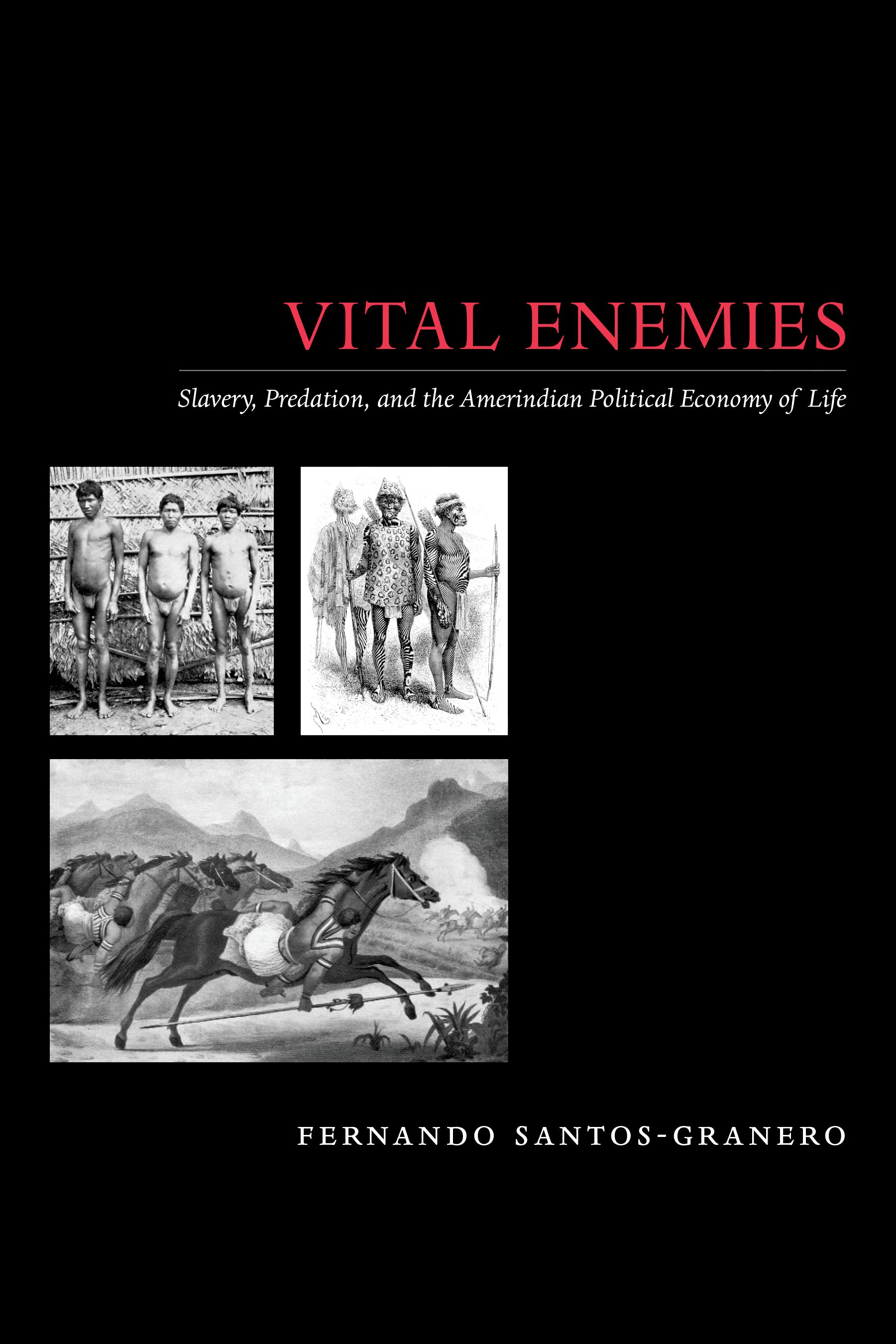
Analyzing slavery and other forms of servitude in six non-state indigenous societies of tropical America at the time of European contact, Vital Enemies offers a fascinating new approach to the study of slavery based on the notion of \"political economy of life.\" Fernando Santos-Granero draws on the earliest available historical sources to provide novel information on Amerindian regimes of servitude, sociologies of submission, and ideologies of capture. Estimating that captive slaves represented up to 20 percent of the total population and up to 40 percent when combined with other forms of servitude, Santos-Granero argues that native forms of servitude fulfill the modern understandings of slavery, though Amerindian contexts provide crucial distinctions with slavery as it developed in the American South. The Amerindian understanding of life forces as being finite, scarce, unequally distributed, and in constant circulation yields a concept of all living beings as competing for vital energy. The capture of human beings is an extreme manifestation of this understanding, but it marks an important element in the ways Amerindian \"captive slavery\" was misconstrued by European conquistadors. Illuminating a cultural facet that has been widely overlooked or miscast for centuries, Vital Enemies makes possible new dialogues regarding hierarchies in the field of native studies, as well as a provocative re-framing of pre- and post-contact America.
eBook

Allegories of encounter : colonial literacy and Indian captivities
\"Presenting an innovative, interdisciplinary approach to colonial America's best-known literary genre, Andrew Newman analyzes depictions of reading, writing, and recollecting texts in Indian captivity narratives. While histories of literacy and colonialism have emphasized the experiences of Native Americans, as students in missionary schools or as parties to treacherous treaties, captivity narratives reveal what literacy meant to colonists among Indians. Colonial captives treasured the written word in order to distinguish themselves from their Native captors and to affiliate with their distant cultural communities. Their narratives suggest that Indians recognized this value, sometimes with benevolence: repeatedly, they presented colonists with books\"-- Provided by publisher.
Book

Vital enemies : slavery, predation, and the Amerindian political economy of life
Analyzing slavery and other forms of servitude in six non-state indigenous societies of tropical America at the time of European contact, Vital Enemies offers a fascinating new approach to the study of slavery based on the notion of “political economy of life.” Fernando Santos-Granero draws on the earliest available historical sources to provide novel information on Amerindian regimes of servitude, sociologies of submission, and ideologies of capture. Estimating that captive slaves represented up to 20 percent of the total population and up to 40 percent when combined with other forms of servitude, Santos-Granero argues that native forms of servitude fulfill the modern understandings of slavery, though Amerindian contexts provide crucial distinctions with slavery as it developed in the American South. The Amerindian understanding of life forces as being finite, scarce, unequally distributed, and in constant circulation yields a concept of all living beings as competing for vital energy. The capture of human beings is an extreme manifestation of this understanding, but it marks an important element in the ways Amerindian “captive slavery” was misconstrued by European conquistadors. Illuminating a cultural facet that has been widely overlooked or miscast for centuries, Vital Enemies makes possible new dialogues regarding hierarchies in the field of native studies, as well as a provocative re-framing of pre- and post-contact America.
eBook