
Catalogue Search | MBRL


Are you sure you want to remove the book from the shelf?

{{itemTitle}}
22
result(s) for
"Indians Press coverage."
Sort by:


Wartime Images, Peacetime Wounds
What does the media coverage of a crisis situation reveal about the nature of dominant-minority relations locally, regionally, and nationally? Sandra Lambertus asks this question of the media coverage of the largest RCMP operation in Canadian history - the 1995 Gustafsen Lake Native Indian standoff.
Drawing from extensive newspaper, television, and radio news products, legal and law enforcement documents, ethnographic interviews with 26 journalists, as well as RCMP, and Native leaders, Lambertus examines the construction and national dissemination of vilifying stereotyped portrayals of Native people. The ethnographic component pushes the standard of media analysis, bringing to light previously unconsidered aspects of media representations of minorities: media and law enforcement processes, frameworks of the news makers, face presentation strategies, information control, and exchange relations in news-gathering. The investigation shows how the values and perspectives of local communities, media, and law enforcement became overshadowed by 'outsiders' during the course of the event and the serious effects of the media coverage on specific audiences and ultimately, Canadian society. The study culminates with an assessment of the structural elements that contributed to the damaging media portrayals: media bias, competition, cooperation, empowerment, and cultural misperceptions.Wartime Images, Peacetime Woundsopens new avenues for studies of minorities in the news and for the study of news media in general.
eBook

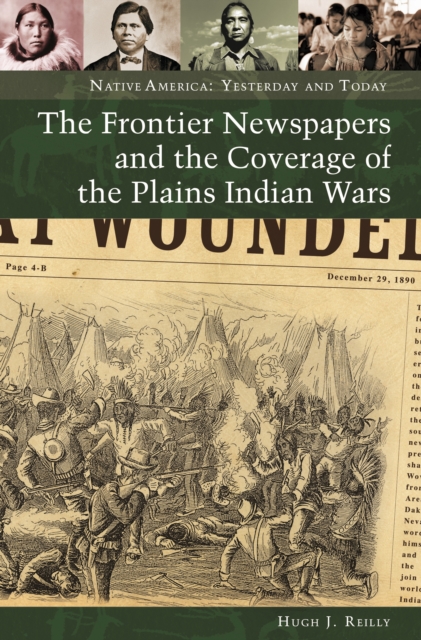
The frontier newspapers and the coverage of the Plains Indian Wars
This book offers a revealing look at how newspapers covered the key events of the Plains Indian Wars between 1862-1891—reporting that offers some surprising viewpoints as well as biases and misrepresentations. The Frontier Newspapers and the Coverage of the Plains Indian Wars takes readers back to the late 19th century to show how newspaper reporting impacted attitudes toward the conflict between the United States and Native Americans. Emphasizing primary sources and eyewitness accounts, the book focuses on eight watershed events between 1862 and 1891—the Great Sioux Uprising in Minnesota, the Sand Creek Massacre, the Fort Laramie Treaty of 1868, the Battle of the Little Big Horn, the Flight of the Nez Perce, the Cheyenne Outbreak, the Trial of Standing Bear, and the Massacre at Wounded Knee in 1890 and its aftermath. Each chapter examines an individual event, analyzing the balance and accuracy of the newspaper coverage and how the reporting of the time reinforced stereotypes about Native Americans.
eBook

Words have a past : the English language, colonialism, and the newspapers of Indian boarding schools
\"For nearly 100 years, Indian boarding schools in Canada and the US produced newspapers read by white settlers, government officials, and Indigenous parents. These newspapers were used as a settler colonial tool, yet within these tightly controlled narratives there also existed sites of resistance. This book traces colonial narratives of language, time, and place from the nineteenth-century to the present day, post-Truth and Reconciliation Commission.\"-- Provided by publisher.
Book

Dividing climate change: global warming in the Indian mass media
Much research has now been conducted into the representation of climate change in the media. Specifically, the communication of climate change from scientists and policy-makers to the public via the mass media has been a subject of major interest because of its implications for creating national variation in public understanding of a global environmental issue. However, to date, no study has assessed the situation in India. As one of the major emerging economies, and so one of the major greenhouse gas emitters, India is a key actor in the climate change story. This study analyses the four major, national circulation English-language newspapers to quantify and qualify the frames through which climate change is represented in India. The results strongly contrast with previous studies from developed countries; by framing climate change along a ‘risk-responsibility divide', the Indian national press set up a strongly nationalistic position on climate change that divides the issue along both developmental and postcolonial lines.
Journal Article

Mythologizing Norval Morrisseau
Mythologizing Norval Morrisseau examines the complex identities assigned to Anishinaabe artist Norval Morrisseau. Robertson looks at news stories, magazine articles, and film footage to examine the cultural assumptions that have framed Morrisseau.
eBook

Sharing Community Created Content in Support of Social Justice: The Dakota Access Pipeline LibGuide
INTRODUCTION Using a known platform to share content which is often overlooked by scholarly communication networks, The Dakota Access Pipeline (DAPL) LibGuide from the University of New Mexico Libraries facilitates access to Native American perspectives on the #NODAPL movement through inclusion of social media content and primary source materials. This LibGuide highlights Native American voices and stories, content that is difficult for people outside Native American communities to find and shares a different view of the protest movement absent from most mainstream media coverage. DESCRIPTION OF PROJECT Rather than a comprehensive listing, a majority of the guide content comes from Native American media outlets and Native American social media accounts by individuals and groups instead of library resources behind paywalls. Non-Native mainstream and alternative media sources are listed if authored by a Native American or if much of the source features a named individual using first-hand accounts. The DAPL LibGuide is the most viewed guide at UNM and was replicated at a small number of other academic libraries. NEXT STEPS Libraries can support the democratic process by highlighting similar types of community created content shared outside of scholarly communication networks, giving space to voices regularly unheard. The DAPL guide may be considered, along with similar social justice and topical guides as the beginnings of a new model which reimagines the possibilities of the LibGuide resource.
Journal Article

Model Blacks or \Ras the Exhorter\: A Quantitative Content Analysis of Black Newspapers' Coverage of the First Wave of Afro-Caribbean Immigration to the United States
This article examines the depiction of first-wave West Indian immigrants to the United States in Black print culture in the early 20th century. The authors conduct a series of content analyses of four newspapers that had wide circulation in the Black community between 1910 and 1940. Each content analysis serves as an empirical test one of four common hypotheses about ethnic differentiation between West Indians and African Americans: (a) the group consciousness hypothesis, (b) the racial nationalism hypothesis, (c) the radical politics hypothesis, and (d) the model minority hypothesis. The authors find very little empirical support for either the group consciousness hypothesis or the racial nationalism hypothesis and find only a modicum of support for the radical politics hypothesis. Finally, the authors find evidence confirming the model minority hypothesis. They also find that the Black press presented an accurate portrayal of the West Indian immigrants' socioeconomic advantages to native-born Blacks.
Journal Article

Women and the press in British India, 1928-1934: a window for protest?
Purpose - The aim of this paper is to understand how, in tough economic times, British-owned, English language newspapers such as The Pioneer received and filtered news, especially gender-related and nationalist-related events and thinking.Design methodology approach - Using qualitative and quantitative methods to assess communications by and about pro-nationalist women, coverage of female activities was categorised into two groups: first, educational, social and peaceful campaigns and second, direct action such as strikes, burning of British cloth and business land rent boycotts.Findings - Direct action provided \"bad news\" coverage, but it simultaneously gave a small window for publicity. Less threatening peaceful campaigns provided a bigger window - enhanced by the novelty value of female activism.Research limitations implications - Historians need to look specifically at Indian newspapers during the struggle for independence for a counter-hegemonic discourse that reached a wide public. When evidence of women's activism is paired with financial news, it becomes clear that women had a negative impact on British business. Furthermore, The Pioneer's own business dilemmas made the paper part of the economic and ideological maelstrom that it reported on.Originality value - This is the first time that the colonial press in India itself has been scrutinised in detail on the subject of the rising nationalist movement and women. Findings underline female influence on both economics and ideology - a neglected aspect of Indian gender scholarship and economic history.
Journal Article