
Catalogue Search | MBRL


Are you sure you want to remove the book from the shelf?

{{itemTitle}}
83
result(s) for
"Indians of North America -- First contact with Europeans"
Sort by:

Skyscrapers hide the heavens : a history of Native-newcomer relations in Canada
\"First published in 1989, Skyscrapers Hide the Heavens continues to earn wide acclaim for its comprehensive account of Native-newcomer relations throughout Canada's history. Author J.R. Miller charts the deterioration of the relationship from the initial, mutually beneficial contact in the fur trade to the current displacement and marginalization of the Indigenous population. The fourth edition of Skyscrapers Hide the Heavens is the result of considerable revision and expansion to incorporate current scholarship and developments over the past twenty years in federal government policy and Aboriginal political organization. It includes new information regarding political organization, land claims in the courts, public debates, as well as the haunting legacy of residential schools in Canada. Critical to Canadian university-level classes in history, Indigenous studies, sociology, education, and law, the fourth edition of Skyscrapers, will be also be useful to journalists and lawyers, as well as leaders of organizations dealing with Indigenous issues. Not solely a text for specialists in post-secondary institutions, Skyscrapers Hide the Heavens, explores the consequence of altered Native-newcomer relations, from cooperation to coercion, and the lasting legacy of this impasse.\"-- Provided by publisher.
Book

The Native Ground
InThe Native Ground, Kathleen DuVal argues that it was Indians rather than European would-be colonizers who were more often able to determine the form and content of the relations between the two groups. Along the banks of the Arkansas and Mississippi rivers, far from Paris, Madrid, and London, European colonialism met neither accommodation nor resistance but incorporation. Rather than being colonized, Indians drew European empires into local patterns of land and resource allocation, sustenance, goods exchange, gender relations, diplomacy, and warfare. Placing Indians at the center of the story, DuVal shows both their diversity and our contemporary tendency to exaggerate the influence of Europeans in places far from their centers of power. Europeans were often more dependent on Indians than Indians were on them. Now the states of Arkansas, Oklahoma, Kansas, and Colorado, this native ground was originally populated by indigenous peoples, became part of the French and Spanish empires, and in 1803 was bought by the United States in the Louisiana Purchase. Drawing on archaeology and oral history, as well as documents in English, French, and Spanish, DuVal chronicles the successive migrations of Indians and Europeans to the area from precolonial times through the 1820s. These myriad native groups-Mississippians, Quapaws, Osages, Chickasaws, Caddos, and Cherokees-and the waves of Europeans all competed with one another for control of the region. Only in the nineteenth century did outsiders initiate a future in which one people would claim exclusive ownership of the mid-continent. After the War of 1812, these settlers came in numbers large enough to overwhelm the region's inhabitants and reject the early patterns of cross-cultural interdependence. As citizens of the United States, they persuaded the federal government to muster its resources on behalf of their dreams of landholding and citizenship. With keen insight and broad vision, Kathleen DuVal retells the story of Indian and European contact in a more complex and, ultimately, more satisfactory way.
eBook

The middle ground : Indians, empires, and republics in the Great Lakes region, 1650-1815
\"An acclaimed book and widely acknowledged classic, The Middle Ground steps outside the simple stories of Indian-white relations - stories of conquest and assimilation and stories of cultural persistence. It is, instead, about a search for accommodation and common meaning. It tells how Europeans and Indians met, regarding each other as alien, as other, as virtually nonhuman, and how between 1650 and 1815 they constructed a common, mutually comprehensible world in the region around the Great Lakes that the French called pays d'en haut. Here the older worlds of the Algonquians and of various Europeans overlapped, and their mixture created new systems of meaning and of exchange. Finally, the book tells of the breakdown of accommodation and common meanings and the re-creation of the Indians as alien and exotic. First published in 1991, the 20th anniversary edition includes a new preface by the author examining the impact and legacy of this study\"-- Provided by publisher.
Book

Zamumo's Gifts
In 1540, Zamumo, the chief of the Altamahas in central Georgia, exchanged gifts with the Spanish conquistador Hernando de Soto. With these gifts began two centuries of exchanges that bound American Indians and the Spanish, English, and French who colonized the region. Whether they gave gifts for diplomacy or traded commodities for profit, Natives and newcomers alike used the exchange of goods such as cloth, deerskin, muskets, and sometimes people as a way of securing their influence. Gifts and trade enabled early colonies to survive and later colonies to prosper. Conversely, they upset the social balance of chiefdoms like Zamumo's and promoted the rise of new and powerful Indian confederacies like the Creeks and the Choctaws.Drawing on archaeological studies, colonial documents from three empires, and Native oral histories, Joseph M. Hall, Jr., offers fresh insights into broad segments of southeastern colonial history, including the success of Florida's Franciscan missionaries before 1640 and the impact of the Indian slave trade on French Louisiana after 1699. He also shows how gifts and trade shaped the Yamasee War, which pitted a number of southeastern tribes against English South Carolina in 1715-17. The exchanges at the heart of Zamumo's Gifts highlight how the history of Europeans and Native Americans cannot be understood without each other.
eBook


New worlds of violence : cultures and conquests in the early American Southeast
From the early 1500s to the mid-1700s, the American Southeast was the scene of continuous tumult as European powers vied for dominance in the region while waging war on Native American communities. Yet even before Hernando de Soto landed his expeditionary force on the Gulf shores of Florida, Native Americans had created their own \"cultures of violence\": sets of ideas about when it was appropriate to use violence and what sorts of violence were appropriate to a given situation. In New Worlds of Violence, Matthew Jennings offers a persuasive new framework for understanding the European-Native American contact period and the conflicts among indigenous peoples that preceded it. This pioneering approach posits that every group present in the Southeast had its own ideas about the use of violence and that these ideas changed over time as they collided with one another. The book starts with the Mississippian era and continues through the successive Spanish and English invasions of the Native South. Jennings argues that the English conquered the Southeast because they were able to force everyone else to adapt to their culture of violence, which, of course, changed over time as well. By 1740, a peculiarly Anglo-American culture of violence was in place that would profoundly influence the expansion of England's colonies and the eventual southern United States. While Native and African violence were present in this world, they moved in circles defined by the English. New Worlds of Violence concludes by pointing out that long-lasting violence bears long-lasting consequences. An important contribution to the growing body of work on the early Southeast, this book will significantly broaden readers' understanding of America's violent past. Matthew Jennings is an assistant professor of history at Macon State College in Macon, Georgia. He is the author of \"Violence in a Shattered World\" in Mapping the Shatter Zone: The European Invasion and the Transformation of the Mississippian World, edited by Robbie Ethridge and Sheri Shuck-Hall. His work has also appeared in The Uniting States, The South Carolina Encyclopedia, A Multicultural History of the United States, and The Encyclopedia of Native American History.
eBook


On Records
Bridging the fields of indigenous, early American, memory, and media studies,On Recordsilluminates the problems of communication between cultures and across generations. Andrew Newman examines several controversial episodes in the historical narrative of the Delaware (Lenape) Indians, including the stories of their primordial migration to settle a homeland spanning the Delaware and Hudson Rivers, the arrival of the Dutch and the first colonial land fraud, William Penn's founding of Pennsylvania with a Great Treaty of Peace, and the \"infamous\" 1737 Pennsylvania Walking Purchase.
As Newman demonstrates, the quest for ideal records-authentic, authoritative, and objective, anchored in the past yet intelligible to the present-has haunted historical actors and scholars alike. Yet without \"proof,\" how can we know what really happened?On Recordsarticulates surprising connections among colonial documents, recorded oral traditions, and material and visual cultures. Its comprehensive, probing analysis of historical evidence yields a multifaceted understanding of events and reveals new insights into the divergent memories of a shared past.
eBook

A cold welcome : the Little Ice Age and Europe's encounter with North America
\"Weaving together evidence from climatology, archaeology, and the written historical record, [the author] describes how the severity and volatility of the Little Ice Age climate threatened to freeze and starve out the Europeans' precarious new settlements. Lacking basic provisions and wholly unprepared to fend for themselves under such harsh conditions, Europeans suffered life-threatening privation, and their desperation precipitated violent conflict with Native Americans\"--Amazon.com.
Book
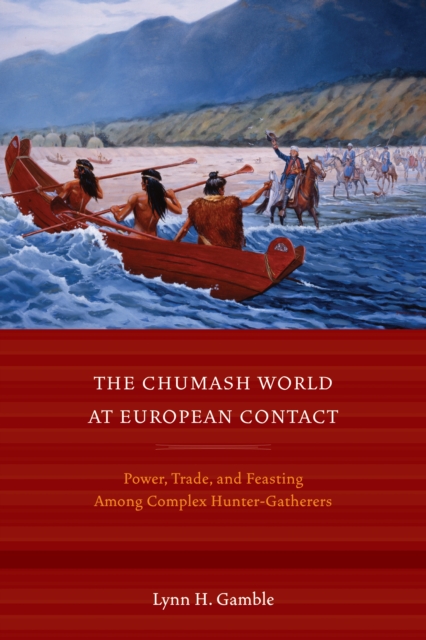
The Chumash world at European contact
When Spanish explorers and missionaries came onto Southern California's shores in 1769, they encountered the large towns and villages of the Chumash, a people who at that time were among the most advanced hunter-gatherer societies in the world. The Spanish were entertained and fed at lavish feasts hosted by chiefs who ruled over the settlements and who participated in extensive social and economic networks. In this first modern synthesis of data from the Chumash heartland, Lynn H. Gamble weaves together multiple sources of evidence to re-create the rich tapestry of Chumash society. Drawing from archaeology, historical documents, ethnography, and ecology, she describes daily life in the large mainland towns, focusing on Chumash culture, household organization, politics, economy, warfare, and more.
eBook