
Catalogue Search | MBRL


Are you sure you want to remove the book from the shelf?

{{itemTitle}}
104
result(s) for
"Indians of North America -- Historiography"
Sort by:

Authorized agents : publication and diplomacy in the era of Indian removal
\"In nineteenth-century North America, the literature of Indian nations extended a long tradition of diplomacy between indigenous people and settler states. While the crisis of removal profoundly reshaped Indian country between 1820 and 1860, indigenous intellectuals and tribal leaders often worked with various collaborators--translators, editors, and amanuenses--to address the tensions between American empire and Indian nations. Drawing on established conventions of Indian diplomacy, these collaborative writings were bound up with the life of colonial institutions but they intervened in them as well. Using multimedia forms of publication, Native authors contested colonial ideas about empire, the frontier, and nationalism, all the while insisting on an indigenous futures in regions where settler expansion caused profound historical change. Authorized Agents examines the writings and speeches of authors such as Black Hawk, Jane Johnston Schoolcraft, and George Copway, as well as more overlooked writers and orators including Sharitarish, Ongpatonga, Keokuk, Hardfish, and Peter Pitchlynn. The fact that their writings were often edited or published by colonial institutions has often left many Native writers to be misread, discredited, or simply ignored. How can we begin to understand these texts as the work of indigenous authors who generated critiques of colonial ideas and policies? Through analysis of a range of texts--from oratory, newspapers, and autobiographies to petitions, council meetings, and manuscript poems--Authorized Agents offers an interdisciplinary method for understanding how Native authors claimed a place in public discourse, and how the cross-cultural conventions of Indian diplomacy shaped their texts\"-- Provided by publisher.
Book

Firsting and Lasting
Firsting and Lasting argues that local histories became a primary means by which European Americans asserted their own modernity while denying it to Indian peoples. Drawing on more than six hundred local histories from Massachusetts, Connecticut, and Rhode Island, Jean M. O’Brien explores how these narratives inculcated the myth of Indian extinction, a myth that has stubbornly remained in the American consciousness.
eBook

The everlasting people : G.K. Chesterton and the First Nations
\"How might the life and work of Christian writer G. K. Chesterton shed light on our understanding of North American Indigenous art and history? In these discerning reflections, art historian Matthew Milliner appeals to Chesterton's life and work in order to understand and appreciate both Indigenous art and the complex, often tragic history of First Nations peoples\"-- Provided by publisher.
BOOK
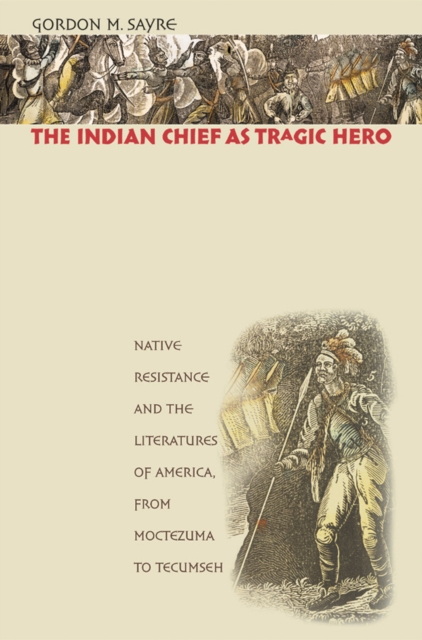
The Indian chief as tragic hero : native resistance and the literatures of America, from Moctezuma to Tecumseh
The leaders of anticolonial wars of resistance--Metacom, Pontiac, Tecumseh, and Cuauhtemoc--spread fear across the frontiers of North America. Yet once defeated, these men became iconic martyrs for postcolonial national identity in Canada, the United States, and Mexico. By the early 1800s a craze arose for Indian tragedy on the U.S. stage, such as John Augustus Stone's Metamora, and for Indian biographies as national historiography, such as the writings of Benjamin Drake, Francis Parkman, and William Apess.With chapters on seven major resistance struggles, including the Pueblo Revolt of 1680 and the Natchez Massacre of 1729, The Indian Chief as Tragic Hero offers an analysis of not only the tragedies and epics written about these leaders, but also their own speeches and strategies, as recorded in archival sources and narratives by adversaries including Hernan Cortes, Antoine-Simon Le Page du Pratz, Joseph Doddridge, Robert Rogers, and William Henry Harrison. Sayre concludes that these tragedies and epics about Native resistance laid the foundation for revolutionary culture and historiography in the three modern nations of North America, and that, at odds with the trope of the complaisant \"vanishing Indian,\" these leaders presented colonizers with a cathartic reproof of past injustices.
eBook

The nature of empires and the empires of nature : Indigenous peoples and the Great Lakes environment
Explores the power of Nature and the attempts by Empires (United States, Canada, and Britain) to control it from Indigenous or Indigenous influenced perspectives. This title hopes to inspire ways of looking at the Great Lakes watershed and the people and empires contained within it.
Book

Call for Change
For too many years, the academic discipline of history has ignored American Indians or lacked the kind of open-minded thinking necessary to truly understand them. Most historians remain oriented toward the American experience at the expense of the Native experience. As a result, both the status and the quality of Native American history have suffered and remain marginalized within the discipline. In this impassioned work, noted historian Donald L. Fixico challenges academic historians-and everyone else-to change this way of thinking. Fixico argues that the current discipline and practice of American Indian history are insensitive to and inconsistent with Native people's traditions, understandings, and ways of thinking about their own history. InCall for Change, Fixico suggests how the discipline of history can improve by reconsidering its approach to Native peoples.
He offers the \"Medicine Way\" as a paradigm to see both history and the current world through a Native lens. This new approach paves the way for historians to better understand Native peoples and their communities through the eyes and experiences of Indians, thus reflecting an insightful indigenous historical ethos and reality.
eBook


The Eastern Archaic, historicized
The Eastern Archaic, Historicized offers an alternative perspective on the genesis and transformation of cultural diversity over eight millennia of hunter-gatherer dwelling in eastern North America. For many decades, archaeological understanding of Archaic diversity has been dominated by perspectives that emphasize localized relationships between humans and environment. The evidence, shows, however that Archaic people routinely associated with other groups throughout eastern North America and expressed themselves materially in ways that reveal historical links to other places and times. Starting with the colonization of eastern North America by two distinct ancestral lines, the Eastern Archaic was an era of migrations, ethnogenesis, and coalescence—an 8,200-year era of making histories through interactions and expressing them culturally in ritual and performance.
eBook

An indigenous peoples' history of the United States
\"The first history of the United States told from the perspective of indigenous peoples\"-- Provided by publisher.
Book

Reflections on Native-Newcomer Relations
Reflections on Native-Newcomer Relationsopens up for discussion a series of issues in Native-newcomer history. It addresses all the trends in the discipline of the past two decades and never shies from showing their contradictions, as well as those in the author's own thinking as he matured as a scholar.
eBook