
Catalogue Search | MBRL


Are you sure you want to remove the book from the shelf?

{{itemTitle}}
28
result(s) for
"Indians of North America Government relations 1789-1869."
Sort by:

Indigenous continent : the epic contest for North America
\"This nation's history and self-understanding have long depended on the notion of a \"colonial America,\" an epoch that supposedly laid the foundation for the modern United States. In Indigenous Continent, Pekka Hämäläinen overturns the traditional, Eurocentric narrative, demonstrating that, far from being weak and helpless \"victims\" of European colonialism, Indigenous peoples controlled North America well into the 19th century. From the Iroquois and Pueblos to the Lakotas and Comanches, Native empires frequently decimated white newcomers in battle, forcing them to accept and even adopt Native ways. Even as the white population skyrocketed and colonists' land greed become ever more extravagant, Indigenous peoples flourished due to sophisticated diplomacy and flexible leadership structures. As Hämäläinen ultimately contends, instead of \"colonial America\" we should speak of an \"Indigenous America\" that was only slowly and unevenly becoming colonial. In our myth-busting era, this restoration of Native Americans to their rightful place at the very center of American history will be seen as one of the most important correctives yet\"-- Provided by publisher.
Book

Seeds of Extinction
This study is the first to explain how the white American's conception of himself and his position on the continent formed his perception of the Indian and directed his selection of policy toward the native tribes. Sheehan presents the paradoxical and pathetic story of how the Jeffersonian generation, with the best of goodwill toward the American Indian, destroyed him with its benevolence, literally killed him with kindness.Originally published 1973.A UNC Press Enduring Edition -- UNC Press Enduring Editions use the latest in digital technology to make available again books from our distinguished backlist that were previously out of print. These editions are published unaltered from the original, and are presented in affordable paperback formats, bringing readers both historical and cultural value.
eBook
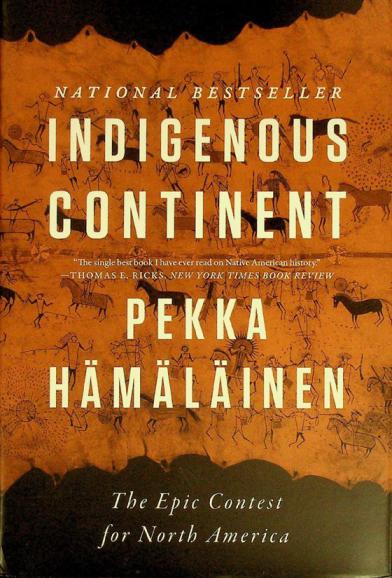
Indigenous continent : the epic contest for North America
\"This nation's history and self-understanding have long depended on the notion of a \"colonial America,\" an epoch that supposedly laid the foundation for the modern United States. In Indigenous Continent, Pekka Hämäläinen overturns the traditional, Eurocentric narrative, demonstrating that, far from being weak and helpless \"victims\" of European colonialism, Indigenous peoples controlled North America well into the 19th century. From the Iroquois and Pueblos to the Lakotas and Comanches, Native empires frequently decimated white newcomers in battle, forcing them to accept and even adopt Native ways. Even as the white population skyrocketed and colonists' land greed become ever more extravagant, Indigenous peoples flourished due to sophisticated diplomacy and flexible leadership structures. As Hämäläinen ultimately contends, instead of \"colonial America\" we should speak of an \"Indigenous America\" that was only slowly and unevenly becoming colonial. In our myth-busting era, this restoration of Native Americans to their rightful place at the very center of American history will be seen as one of the most important correctives yet\"-- Provided by publisher.
Book

Oregon and the Collapse of Illahee
Modern western Oregon was a crucial site of imperial competition in North America during the formative decades of the United States. In this book, Gray Whaley examines relations among newcomers and between newcomers and Native peoples--focusing on political sovereignty, religion, trade, sexuality, and the land--from initial encounters to Oregon's statehood. He emphasizes Native perspectives, using the Chinook wordIllahee(homeland) to refer to the indigenous world he examines.Whaley argues that the process of Oregon's founding is best understood as a contest between the British Empire and a nascent American one, with Oregon's Native people and their lands at the heart of the conflict. He identifies race, republicanism, liberal economics, and violence as the key ideological and practical components of American settler-colonialism. Native peoples faced capriciousness, demographic collapse, and attempted genocide, but they fought to preserveIllaheeeven as external forces caused the collapse of their world. Whaley's analysis compellingly challenges standard accounts of the quintessential antebellum \"Promised Land.\"
eBook

Documents of American Indian removal
\"This powerful collection of documents illumines the experiences of the original people of the United States during American Indian removal, offering readers a unique standpoint from which to understand American identity and the historical processes that have shaped it\"-- Provided by publisher.
Book

Engines of Diplomacy
As a fledgling republic, the United States implemented a series of trading outposts to engage indigenous peoples and to expand American interests west of the Appalachian Mountains. Under the authority of the executive branch, this Indian factory system was designed to strengthen economic ties between Indian nations and the United States, while eliminating competition from unscrupulous fur traders. In this detailed history of the Indian factory system, David Andrew Nichols demonstrates how Native Americans and U.S. government authorities sought to exert their power in the trading posts by using them as sites for commerce, political maneuvering, and diplomatic action.
Using the factory system as a lens through which to study the material, political, and economic lives of Indian peoples, Nichols also sheds new light on the complexities of trade and diplomacy between whites and Native Americans. Though the system ultimately disintegrated following the War of 1812 and the Panic of 1819, Nichols shows that these factories nonetheless served as important centers of economic and political authority for an expanding inland empire.
eBook


Uncommon Defense
In the spring of 1832, when the Indian warrior Black Hawk and a thousand followers marched into Illinois to reoccupy lands earlier ceded to American settlers, the U.S. Army turned to rival tribes for military support. Elements of the Menominee, Dakota, Potawatomi, and Ho Chunk tribes willingly allied themselves with the United States government against their fellow Native Americans in an uncommon defense of their diverse interests. As the Black Hawk War came only two years after the passage of the Indian Removal Act and is widely viewed as a land grab by ravenous settlers, the military participation of these tribes seems bizarre. What explains this alliance?
In order to grasp Indian motives, John Hall explores their alliances in earlier wars with colonial powers as well as in intertribal antagonisms and conflicts. In the crisis of 1832, Indians acted as they had traditionally, leveraging their relationship with a powerful ally to strike tribal enemies, fulfill important male warrior expectations, and pursue political advantage and material gain. However, times had changed and, although the Indians achieved short-term objectives, they helped create conditions that permanently changed their world.
Providing a rare view of Indian attitudes and strategies in war and peace, Hall deepens our understanding of Native Americans and the complex roles they played in the nation's history. More broadly, he demonstrates the risks and lessons of small wars that entail an \"uncommon defense\" by unlikely allies in pursuit of diverse, even conflicting, goals.
eBook

Authorized agents : publication and diplomacy in the era of Indian removal
\"In nineteenth-century North America, the literature of Indian nations extended a long tradition of diplomacy between indigenous people and settler states. While the crisis of removal profoundly reshaped Indian country between 1820 and 1860, indigenous intellectuals and tribal leaders often worked with various collaborators--translators, editors, and amanuenses--to address the tensions between American empire and Indian nations. Drawing on established conventions of Indian diplomacy, these collaborative writings were bound up with the life of colonial institutions but they intervened in them as well. Using multimedia forms of publication, Native authors contested colonial ideas about empire, the frontier, and nationalism, all the while insisting on an indigenous futures in regions where settler expansion caused profound historical change. Authorized Agents examines the writings and speeches of authors such as Black Hawk, Jane Johnston Schoolcraft, and George Copway, as well as more overlooked writers and orators including Sharitarish, Ongpatonga, Keokuk, Hardfish, and Peter Pitchlynn. The fact that their writings were often edited or published by colonial institutions has often left many Native writers to be misread, discredited, or simply ignored. How can we begin to understand these texts as the work of indigenous authors who generated critiques of colonial ideas and policies? Through analysis of a range of texts--from oratory, newspapers, and autobiographies to petitions, council meetings, and manuscript poems--Authorized Agents offers an interdisciplinary method for understanding how Native authors claimed a place in public discourse, and how the cross-cultural conventions of Indian diplomacy shaped their texts\"-- Provided by publisher.
Book

Revolutionary Negotiations
Revolutionary Negotiationsexamines early American diplomatic negotiations with both the European powers and the various American Indian nations from the 1740s through the 1820s. Sadosky interweaves previously distinct settings for American diplomacy-courts and council fires-into one singular, transatlantic system of politics.
Whether as provinces in the British Empire or as independent states, American assertions of power were directed simultaneously to the west and to the east-to Native American communities and to European empires across the Atlantic. American leaders aspired to equality with Europeans, who often dismissed them, while they were forced to concede agency to Native Americans, whom they often wished they could ignore. As Americans used diplomatic negotiation to assert their new nation's equality with the great powers of Europe and gradually defined American Indian nations as possessing a different (and lesser) kind of sovereignty, they were also forced to confront the relations between the states in their own federal union.
Acts of diplomacy thus defined the founding of America, not only by drawing borders and facilitating commerce, but also by defining and constraining sovereign power in a way that privileged some and weakened others. These negotiations truly were revolutionary.
eBook