
Catalogue Search | MBRL


Are you sure you want to remove the book from the shelf?

{{itemTitle}}
25
result(s) for
"Indians of North America Health and hygiene History."
Sort by:

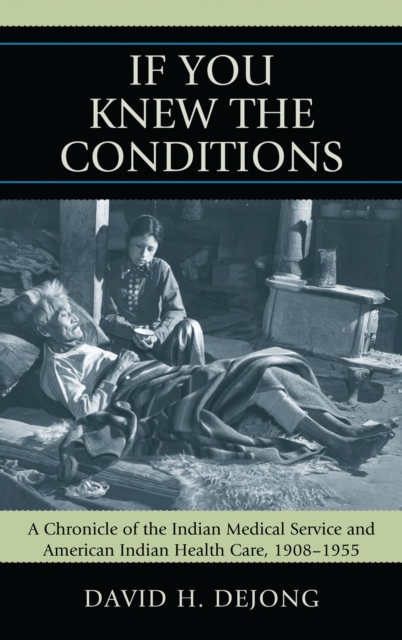
\If you knew the conditions\
After their sequestering on reservations across the West, American Indians suffered from appalling rates of disease and morbidity. While the United States Indian Service (Bureau of Indian Affairs) provided some services prior to 1908, it was not until then that the Indian Medical Service was established for the purpose of providing services to American Indians. Born in an era of assimilation and myths of vanishing Indians, the Indian Medical Service provided emergency and curative care with little forethought of preventive medicine. DeJong argues that the U.S. Congress provided little more than basic, curative treatment, and that this Congressional parsimony is reflected in the services (or lack thereof) provided by the Indian Medical Service. DeJong considers the mediocre results of the Indian Medical Service from a cultural perspective. He argues that, rather than considering a social conservation model of medicine, the Indian Service focused on curative medicine from a strictly Western perspective. This failure to appreciate the unique American Indian cultural norms and values associated with health and well-being led to a resistance from American Indians which seemingly justified parsimonious Congressional appropriations and initiated a cycle of benign neglect. 'If You Knew the Conditions' examines the impact of the long-standing Congressional mandate of cultural assimilation, combined with the Congressional desire to abolish the Indian Service, on the degree and extent of disease in Indian Country.
eBook

Native American communities on health and disability : a borderland dialogue
This volume examines concepts of disability and wellness in Native American communities, prominently featuring the life's work of Dr. Carol Locust. Authors Locust and Lovern confront the difficulties of translating not only words but also entire concepts between Western and Indigenous cultures, and by increasing the cultural competency of those unfamiliar with Native American ways of being are able to bring readers from both cultures into a more equal dialogue. The three sections contained herein focus on intercultural translation; dialogues with Native American community members; and finally a discussion of being in the world gently as caregivers.
eBook


Native American Communities on Health and Disability
This volume examines concepts of disability and wellness in Native American communities, prominently featuring the life's work of Dr.Carol Locust.Authors Locust and Lovern confront the difficulties of translating not only words but also entire concepts between Western and Indigenous cultures, and by increasing the cultural competency of those.
eBook

Clearing the Plains : disease, politics of starvation, and the loss of indigenous life
\"This new edition of Clearing the Plains has a forward by Pulitzer Prize winning author, Elizabeth Fenn, and explanations of the book's influence by leading Canadian historians. Called \"one of the most important books of the twenty-first century\" by the Literary Review of Canada, it was named a \"Book of the Year\" by The Globe and Mail, Quill & Quire, the Writers' Trust, and won the Sir John A. Macdonald Prize, among many others.\"-- Provided by publisher.
Book

Clearing the Plains
Revealing how Canada's first Prime Minister used a policy of starvation against Indigenous people to clear the way for settlement, the multiple award-winning Clearing the Plains sparked widespread debate about genocide in Canada.
eBook


Indigenous Bodies, Cells, and Genes
This book explores Native American literary responses to
biomedical discourses and biomedicalization processes as they circulate in social
and cultural contexts.
Native American communities resist reductivism of biomedicine that excludes
Indigenous (and non-Western) epistemologies and instead draw attention to how
illness, healing, treatment, and genetic research are socially constructed and
dependent on inherently racialist thinking. This volume highlights how interventions
into the hegemony of biomedicine are vigorously addressed in Native American
literature. The book covers tuberculosis and diabetes epidemics, the emergence of
Native American DNA, discoveries in biotechnology, and the problematics of a
biomedical model of psychiatry. The book analyzes the works of Madonna Swan, Louise
Erdrich, Sherman Alexie, LeAnne Howe, Linda Hogan, Heid E. Erdrich, Elissa Washuta
and Frances Washburn.
The book will appeal to scholars of Native American and Indigenous Studies, as well
as to others with an interest in literature and medicine.
eBook