
Catalogue Search | MBRL


Are you sure you want to remove the book from the shelf?

{{itemTitle}}
397
result(s) for
"Indians of North America West (U.S.) Government relations."
Sort by:

Native
\"The first book in a dramatic fictional trilogy set in the old west. Takoda, a young Lakota warrior, is compelled to fight for his life after his father is killed in a hunting accident, facing murderous beaver trappers and brutal treatment at the hands of a ruthless band of buffalo hunters. However, his future is to become defined by the dark influence of Theodore Winthrop, a Minnesotan senator who wants to rid the plains of the native tribes. Takoda's survival depends on a chance encounter with a wagon train, where he meets Carla Kopp, with whom he is destined to unveil the scope of Winthrop's political and military subterfuge, a plan to steal four hundred million dollars in gold, and strategies designed to challenge the Lakota's very existence\"-- Provided by publisher.
Book

Unlikely Alliances
Often when Native nations assert their treaty rights and sovereignty, they are confronted with a backlash from their neighbors, who are fearful of losing control of the natural resources. Yet, when both groups are faced with an outside threat to their common environment—such as mines, dams, or an oil pipeline—these communities have unexpectedly joined together to protect the resources. Some regions of the United States with the most intense conflicts were transformed into areas with the deepest cooperation between tribes and local farmers, ranchers, and fishers to defend sacred land and water.Unlikely Alliances explores this evolution from conflict to cooperation through place-based case studies in the Pacific Northwest, Great Basin, Northern Plains, and Great Lakes regions during the 1970s through the 2010s. These case studies suggest that a deep love of place can begin to overcome even the bitterest divides.
eBook

The vengeance of mothers : the journals of Margaret Kelly & Molly McGill
A novel about Molly McGill and \"Margaret Kelly, [women] who participated in the government's 'Brides for Indians' program in 1873, a program whose conceit was that the way to peace between the United States and the Cheyenne Nation was for one thousand white women to be given as brides in exchange for three hundred horses. Mostly fallen women, the brides themselves thought it was simply a chance at freedom. But many fell in love with the Cheyenne spouses and had children with them--and became Cheyenne themselves\"-- Provided by publisher.
Book

Securing the West
A close look at westward expansion, federal lands, and American destiny in the early republic. Few issues defined the period between American independence and the Mexican War more sharply than westward settlement and the role of the federal government in that expansion. In Securing the West, John R. Van Atta examines the visions of the founding generation and the increasing influence of ideological differences in the years after the peace of 1815. Americans expected the country to grow westward, but on the details of that growth they held strongly different opinions. What part should Congress play in this development? How much should public land cost? What of the families and businesses left behind, and how would society's institutions be established in the West? What of the premature settlers, the \"squatters\" who challenged the rule of law while epitomizing democratic daring? Taking a broad approach, Van Atta addresses three interrelated queries: First, how did competing economic beliefs and divergent cultural mandates influence the various outcomes of this broad debate over the means, timing, and purposes of settling the trans-Appalachian West? Second, what alternative visions of western society lay behind the battles among policy makers within the government and the interested parties who would sway them? Third, why did settlement of the West take such a different course in the end from that which the earliest leaders of the republic intended? This story explores dimensions of the federal lands question that other historians have minimized or left out entirely. Van Atta draws upon a range of sources known to have influenced the public discourse, including congressional debates, committee reports, and correspondence; editorial writings by the famous and unknown; and news coverage in various widely circulated newspapers and magazines of the period. Much of the attention focuses on Congress—the elected leaders who advocated divergent plans about western lands. In Congress, more than any other place, public leaders articulated basic concerns about the character, structure, direction, and destiny of society in the early United States. By 1830, many other important national concerns had become critically entangled with land disposition, creating points of ideological tension among rival regions, parties, and interests in the early years of the republic—particularly in Jacksonian America.
eBook


The Indian frontier, 1846-1890
First published in 1984, Robert Utley's The Indian Frontier of the American West, 1846-1890, is considered a classic for both students and scholars. For this revision, Utley includes scholarship and research that has become available in recent years.
What they said about the first edition:
[The Indian Frontier of the American West, 1846-1890] provides an excellent synthesis of Indian-white relations in the trans-Mississippi West during the last half-century of the frontier period. - Journal of American History
The Indian Frontier of the American West combines good writing, solid research, and penetrating interpretations. The result is a fresh and welcome study that departs from the soldier-chases-Indian approach that is all too typical of other books on the topic. - Minnesota History
[Robert M. Utley] has carefully eschewed sensationalism and glib oversimplification in favor of critical appraisal, and his firm command of some of the best published research of others provides a solid foundation for his basic argument that Indian hostility in the half century following the Mexican War was directed less at the white man per se than at the hated reservation system itself. - Pacific Historical Review
Choice Magazine Outstanding Selection
eBook
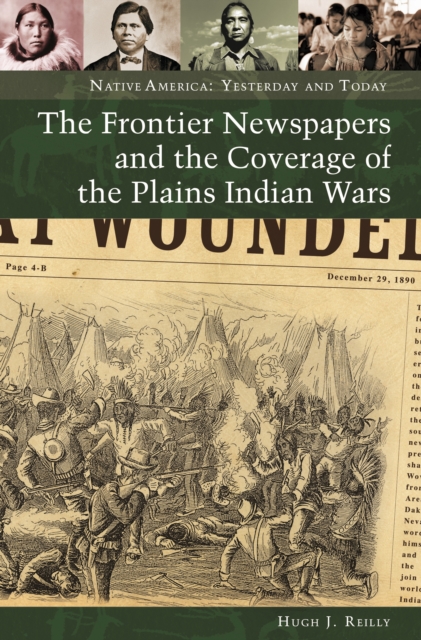
The frontier newspapers and the coverage of the Plains Indian Wars
This book offers a revealing look at how newspapers covered the key events of the Plains Indian Wars between 1862-1891—reporting that offers some surprising viewpoints as well as biases and misrepresentations. The Frontier Newspapers and the Coverage of the Plains Indian Wars takes readers back to the late 19th century to show how newspaper reporting impacted attitudes toward the conflict between the United States and Native Americans. Emphasizing primary sources and eyewitness accounts, the book focuses on eight watershed events between 1862 and 1891—the Great Sioux Uprising in Minnesota, the Sand Creek Massacre, the Fort Laramie Treaty of 1868, the Battle of the Little Big Horn, the Flight of the Nez Perce, the Cheyenne Outbreak, the Trial of Standing Bear, and the Massacre at Wounded Knee in 1890 and its aftermath. Each chapter examines an individual event, analyzing the balance and accuracy of the newspaper coverage and how the reporting of the time reinforced stereotypes about Native Americans.
eBook