
Catalogue Search | MBRL


Are you sure you want to remove the book from the shelf?

{{itemTitle}}
221
result(s) for
"Indigenous consultation"
Sort by:

The Prior Consultation of Indigenous Peoples in Latin America
This book delves into the reasons behind and the consequences of the implementation gap regarding the right to prior consultation and the Free, Prior and Informed Consent (FPIC) of Indigenous Peoples in Latin America.
In recent years, the economic and political projects of Latin American States have become increasingly dependent on the extractive industries. This has resulted in conflicts when governments and international firms have made considerable investments in those lands that have been traditionally inhabited and used by Indigenous Peoples, who seek to defend their rights against exploitative practices. After decades of intense mobilisation, important gains have been made at international level regarding the opportunity for Indigenous Peoples to have a say on these matters. Notwithstanding this, the right to prior consultation and the FPIC of Indigenous Peoples on the ground are far from being fully applied and guaranteed. And, even when prior consultation processes are carried out, the outcomes remain uncertain.
This volume rigorously investigates the causes of this implementation gap and its consequences for the protection of Indigenous Peoples' rights, lands, identities and ways of life in the Latin American region.
eBook

Participatory decision-making in the policy integration process: indigenous consultation and sustainable development in Mexico
This article explores the role of participation by indigenous peoples in Latin America in the political process of Environmental Policy Integration (EPI). Although the benefits of participation have been largely taken for granted, this article shows that participation makes the policy integration process even more complex. By selecting two cases of clean energy infrastructure projects (a wind power plant and a natural gas pipeline) in Mexico, whose policy processes included an indigenous consultation, this article traces the competing problem definitions in public policy debates and the resulting policy frame in relation to sustainable development. The goal is to assess the ways that indigenous consultation functions as a procedural EPI instrument aimed at boosting participation from a public that is largely composed by indigenous communities in the decision-making stage. This article contributes to the existing literature on policy integration in two ways: (1) it explores the role of participation by non-state actors in the policy integration process, especially in highly politicized policy areas such as energy and the environment, and (2) it identifies the limitations of applicability of policy integration literature, particularly in contexts where state–society interactions are radically different compared to Western countries, including Latin American countries inhabited by indigenous groups.
Journal Article
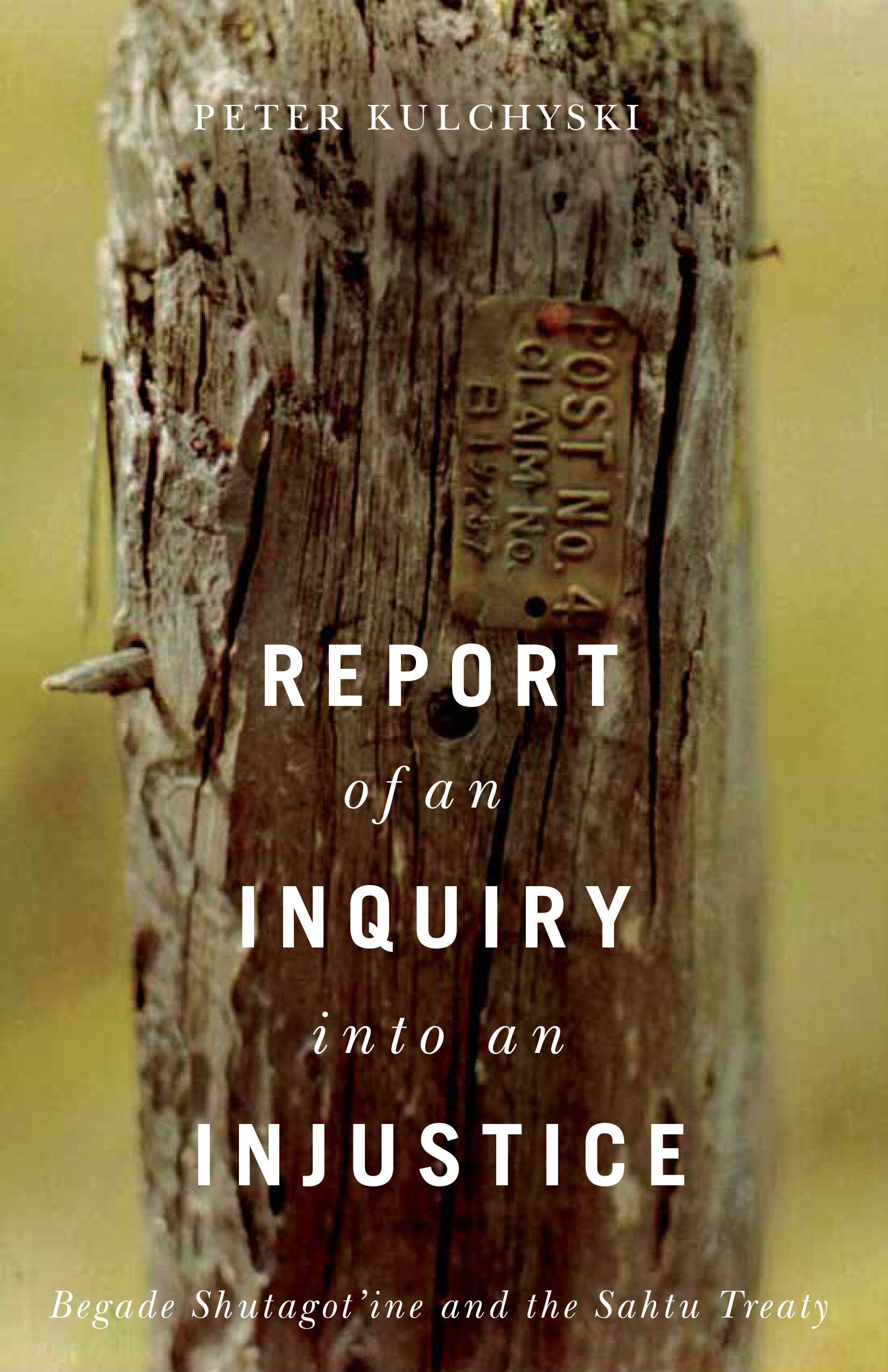
Report of an Inquiry into an Injustice
A Report of an Inquiry into an Injustice chronicles Peter Kulchyski's experiences with the Begade Shutagot'ine, a small community of a few hundred people living in and around Tulita (formerly Fort Norman), on the Mackenzie River in the heart of Canada's Northwest Territories. Despite their formal objections and boycott of the agreement, the band and their lands were included in the Sahtu Treaty, a modern comprehensive land claims agreement negotiated between the Government of Canada and the Sahtu Tribal Council, representing Dene and Metis peoples of the region. While both Treaty 11 (1921) and the Sahtu Treaty (1994) purport to extinguish Begade Shutagot'ine Aboriginal title, oral history and documented attempts to exclude themselves from treaty strongly challenge the validity of that extinguishment. Structured as a series of briefs to an inquiry into the Begade Shutagot'ine's claim, this manuscript documents the negotiation and implementation of the Sahtu Treaty and amasses evidence of historical and continued presence and land use to make eminently clear that the Begade Shutagot'ine are the continued owners of the land by law: they have not extinguished title to their traditional territories; they continue to exercise their customs, practices, and traditions on those territories; and they have a fundamental right to be consulted on, and refuse or be compensated for, development projects on those territories. Kulchyski bears eloquent witness to the Begade Shutagot'ine people's two-decade struggle for land rights, which have been blatantly ignored by federal and territorial authorities for too long.
eBook

The Legitimacy of Environmental Governance Based on Consultation with Indigenous People: Insights from Mexico's REDD+ Readiness Process in the Yucatan Peninsula
To what extent does consulting with indigenous communities improve the legitimacy of environmental governance? This question was addressed by analysing the consultation process organised within the Reducing Emissions from Deforestation and Forest Degradation (REDD+) readiness phase in Mexico. Criteria to assess governance legitimacy were compiled from scientific literature and compared with those adopted by international indigenous rights agreements. The extent to which these criteria were met and how they were implemented in two indigenous communities in the Yucatan Peninsula was assessed through documents and interviews analyses. Results show that, despite the progress that Mexico's consultation protocol represents, it did not include an intra-community representation criterion; transparency, accountability and deliberation criteria were not completely reached in practice; there was discordance between official and local participants' understanding of consultation objectives; and no agreement or consent were sought from the participants. These findings provide lessons for other governance projects implemented through consultation with local communities both in Mexico and elsewhere.
Journal Article

An Enquiry Concerning Administrative Discretion in Indigenous Consultations
Statutory legislation endows a government agency with administrative discretion in structuring evidence exchanges in Indigenous consultations over resource projects. Those projects are contentious issues, and evidence shall be evaluated impartially on both sides to make a balanced decision. In ordering the evidence submissions and evaluations, an agency imposes mandatory requirements that burden the reasoning capacity of Indigenous arguers to challenge a project. The diminished reasoning capacity to disagree makes it easy for an agency to produce motivated responses toward outstanding concerns. The article aims not to challenge the validity of administrative discretion but to reveal how burdens originating from statutory discretion can be a “legal source” of authoritative criticism and fallacious reasoning in a state-led adjudication.
Journal Article

A Question of Inclusion: BC Hydro’s Site C Dam Indigenous Consultation Process
Site C Dam, a third large hydroelectric project on the Peace River, Canada, could potentially impact many Indigenous groups’ traditional ways of life and cultural lands. Through an explanatory case study, we evaluated the quality of the consultation process between three Indigenous groups and BC Hydro. We reviewed all relevant project documents (
n
=
6
8
) from the Canadian Environmental Assessment Agency Public Registry site to identify concerns of three affected Indigenous groups, then evaluated the Indigenous consultation process against best management practices (BMPs) of the International Association for Impact Assessment and the World Bank. Overall, BC Hydro did not apply the international BMPs effectively, due in part to the legislated process and the proponent’s own consultation approach, which limited the ability of the proponent to obtain free, prior, informed consent or identify resource rights. Our findings provide new insights into constraints affecting social impact assessments within and outside of Canada.
Journal Article

The Writ of Amparo and Indigenous Consultation as Instruments to Enforce Inclusive Land Management in San Andrés Cholula, Mexico
In 2019, residents of the rural district of San Rafael Comac in the municipality of San Andrés Cholula, Mexico, challenged the implementation of the 2018 Municipal Program for Sustainable Urban Development of San Andrés Cholula (MPSUD), a rapacious urban-planning policy that was negatively affecting ancestral communities—pueblos originarios—and their lands and traditions. In 2020, a legal instrument called the writ of amparo was proven effective in ordering the repeal of the MPSUD and demanding an Indigenous consultation, based on the argument of self-recognition of local and Indigenous identity. Such identity would grant them the specific land rights contained in the Mexican Constitution and in international treaties. To explain their Indigenous identity in the writ of amparo, they referred to an established ancient socio-spatial system of organization that functioned beyond administrative boundaries: the Mesoamerican altepetl system. The altepetl, consisting of the union between land and people, is appointed in the writ of amparo as the foundation of their current form of socio-spatial organization. This paper is a land-policy review of the MPSUD and the writ of amparo, with a case-study approach for San Rafael Comac, based on a literature review. The research concludes that Indigenous consultation is a key tool and action for empowerment towards responsible land-management in a context where private urban-development impinges on traditional land uses and customs, and could be beneficial for traditional communities in Mexico and other Latin American countries.
Journal Article

Understanding Consultation and Engagement with Indigenous Peoples in Resource Development
Canada’s legal system has repeatedly ruled that the Crown has a duty to consult with Indigenous Peoples when approving and shaping resource development projects that are located on their land or could infringe on their rights. But the duty to consult means different things to Indigenous groups, government and industry. Different understandings among stakeholders, in particular Indigenous groups dissatisfaction with consultation, has often led to court challenges of project decisions. Recently, the Federal Court of Appeal’s decision to overturn the federal government’s approval of the Trans Mountain pipeline project in 2018 has attracted the attention of politicians, media and the public. Legal challenges have also occurred over smaller, yet still important, activities and decisions, where Indigenous communities and organizations find formal consultation processes, and the overall approach to engagement taken by industry and government, to be lacking. While these represent a small portion of the total number of cases where the legal duty to consult has been triggered (Newman 2017) they have an outsized impact on the relationships and level of trust between Indigenous Peoples, industry and governments. Finding ways to resolve these conflicts and improve relations can contribute to reconciliation between Indigenous Peoples, non-Indigenous Canadians and the Canadian state and is essential to the future of Canada’s natural resource industries.
Journal Article
Monitoring Nûtimesânân Following the Diversion of Our River: A Community-led Registry in Eeyou Istchee, Northern Québec
The Waskaganish Voluntary Anadromous Cisco Catch Registry is a community-led ex post monitoring programme carried out within the Environmental Impact Assessment (EIA) Follow-up Phase of the Rupert River Diversion Hydroelectric Project. The Registry monitors an aboriginal subsistence fishery in the Cree community of Waskaganish. Due to the complexity of the socio-ecological system, predicting the project’s impacts on the fishery at the ex ante stage proved difficult. The programme has allowed the community to monitor changes in the cisco fishery, while also providing a forum for communication and collaboration with the proponent, Hydro-Québec. The programme recognises and incorporates both local ecological knowledge and scientific results from site-specific biological monitoring studies. Overall, the Registry has enhanced stakeholder understanding of project impacts, improved mitigation management decision-making and led to the development of an effective consultation framework. Most importantly, the Registry has helped the fishery to continue into the future despite project impacts.
Journal Article

Reconocimiento débil: derechos de pueblos indígenas en Chile
Después de diecisiete años de discusión, el Congreso en Chile aprobó la suscripción de este paísal Convenio 169 de la oit que obliga al Estado a consultar a los pueblos indígenas sobre los temasque los afectan directamente. Como las condiciones políticas e intereses económicos no eran favorables,sorprende este resultado debido a que en la región Chile es uno de los países más retrasadosen dicha materia. Con base en un detallado análisis, en este artículo se sostiene que ciertos giroslegales y una creciente presión del movimiento indígena impulsaron un cambio en la estrategia dela derecha política. A esto se suma la mayor aceptación de legisladores que representan territorioscon alta concentración indígena. Se trata de una adaptación discursiva hacia un reconocimientodébil en un contexto político caracterizado por una fuerte resistencia a la diversidad.
Journal Article