
Catalogue Search | MBRL


Are you sure you want to remove the book from the shelf?

{{itemTitle}}
62
result(s) for
"Indigenous people-Antiquities"
Sort by:

Unseen Art
In Unseen Art, Claudia Brittenham unravels one of the most puzzling phenomena in Mesoamerican art history: why many of the objects that we view in museums today were once so difficult to see. She examines the importance that ancient Mesoamerican people assigned to the process of making and enlivening the things we now call art, as well as Mesoamerican understandings of sight as an especially godlike and elite power, in order to trace a gradual evolution in the uses of secrecy and concealment, from a communal practice that fostered social memory to a tool of imperial power.Addressing some of the most charismatic of all Mesoamerican sculptures, such as Olmec buried offerings, Maya lintels, and carvings on the undersides of Aztec sculptures, Brittenham shows that the creation of unseen art has important implications both for understanding status in ancient Mesoamerica and for analyzing art in the present. Spanning nearly three thousand years of the Indigenous art of Mexico, Guatemala, Honduras, and Belize, Unseen Art connects the dots between vision, power, and inequality, providing a critical perspective on our own way of looking.
eBook

Contesting Human Remains in Museum Collections
Since the late 1970s human remains in museum collections have been subject to claims and controversies, such as demands for repatriation by indigenous groups who suffered under colonization. These requests have been strongly contested by scientists who research the material and consider it unique evidence.
This book charts the influences at play on the contestation over human remains and examines the construction of this problem from a cultural perspective. It shows that claims on dead bodies are not confined to once colonized groups. A group of British Pagans, Honouring the Ancient Dead, formed to make claims on skeletons from the British Isles, and ancient human remains, bog bodies and Egyptian mummies, which have not been requested by any group, have become the focus of campaigns initiated by members of the profession, at times removed from display in the name of respect.
By drawing on empirical research including extensive interviews with the claims-making groups, ethnographic work, document, media, and policy analysis, Contesting Human Remains in Museum Collections demonstrates that strong internal influences do in fact exist. The only book to examine the construction of contestation over human remains from a sociological perspective, it advances an emerging area of academic research, setting the terms of debate, synthesizing disparate ideas, and making sense of a broader cultural focus on dead bodies in the contemporary period.
Dr Tiffany Jenkins is arts and society director of the London based think-tank, the Institute of Ideas. She is a Visiting Fellow at the London School of Economics and a member of the Working Group on Cultural Property and Heritage Law. She writes and comments for the national media on cultural matters.
'This is an excellent and detailed introduction to an important topic in the museum field today.' – Annette Rein, ICOM News
'Fluent and well-argued' – Minerva
'describes, with thinly disguised dismay, the changes that led the British Museum and Natural History Museum to abandon their opposition to repatriating human remains.' – The Art Newspaper
Introduction 1.Transforming Concerns about Human Remains into an Issue 2. Scientists Contest Repatriation 3.The Crisis of Cultural Authority 4.The Rise and Impact of Pagan Claims-Makers 5. Explaining Why Human Remains Are the Problem 6. Covering Up the Mummies. Concluding Thoughts
eBook

Indigenous archaeologies : decolonizing theory and practice
With case studies from North America to Australia and South Africa and covering topics from archaeological ethics to the repatriation of human remains, this book charts the development of a new form of archaeology that is informed by indigenous values and agendas. This involves fundamental changes in archaeological theory and practice as well as substantive changes in the power relations between archaeologists and indigenous peoples. Questions concerning the development of ethical archaeological practices are at the heart of this process.
eBook

Exploring Ontologies of the Precontact Americas
Applying social theory and incorporating non-Western
perspectives in the interpretation of bioarchaeological
research
This volume demonstrates how researchers in bioarchaeology and
mortuary archaeology can work to better understand concepts of life
and death in past societies of the Indigenous Americas. Through
case studies that apply the \"ontological turn\" to human funerary
and skeletal remains, contributors set aside Western views of
reality, nature, and personhood to explore how people of various
cultures understood existence and the human body.
Contributors examine mortuary records from Inuit groups in
Labrador and Greenland, Hopewell culture in the Lower Illinois
River Valley, and Weeden Island and Puebloan traditions in the
United States Southeast and Southwest. They look at the Paquimé
community in Mexico, iconography of the Maya civilization, the
demographics of Inka populations, and an ancient village on the
Amazon River in Brazil. With attention to the viewpoints of these
cultures, these essays deconstruct the boundaries between human
remains and other interred artifacts, the living and the dead, and
other binaries rooted deeply in Western science.
Exploring Ontologies of the Precontact Americas reminds
readers that their own ontological perspectives affect how they
interpret the past. By considering diverse, non-Western worldviews
and engaging with novel social theories of the body, this volume
inspires new understandings of precontact societies.
Contributors: Gordon F. M. Rakita | Pamela
Geller | Jason L. King | Sarah Jackson | Jane Buikstra | Robert
Pickering | Peter Whitridge | John Krigbaum | Neill J. Wallis |
Adrianne Offenbecker | Avelino Gambim Júnior | Bethany L. Turner |
Mari Kleist | María Cecilia Lozada | Debra L. Martin | Kyle Waller
| James L. Fitzsimmons | J. Christina Freiberger
eBook

Appropriating the Past
In this book an international team of archaeologists, philosophers, lawyers and heritage professionals addresses significant ethical questions about the rights to access, manage and interpret the material remains of the past. The chapters explore competing claims to interpret and appropriate the past and the major ethical issues associated with them, including handling the sacred; contested rights over sites, antiquities and artifacts; the involvement of local communities in archaeological research; and the legal status of heritage sites. The book covers a range of hotly debated topics in contemporary archaeological practice, focusing particularly on the relationship between academic archaeologists and indigenous communities for whom the material remnants of the past that form the archaeological record may be part of a living tradition and anchors of social identity.
eBook
Manual de historia y arte de América Antigua
El manual comienza con los conceptos fundamentales sobre lo histórico, ideológico y estético de las culturas amerindias. Continua con la descripción general de los primeros tiempos de la prehistoria americana manteniendo la continuidad de los procesos sociales explicados en secuencias coherentes. Refleja sintéticamente 3 mil años de evolución ininterrumpida, la transformación de los primeros grupos de cazadores nómadas en altas y medias culturas y sus logros intelectuales de relevancia. Establece cuatro grandes áreas geográficas identificando en ellas las distintas regiones; cada zona determina un orden cronológico, étnico y cultural basado en la periodificación arqueológica. Cada una de las zonas estudiadas se divide en cuatro períodos históricos: Arcaico, Preclásico o Temprano, Clásico o Medio y Posclásico o Tardío, y dos subperíodos imperiales: en Mesoamérica generado por los aztecas, y en los Andes Centrales por los incas. Los cuadros cronológicos nombran especialmente a las culturas hegemónicas y los grupos menores son denominados en general. Las regiones donde los pueblos tuvieron notable producción agrícola y cerámica, alcanzando un nivel cultural alto o medio, van acompañadas de una sinopsis evolutiva. Tales síntesis son de carácter didáctico y atienden la comprensión general de períodos, procesos sociales, causas que los originaron y grupos que los protagonizaron. Se presenta un mapa para cada zona con la ubicación de los centros ceremoniales y/o urbanos más importantes. El libro se divide en cuatro partes: Norteamérica, Mesoamérica, Centroamérica y Suramérica; dos Glosarios: Histórico y Estético; una síntesis de culturas y una síntesis bibliográfica.
eBook

Indigenous Peoples and Archaeology in Latin America
This book is the first to describe indigenous archaeology in Latin America for an English speaking audience. Eighteen chapters primarily by Latin American scholars describe relations between indigenous peoples and archaeology in the frame of national histories and examine the emergence of the native interest in their heritage. Relationships between archaeology and native communities are ambivalent: sometimes an escalating battleground, sometimes a promising site of intercultural encounters. The global trend of indigenous empowerment today has renewed interest in history, making it a tool of cultural meaning and political legitimacy. This book deals with the topic with a raw forthrightness not often demonstrated in writings about archaeology and indigenous peoples. Rather than being 'politically correct,' it attempts to transform rather than simply describe.
eBook
Working with and for Ancestors
Working with and for Ancestors examines collaborative partnerships that have developed around the study and care of Indigenous ancestral human remains.
In the interest of reconciliation, museums and research institutions around the world have begun to actively seek input and direction from Indigenous descendants in establishing collections care and research policies. However, true collaboration is difficult, time-consuming, and sometimes awkward. By presenting examples of projects involving ancestral remains that are successfully engaged in collaboration, the book provides encouragement for scientists and descendant communities alike to have open and respectful discussions around the research and care of ancestral human remains. Key themes for discussion include new approaches to the care for ancestors; the development of culturally sensitive museum policies; the emergence of mutually beneficial research partnerships; and emerging issues such as those of intellectual property, digital data, and alternatives to destructive analyses. Critical discussions by leading scholars also identify the remaining challenges in the repatriation process and offer a means to continue moving forward.
This volume will appeal to a broad, interdisciplinary audience interested in collaborative research and management strategies that are aimed at developing mutually beneficial relationships between researchers and descendant communities. This includes students and researchers in archaeology, anthropology, museums studies, and Indigenous communities.
eBook
The Dead and their Possessions
Inspired by a key session for the World Archaeological Congress in South Africa, The Dead and their Possessions is the first book to tackle the principle, policy and practice of repatriating museum artefacts, rather than cultural heritage in general.
Increasingly, indigenous people world-wide are asserting their fundamental right to determine the future of the human remains of their ancestors, and are requesting their return, often for reburial, with varying degrees of success. This repatriation campaign has become hugely significant in universities and museums where human remains uncovered through archaeological excavation have been retained for the scientific study of past populations.
This book will be invaluable to those involved in the collection and repatriation of remains and cultural objects to indigenous groups.
\"Jane Hubert and Cressida Fforde introduce 27 engrossing papers on the problems of ethics and ownership arising over how First World biological anthropologists and museums treat human remains from 'developing' countries and Fourth World peoples.\" - Antiquity
Cressida Fforde is an independent researcher and holds an honorary post at the Institute of Archaeology, University of London. Jane Hubert is Senior Research Fellow and Honorary Senior Lecturer in the Dept of Psychiatry of Disability at St George's Hospital Medical School. Paul Turnball is Senior Research Fellow, Centre for Cross-Cultural Research, Australian National University
eBook
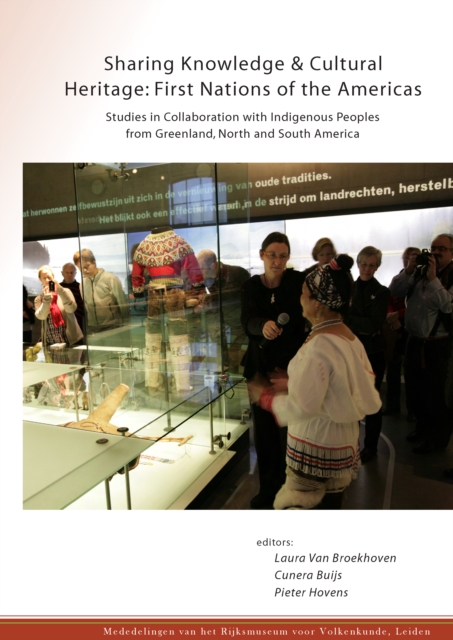
Sharing knowledge & cultural heritage: first nations of the Americas : studies in collaboration with indigenous peoples from Greenland, North and South America
Sharing Knowledge Cultural Heritage (SKCH), First Nations of the Americas, testifies to the growing commitment of museum professionals in the twenty-first century to share collections with the descendants of people and communities from whom the collections originated. Thanks to collection histories and the documenting of relations with particular indigenous communities, it is well known that until as recently as the 1970s, museum doors - except for a handful of cases - were shut to indigenous peoples. This volume is the result of an \"expert meeting\" held in November 2007 at the National Museum of Ethnology (NME) in Leiden, the Netherlands. Since then SKCH projects have developed. The NME invited leading indigenous as well as non-native professional experts in the field from the Americas and Europe to explore and discuss case studies based on fieldwork, collecting material culture and/or work with indigenous communities in Greenland, the Canadian Arctic, North America and Central and South America.
eBook