
Catalogue Search | MBRL


Are you sure you want to remove the book from the shelf?

{{itemTitle}}
6
result(s) for
"Indigenous people-Southern States-History-Colonial period, ca. 1600-1775"
Sort by:

Republic of Indians
A sweeping history of the Native Southerners who wrote their principles into Spanish and English law A sweeping history of the Native Southerners who challenged European empires from the inside, Republic of Indians tells the story of Indigenous leaders who wrote their principles into Spanish and English law.While in the Spanish Empire, Natives were a recognized part of \"la república de indios, \" the \"republic of Indians, \" other Natives across the early American South understood themselves to be joined with European colonists in larger polities, each jealously guarding their own bodies of liberties under royal sanction. Thus, rather than simply rejecting European pretensions to rule them as subjects and vassals, Native Southerners as diverse as the Apalachees, Pamunkeys, Powhatans, and Timucuas redefined their status to become political players in legislative assemblies and the courts of distant monarchs. They pushed for incorporation in larger political systems in which they had a say and were themselves instrumental in creating.Adapting pre-invasion practices to the technology of writing and the challenges of colonialism, Indigenous petitioners sought exemptions from labor and protection for \"the lands that God gave to them, \" as well as the right to install preferred leaders, avoid enslavement, ally with the Crown against colonists, ease harsh colonial laws, and even amend the terms of treaties and compacts. Bradley J. Dixon shows how their petitions also stand as enduring contributions to American political thought and how it was these \"vassals\" and \"subjects\" who gave meaning to the modern idea of tribal sovereignty. In the South, the Spanish and English empires came to resemble one another precisely because they were both dependent to a remarkable degree on maintaining Indigenous political consent and were founded in large part on Indigenous conceptions of law.
eBook

New worlds of violence : cultures and conquests in the early American Southeast
From the early 1500s to the mid-1700s, the American Southeast was the scene of continuous tumult as European powers vied for dominance in the region while waging war on Native American communities. Yet even before Hernando de Soto landed his expeditionary force on the Gulf shores of Florida, Native Americans had created their own \"cultures of violence\": sets of ideas about when it was appropriate to use violence and what sorts of violence were appropriate to a given situation. In New Worlds of Violence, Matthew Jennings offers a persuasive new framework for understanding the European-Native American contact period and the conflicts among indigenous peoples that preceded it. This pioneering approach posits that every group present in the Southeast had its own ideas about the use of violence and that these ideas changed over time as they collided with one another. The book starts with the Mississippian era and continues through the successive Spanish and English invasions of the Native South. Jennings argues that the English conquered the Southeast because they were able to force everyone else to adapt to their culture of violence, which, of course, changed over time as well. By 1740, a peculiarly Anglo-American culture of violence was in place that would profoundly influence the expansion of England's colonies and the eventual southern United States. While Native and African violence were present in this world, they moved in circles defined by the English. New Worlds of Violence concludes by pointing out that long-lasting violence bears long-lasting consequences. An important contribution to the growing body of work on the early Southeast, this book will significantly broaden readers' understanding of America's violent past. Matthew Jennings is an assistant professor of history at Macon State College in Macon, Georgia. He is the author of \"Violence in a Shattered World\" in Mapping the Shatter Zone: The European Invasion and the Transformation of the Mississippian World, edited by Robbie Ethridge and Sheri Shuck-Hall. His work has also appeared in The Uniting States, The South Carolina Encyclopedia, A Multicultural History of the United States, and The Encyclopedia of Native American History.
eBook

Zamumo's Gifts
In 1540, Zamumo, the chief of the Altamahas in central Georgia, exchanged gifts with the Spanish conquistador Hernando de Soto. With these gifts began two centuries of exchanges that bound American Indians and the Spanish, English, and French who colonized the region. Whether they gave gifts for diplomacy or traded commodities for profit, Natives and newcomers alike used the exchange of goods such as cloth, deerskin, muskets, and sometimes people as a way of securing their influence. Gifts and trade enabled early colonies to survive and later colonies to prosper. Conversely, they upset the social balance of chiefdoms like Zamumo's and promoted the rise of new and powerful Indian confederacies like the Creeks and the Choctaws.Drawing on archaeological studies, colonial documents from three empires, and Native oral histories, Joseph M. Hall, Jr., offers fresh insights into broad segments of southeastern colonial history, including the success of Florida's Franciscan missionaries before 1640 and the impact of the Indian slave trade on French Louisiana after 1699. He also shows how gifts and trade shaped the Yamasee War, which pitted a number of southeastern tribes against English South Carolina in 1715-17. The exchanges at the heart of Zamumo's Gifts highlight how the history of Europeans and Native Americans cannot be understood without each other.
eBook

From Chicaza to Chickasaw
In this sweeping regional history, anthropologist Robbie Ethridge traces the metamorphosis of the Native South from first contact in 1540 by Hernando De Soto to the dawn of the eighteenth century, when indigenous people no longer lived in a purely Indian world but rather on the edge of an expanding European empire and in a new social landscape that included a large population of Europeans and Africans. Despite the fact that thousands of Indians died or were enslaved and virtually all Native polities were radically altered in these years, the collapse of this complex Mississippian world did not extinguish the Native peoples of the South but rather transformed them.Using a new interpretive framework that Ethridge calls the \"Mississippian shatter zone\" to explicate these tumultuous times,From Chicaza to Chickasawexamines the European invasion and the collapse of the precontact Mississippian world and the restructuring of discrete chiefdoms into coalescent Native societies in a colonial world. Within this larger regional context, she closely follows the story of one group--the Chickasaws--throughout this period. With skillfully synthesized archaeological and documentary evidence, Ethridge illuminates the Native South in its earliest colonial context and sheds new light on the profound upheaval and cultural transformation experienced by the region's first peoples.
eBook

Okfuskee
A work of original scholarship and compelling sweep,
Okfuskee is a community-centered Indian history with an
explicitly comparativist agenda. Joshua Piker uses the history of
Okfuskee, an eighteenth-century Creek town, to reframe standard
narratives of both Native and American experiences. This unique,
detailed perspective on local life in a Native society allows us to
truly understand both the pervasiveness of colonialism's influence
and the inventiveness of Native responses. At the same time, by
comparing the Okfuskees' experiences to those of their
contemporaries in colonial British America, the book provides a
nuanced discussion of the ways in which Native and Euro-American
histories intersected with, and diverged from, each other. Piker
examines the diplomatic ties that developed between the Okfuskees
and their British neighbors; the economic implications of the
Okfuskees' shifting world view; the integration of British traders
into the town; and the shifting gender and generational
relationships in the community. By both providing an in-depth
investigation of a colonial-era Indian town in Indian country and
placing the Okfuskees within the processes central to early
American history, Piker offers a Native history with important
implications for American history.
eBook
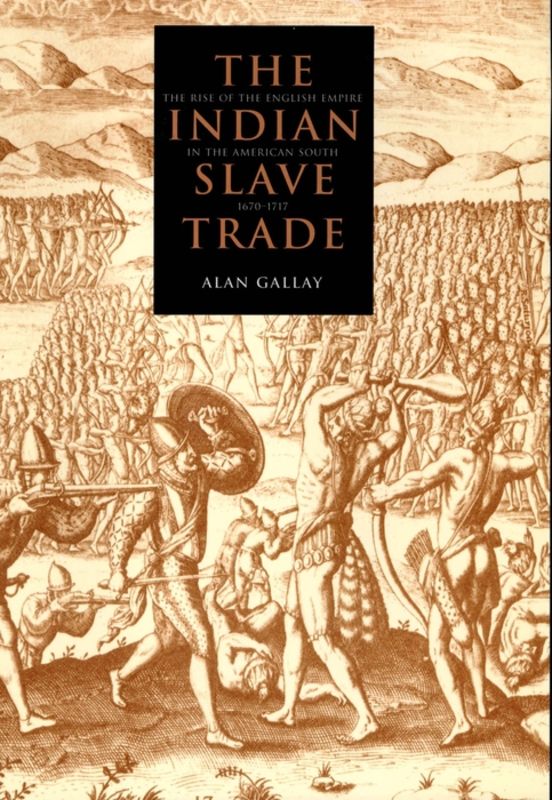
The Indian Slave Trade
This absorbing book is the first ever to focus on the traffic in Indian slaves during the early years of the American South. The Indian slave trade was of central importance from the Carolina coast to the Mississippi Valley for nearly fifty years, linking southern lives and creating a whirlwind of violence and profit-making, argues Alan Gallay. He documents in vivid detail how the trade operated, the processes by which Europeans and Native Americans became participants, and the profound consequences for the South and its peoples.The author places Native Americans at the center of the story of European colonization and the evolution of plantation slavery in America. He explores the impact of such contemporary forces as the African slave trade, the unification of England and Scotland, and the competition among European empires as well as political and religious divisions in England and in South Carolina. Gallay also analyzes how Native American societies approached warfare, diplomacy, and decisions about allying and trading with Europeans. His wide-ranging research not only illuminates a crucial crossroad of European and Native American history but also establishes a new context for understanding racism, colonialism, and the meaning of ethnicity in early America.
eBook