
Catalogue Search | MBRL


Are you sure you want to remove the book from the shelf?

{{itemTitle}}
95
result(s) for
"Indigenous peoples Land tenure Canada."
Sort by:


A common hunger : land rights in Canada and South Africa
Geographically, demographically, and politically, South Africa and Canada are two countries that are very far apart. What they have in common are indigenous populations, which, because of their historical and ongoing experience of colonization and dispossession, share a hunger for land and human dignity. Based on extensive research carried out in both countries, A Common Hunger is a comparative work on the history of indigenous land rights in Canada and post-apartheid South Africa. Joan Fairweather has constructed a balanced examination of the impact of land dispossession on the lives of indigenous peoples in both countries and their response to centuries of European domination. By reclaiming rights to the land and an equitable share in the wealth-producing resources they contain, the first peoples of Canada and South Africa are taking important steps to confront the legacies of poverty that characterize many of their communities. A Common Hunger provides historical context to the current land claim process in these two former British colonies and examines the efforts of governments and the courts to ensure that justice is done.
eBook

Negotiating the deal : comprehensive land claims agreements in Canada
Using in-depth interviews with Indigenous, federal, provincial, and territorial officials, Christopher Alcantara compares the experiences of four Aboriginal groups: the Kwanlin Dün First Nation (with a completed treaty) and the Kaska Nations (with incomplete negotiations) in Yukon Territory, and the Inuit (completed) and Innu (incomplete) in Newfoundland and Labrador. Based on the experiences of these groups, Alcantara argues that scholars and policymakers need to pay greater attention to the institutional framework governing treaty negotiations and, most importantly, to the active role that Aboriginal groups play in these processes.\"--pub. desc.
Book

Let right be done : Aboriginal title, the Calder case, and the future of Indigenous rights
No detailed description available for \"Let Right Be Done\".
eBook


Aboriginal rights claims and the making and remaking of history
Forums such as commissions, courtroom trials, and tribunals that have been established through the second half of the twentieth century to address aboriginal land claims have consequently created a particular way of presenting aboriginal, colonial, and national histories. The history that emerges from these land-claims processes is often criticized for being \"presentist\" - inaccurately interpreting historical actions and actors through the lens of present-day values, practices, and concerns. In Aboriginal Rights Claims and the Making and Remaking of History, Arthur Ray examines how claims-oriented research is often fitted to the existing frames of indigenous rights law and claims legislation and, as a result, has influenced the development of these laws and legislation. Through a comparative study encompassing the United States, Canada, South Africa, Australia and New Zealand, Ray also explores the ways in which various procedures and settings for claims adjudication have influenced and changed the use of historical evidence, made space for indigenous voices, stimulated scholarly debates about the cultural and historical experiences of indigenous peoples at the time of initial European contact and afterward, and have provoked reactions from politicians and scholars. While giving serious consideration to the flaws and strengths of presentist histories, Aboriginal Rights Claims and the Making and Remaking of History provides communities with essential information on how history is used and how methods are adapted and changed.
eBook

Grounded authority : the Algonquins of Barriere Lake against the state
\"Since Justin Trudeau's election in 2015, Canada has been hailed internationally as embarking on a truly progressive, post-postcolonial era--including an improved relationship between the state and its Indigenous peoples. Shiri Pasternak corrects this misconception, showing that colonialism is very much alive in Canada. From the perspective of Indigenous law and jurisdiction, she tells the story of the Algonquins of Barriere Lake, in western Quebec, and their tireless resistance to federal land claims policy. Grounded Authority chronicles the band's ongoing attempts to restore full governance over its lands and natural resources through an agreement signed by settler governments almost three decades ago--an agreement the state refuses to fully implement. Pasternak argues that the state's aversion to recognizing Algonquin jurisdiction stems from its goal of perfecting its sovereignty by replacing the inherent jurisdiction of Indigenous peoples with its own, delegated authority. From police brutality and fabricated sexual abuse cases to an intervention into and overthrow of a customary government, Pasternak provides a compelling, richly detailed account of rarely documented coercive mechanisms employed to force Indigenous communities into compliance with federal policy. A rigorous account of the incredible struggle fought by the Algonquins to maintain responsibility over their territory, Grounded Authority provides a powerful alternative model to one nation's land claims policy and a vital contribution to current debates in the study of colonialism and Indigenous peoples in North America and globally\"-- Provided by publisher.
Book
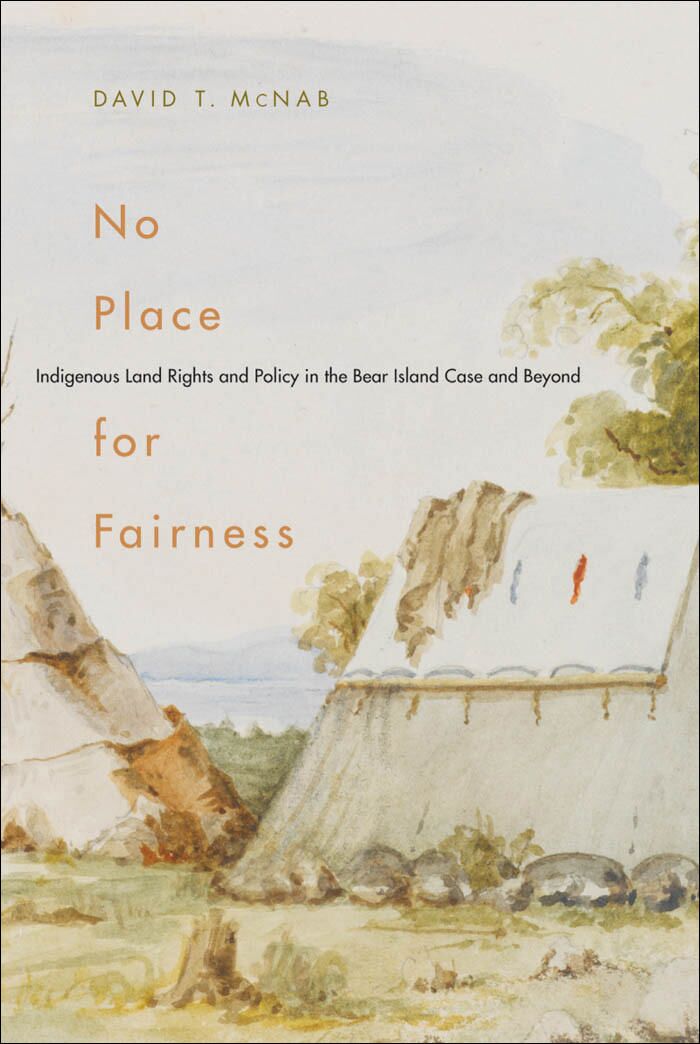
No Place for Fairness
Aboriginal land policy in Canada began as an Aboriginal initiative. In No Place for Fairness, David McNab - a long time advisor on land and treaty rights for both government and First Nations groups - looks at the Bear Island Indigenous rights case, initiated by the Teme-Augama Anishinabe, to explore why governments fail to deal effectively with Aboriginal land claims. The book, divided into two sections, includes a survey of the historical background of the Bear Island claim followed by a more personal series of reflections about what happened as the claim encountered decades of policy hurdles, court cases, public protests, and above all resistance by the Temagami First Nation. McNab provides details of how ministers and their senior officials resisted real efforts to resolve problems as well as examples of field staff resisting government attempts at resolution. He also shows that government entities such as the Indian Commission of Ontario and the Native Affairs Directorate were largely used as \"mailboxes\" where successive federal and provincial governments sent things they wanted to bury.
eBook
Reclaiming Indigenous Planning
Centuries-old community planning practices in Indigenous communities in Canada, the United States, New Zealand, and Australia have, in modern times, been eclipsed by ill-suited western approaches, mostly derived from colonial and neo-colonial traditions. Since planning outcomes have failed to reflect the rights and interests of Indigenous people, attempts to reclaim planning have become a priority for many Indigenous nations throughout the world. In Reclaiming Indigenous Planning, scholars and practitioners connect the past and present to facilitate better planning for the future. With examples from the Canadian Arctic to the Australian desert, and the cities, towns, reserves and reservations in between, contributors engage topics including Indigenous mobilization and resistance, awareness-raising and seven-generations visioning, Indigenous participation in community planning processes, and forms of governance. Relying on case studies and personal narratives, these essays emphasize the critical need for Indigenous communities to reclaim control of the political, socio-cultural, and economic agendas that shape their lives. The first book to bring Indigenous and non-Indigenous authors together across continents, Reclaiming Indigenous Planning shows how urban and rural communities around the world are reformulating planning practices that incorporate traditional knowledge, cultural identity, and stewardship over land and resources. Contributors include Robert Adkins (Community and Economic Development Consultant, USA), Chris Andersen (Alberta), Giovanni Attili (La Sapienza), Aaron Aubin (Dillon Consulting), Shaun Awatere (Landcare Research, New Zealand), Yale Belanger (Lethbridge), Keith Chaulk (Memorial), Stephen Cornell (Arizona), Sherrie Cross (Macquarie), Kim Doohan (Native Title and Resource Claims Consultant, Australia), Kerri Jo Fortier (Simpcw First Nation), Bethany Haalboom (Victoria University, New Zealand), Lisa Hardess (Hardess Planning Inc.), Garth Harmsworth (Landcare Research, New Zealand), Sharon Hausam (Pueblo of Laguna), Michael Hibbard (Oregon), Richard Howitt (Macquarie), Ted Jojola (New Mexico), Tanira Kingi (AgResearch, New Zealand), Marcus Lane (Commonwealth Scientific and Industrial Research Organization, Australia), Rebecca Lawrence (Umea), Gaim Lunkapis (Malaysia Sabah), Laura Mannell (Planning Consultant, Canada), Hirini Matunga (Lincoln University, New Zealand), Deborah McGregor (Toronto), Oscar Montes de Oca (AgResearch, New Zealand), Samantha Muller (Flinders), David Natcher (Saskatchewan), Frank Palermo (Dalhousie), Robert Patrick (Saskatchewan), Craig Pauling (Canterbury Earthquake Recovery Authority, New Zealand), Kurt Peters (Oregon State), Libby Porter (Monash), Andrea Procter (Memorial), Sarah Prout (Combined Universities Centre for Rural Health, Australia), Catherine Robinson (Commonwealth Scientific and Industrial Research Organization, Australia), Shadrach Rolleston (Planning Consultant, New Zealand), Leonie Sandercock (British Columbia), Crispin Smith (Planning Consultant, Canada), Sandie Suchet-Pearson (Macquarie), Siri Veland (Brown), Ryan Walker (Saskatchewan), Liz Wedderburn (AgResearch, New Zealand).
eBook

Beyond the Indian Act
The authors not only investigate the current forms of property rights on reservations but also expose the limitations of each system, showing that customary rights are insecure, certificates of possession cannot be sold outside the First Nation, and leases are temporary. As well, analysis of legislation, court decisions, and economic reports reveals that current land management has led to unnecessary economic losses. The authors propose creation of a First Nations Property Ownership Act that would make it possible for First Nations to take over full ownership of reserve lands from the Crown, arguing that permitting private property on reserves would provide increased economic advantages. An engaging and well-reasoned book, Beyond the Indian Act is a bold argument for a new system that could improve the quality of life for First Nations people in communities across the country.
eBook