
Catalogue Search | MBRL


Are you sure you want to remove the book from the shelf?

{{itemTitle}}
56
result(s) for
"Indigenous peoples of North America Legal status, laws, etc. Canada."
Sort by:

Peace and good order : the case for indigenous justice in Canada
\"An urgent, informed, intimate condemnation of the Canadian state and its failure to deliver justice to Indigenous people by national bestselling author and former Crown prosecutor Harold R. Johnson. \"The night of the decision in the Gerald Stanley trial for the murder of Colten Boushie, I received a text message from a retired provincial court judge. He was feeling ashamed for his time in a system that was so badly tilted. I too feel this way about my time as both defence counsel and as a Crown prosecutor; that I didn't have the courage to stand up in the court room and shout 'Enough is enough.' This book is my act of taking responsibility for what I did, for my actions and inactions.\"--Harold R. Johnson. In early 2018, the failures of Canada's justice system were sharply and painfully revealed in the verdicts issued in the deaths of Colten Boushie and Tina Fontaine. The outrage and confusion that followed those verdicts inspired former Crown prosecutor and bestselling author Harold R. Johnson to make the case against Canada for its failure to fulfill its duty under Treaty to effectively deliver justice to Indigenous people, worsening the situation and ensuring long-term damage to Indigenous communities. In this direct, concise, and essential volume, Harold R. Johnson examines the justice system's failures to deliver \"peace and good order\" to Indigenous people. He explores the part that he understands himself to have played in that mismanagement, drawing on insights he has gained from the experience; insights into the roots and immediate effects of how the justice system has failed Indigenous people, in all the communities in which they live; and insights into the struggle for peace and good order for Indigenous people now.\"-- Provided by publisher.
Book

Red Skin, White Masks
Over the past forty years, recognition has become the dominant mode of negotiation and decolonization between the nation-state and Indigenous nations in North America. The term \"recognition\" shapes debates over Indigenous cultural distinctiveness, Indigenous rights to land and self-government, and Indigenous peoples' right to benefit from the development of their lands and resources.
In a work of critically engaged political theory, Glen Sean Coulthard challenges recognition as a method of organizing difference and identity in liberal politics, questioning the assumption that contemporary difference and past histories of destructive colonialism between the state and Indigenous peoples can be reconciled through a process of acknowledgment. Beyond this, Coulthard examines an alternative politics-one that seeks to revalue, reconstruct, and redeploy Indigenous cultural practices based on self-recognition rather than on seeking appreciation from the very agents of colonialism.
Coulthard demonstrates how a \"place-based\" modification of Karl Marx's theory of \"primitive accumulation\" throws light on Indigenous-state relations in settler-colonial contexts and how Frantz Fanon's critique of colonial recognition shows that this relationship reproduces itself over time. This framework strengthens his exploration of the ways that the politics of recognition has come to serve the interests of settler-colonial power.
In addressing the core tenets of Indigenous resistance movements, like Red Power and Idle No More, Coulthard offers fresh insights into the politics of active decolonization.
eBook


Between Indigenous and Settler Governance
Between Indigenous and Settler Governance addresses the history, current development and future of Indigenous self-governance in four settler-colonial nations: Australia, Canada, New Zealand and the United States. Bringing together emerging scholars and leaders in the field of indigenous law and legal history, this collection offers a long-term view of the legal, political and administrative relationships between Indigenous collectivities and nation-states. Placing historical contingency and complexity at the center of analysis, the papers collected here examine in detail the process by which settler states both dissolved indigenous jurisdictions and left spaces - often unwittingly - for indigenous survival and corporate recovery. They emphasise the promise and the limits of modern opportunities for indigenous self-governance; whilst showing how all the players in modern settler colonialism build on a shared and multifaceted past. Indigenous tradition is not the only source of the principles and practices of indigenous self-determination; the essays in this book explore some ways that the legal, philosophical and economic structures of settler colonial liberalism have shaped opportunities for indigenous autonomy. Between Indigenous and Settler Governance will interest all those concerned with Indigenous peoples in settler-colonial nations.
eBook

Freedom and indigenous constitutionalism
\"Indigenous traditions can be uplifting, positive, and liberating forces when they are connected to living systems of thought and practice. Problems arise when they are treated as timeless models of unchanging truth that require unwavering deference and unquestioning obedience. Freedom and Indigenous Constitutionalism celebrates the emancipatory potential of Indigenous traditions, considers their value as the basis for good laws and good lives, and critiques the failure of Canadian constitutional traditions to recognize their significance.\"-- Provided by publisher.
Book

\Real\ Indians and others : mixed-blood urban native peoples and indigenous nationhood
Mixed-blood urban Native peoples in Canada are profoundly affected by federal legislation that divides Aboriginal peoples into different legal categories. In this pathfinding book, Bonita Lawrence reveals the ways in which mixed-blood urban Natives understand their identities and struggle to survive in a world that, more often than not, fails to recognize them. In Real Indians and Others Lawrence draws on the first-person accounts of thirty Toronto residents of Native heritage, as well as archival materials, sociological research, and her own urban Native heritage and experiences. She sheds light on the Canadian governments efforts to define Native identity through the years by means of the Indian Act and shows how residential schooling, the loss of official Indian status, and adoption have affected Native identity. Lawrence looks at how Natives with Indian status react and respond to nonstatus Natives and how federally recognized Native peoples attempt to impose an identity on urban Natives. Drawing on her interviews with urban Natives, she describes the devastating loss of community that has resulted from identity legislation and how urban Native peoples have wrestled with their past and current identities. Lawrence also addresses the future and explores the forms of nation building that can reconcile the differences in experiences and distinct agendas of urban and reserve-based Native communities.
eBook
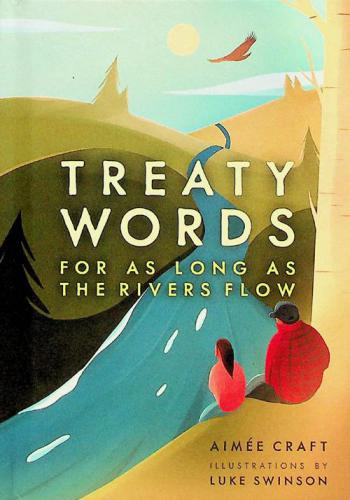
Treaty words : for as long as the rivers flow
\"The first treaty that was made was between the earth and the sky. It was an agreement to work together. We build all of our treaties on that original treaty. On the banks of the river that have been Mishomis's home his whole life, he teaches his granddaughter to listen--to hear both the sounds and the silences, and so to learn her place in Creation. Most importantly, he teaches her about treaties--the bonds of reciprocity and renewal that endure for as long as the sun shines, the grass grows, and the rivers flow. Accompanied by beautiful illustrations by Luke Swinson and an author's note at the end, Aimée Craft affirms the importance of understanding an Indigenous perspective on treaties in this evocative book that is essential for readers of all ages.\"-- Provided by publisher.
Aboriginal rights claims and the making and remaking of history
Forums such as commissions, courtroom trials, and tribunals that have been established through the second half of the twentieth century to address aboriginal land claims have consequently created a particular way of presenting aboriginal, colonial, and national histories. The history that emerges from these land-claims processes is often criticized for being \"presentist\" - inaccurately interpreting historical actions and actors through the lens of present-day values, practices, and concerns. In Aboriginal Rights Claims and the Making and Remaking of History, Arthur Ray examines how claims-oriented research is often fitted to the existing frames of indigenous rights law and claims legislation and, as a result, has influenced the development of these laws and legislation. Through a comparative study encompassing the United States, Canada, South Africa, Australia and New Zealand, Ray also explores the ways in which various procedures and settings for claims adjudication have influenced and changed the use of historical evidence, made space for indigenous voices, stimulated scholarly debates about the cultural and historical experiences of indigenous peoples at the time of initial European contact and afterward, and have provoked reactions from politicians and scholars. While giving serious consideration to the flaws and strengths of presentist histories, Aboriginal Rights Claims and the Making and Remaking of History provides communities with essential information on how history is used and how methods are adapted and changed.
eBook

Grounded authority : the Algonquins of Barriere Lake against the state
\"Since Justin Trudeau's election in 2015, Canada has been hailed internationally as embarking on a truly progressive, post-postcolonial era--including an improved relationship between the state and its Indigenous peoples. Shiri Pasternak corrects this misconception, showing that colonialism is very much alive in Canada. From the perspective of Indigenous law and jurisdiction, she tells the story of the Algonquins of Barriere Lake, in western Quebec, and their tireless resistance to federal land claims policy. Grounded Authority chronicles the band's ongoing attempts to restore full governance over its lands and natural resources through an agreement signed by settler governments almost three decades ago--an agreement the state refuses to fully implement. Pasternak argues that the state's aversion to recognizing Algonquin jurisdiction stems from its goal of perfecting its sovereignty by replacing the inherent jurisdiction of Indigenous peoples with its own, delegated authority. From police brutality and fabricated sexual abuse cases to an intervention into and overthrow of a customary government, Pasternak provides a compelling, richly detailed account of rarely documented coercive mechanisms employed to force Indigenous communities into compliance with federal policy. A rigorous account of the incredible struggle fought by the Algonquins to maintain responsibility over their territory, Grounded Authority provides a powerful alternative model to one nation's land claims policy and a vital contribution to current debates in the study of colonialism and Indigenous peoples in North America and globally\"-- Provided by publisher.
Book

Protection of first nations cultural heritage : laws, policy, and reform
No detailed description available for \"Protection of First Nations Cultural Heritage\".
eBook