
Catalogue Search | MBRL


Are you sure you want to remove the book from the shelf?

{{itemTitle}}
35
result(s) for
"Indogermanisch"
Sort by:

Language and prehistory of the Indo-European peoples : a cross-disciplinary perspective
Our knowledge of neolithic and bronze age Europe is growing rapidly, and this book offers a major contribution to our understanding of the language and history of the peoples of that period. The editors have taken a deliberately cross-disciplinary approach, bringing in historical linguists, archaeologists, geneticists, and more to both examine specific questions in the field and to analyze the basic methodology in use. The book is the result of a Scandinavian conference, the first dedicated to this approach to the field.
Book

Dispersals and diversification : linguistic and archaeological perspectives on the early stages of Indo-European
Dispersals and diversification offers a reassessment of some of the pivotal linguistic and archaeological questions concerning the early phases of the disintegration of Proto-Indo-European, including discussions of the methodological approaches involved.
eBook
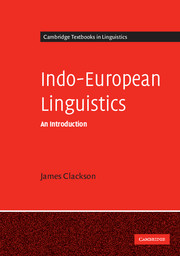
Indo-European Linguistics
The Indo-European language family consists of many of the modern and ancient languages of Europe, India and Central Asia, including Latin, Greek, Sanskrit, Russian, German, French, Spanish and English. Spoken by an estimated three billion people, it has the largest number of native speakers in the world today. This textbook provides an accessible introduction to the study of the Indo-European languages. It clearly sets out the methods for relating the languages to one another, presents an engaging discussion of the current debates and controversies concerning their classification, and offers sample problems and suggestions for how to solve them. Complete with a comprehensive glossary, almost 100 tables in which language data and examples are clearly laid out, suggestions for further reading, discussion points, and a range of exercises, this text will be an essential toolkit for all those studying historical linguistics, language typology and the Indo-European languages for the first time.
eBook

Dictionary of indo-european concepts and society
Since its publication in 1969, Émile Benveniste's Vocabulaire --here in a new translation as the Dictionary of Indo-European Concepts and Society --has been the classic reference for tracing the institutional and conceptual genealogy of the sociocultural worlds of gifts, contracts, sacrifice, hospitality, authority, freedom, ancient economy, and.
eBook


Studies on the Collective and Feminine in Indo-European from a Diachronic and Typological Perspective
This volume contains contributions on the origin of the feminine gender and its relation to the collective in the Indo-European parent language. Particular attention is paid to the question whether original flexion or word formation categories are involved and if the used formative elements have a common origin. Der Band versammelt Beiträge zur Herausbildung des Genus Femininum und seinem Verhältnis zum Kollektivum in der indogermanischen Grundsprache. Besondere Aufmerksamkeit wird der Frage gewidmet, ob es sich dabei um ursprüngliche Flexions- oder Wortbildungskategorien handelt und die dazu verwendeten formativen Elemente gemeinsamen Ursprungs sind.
eBook

Nominal apposition in Indo-European : its forms and functions, and its evolution in Latin-Romance
The series publishes state-of-the-art work on core areas of linguistics across theoretical frameworks as well as studies that provide new insights by building bridges to neighbouring fields such as neuroscience and cognitive science. The series considers itself a forum for cutting-edge research based on solid empirical data on language in its various manifestations, including sign languages. It regards linguistic variation in its synchronic and diachronic dimensions as well as in its social contexts as important sources of insight for a better understanding of the design of linguistic systems and the ecology and evolution of language.
eBook
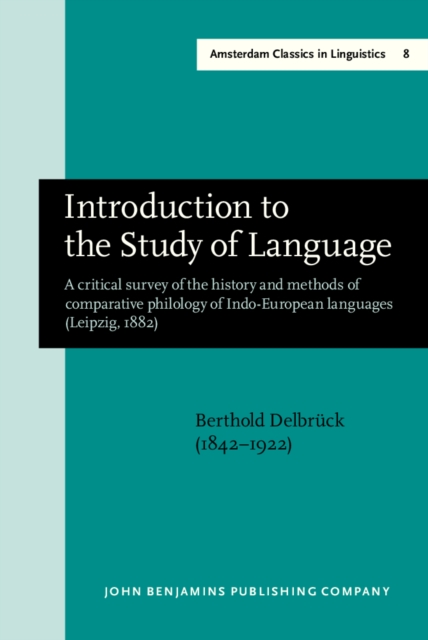
Introduction to the study of language : a critical survey of the history and methods of comparative philology of Indo-European languages
This volume contains a fac simile edition of the 1882 English translation of Delbruck's Einleitung in das Sprachstudium. Ein Beitrag zur Geschichte und Methodik der vergleichenden Sprachforschung (Leipzig 1880), together with a Foreword and a Selected Bibliography.
eBook
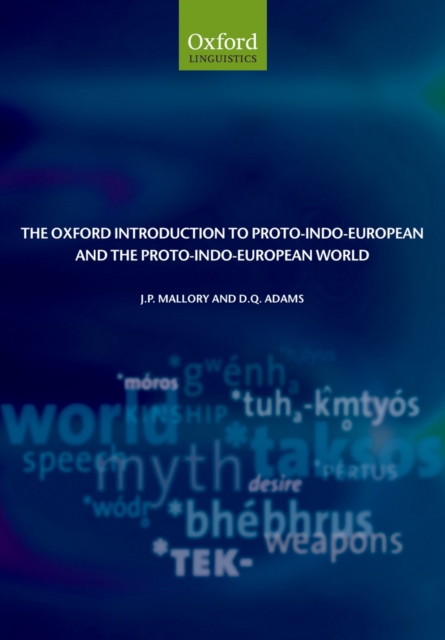
The Oxford introduction to Proto-Indo-European and the Proto-Indo-European world
This book introduces Proto-Indo-European, describes how it was reconstructed from its descendant languages, and shows what it reveals about the people who spoke it between 5,500 and 8,000 years ago. Using related evidence from archaeology and natural history the authors explore the lives, thoughts, passions, culture, society, economy, history, and environment of the Proto-Indo-Europeans. They include chapters on fauna, flora, family and kinship, clothing and textiles, food and drink, space and time, emotions, mythology, and religion, and describe the quest to discover the Proto-Indo-European homeland.
eBook

The study of Indo-European vocalism in the 19th century : from the beginnings to Whitney and Scherer : a critical-historical account
In the 19th century research on the Indo-European languages was to a large degree coterminus with the development of linguistics itself. The most notable accomplishments, as related in every history of linguistics, took place in the area of phonology. The present study examines one aspect of phonological investigation of the Indo-European languages: vocalism from the early 1800's to around 1870, the threshold of the neogrammarian era. It attempts to go beyond a mere chronological presentation of research on vocalism in the 19th century to examine other questions, such as the origin of the concepts which linguists employed and the methodology they advanced. Moreover, it attempts to illustrate anew that the history of any science cannot be reduced to a simple linear arrangement of discoveries.
eBook