
Catalogue Search | MBRL


Are you sure you want to remove the book from the shelf?

{{itemTitle}}
63
result(s) for
"Indonesia -- Colonization -- History"
Sort by:


Emerging Memory
This incisive volume brings together postcolonial studies, visual culture and cultural memory studies to explain how the Netherlands continues to rediscover its history of violence in colonial Indonesia. Dutch commentators have frequently claimed that the colonial past and especially the violence associated with it has been 'forgotten' in the Netherlands. Uncovering 'lost' photographs and other documents of violence has thereby become a recurring feature aimed at unmasking a hidden truth. The author argues that, rather than absent, such images have been consistently present in the Dutch public sphere and have been widely available in print, on television and now on the internet. Emerging Memory: Photographs of Colonial Atrocity in Dutch Cultural Remembrance shows that between memory and forgetting there is a haunted zone from which pasts that do not fit the stories nations live by keep on emerging and submerging while retaining their disturbing presence.
eBook

A History of Plague in Java, 1911–1942
In A History of Plague in Java,
1911-1942 , Maurits Bastiaan Meerwijk
demonstrates how the official response to the 1911 outbreak of
plague in Malang led to one of the most invasive health
interventions in Dutch colonial Indonesia. Eager to combat
disease, Dutch physicians and officials integrated the traditional
Javanese house into the \"rat-flea-man\" theory of transmission.
Hollow bamboo frames and thatched roofs offered hiding spaces for
rats, suggesting a material link between rat plague and human
plague. Over the next thirty years, 1.6 million houses were
renovated or rebuilt, millions more were subjected to periodic
inspection, and countless Javanese were exposed to health messaging
seeking to \"rat-proof\" their beliefs along with their houses.
The transformation of houses, villages, and people was
documented in hundreds of photographs and broadcast to overseas
audiences as evidence of the \"ethical\" nature of colonial rule,
proving so effective as propaganda that the rebuilding continued
even as better alternatives, such as inoculation, became available.
By systematically reshaping the built environment, the Dutch plague
response dramatically expanded colonial oversight and influence in
rural Java.
eBook

Mobilizing Labour for the Global Coffee Market
Coffee has been grown on Java for the commercial market since the early eighteenth century, when the Dutch East India Company began buying from peasant producers in the Priangan highlands. What began as a commercial transaction, however, soon became a system of compulsory production. This book shows how the Dutch East India Company mobilized land and labor, why they turned to force cultivation, and what effects the brutal system they installed had on the economy and society.
eBook

Fire and the Full Moon
Fire and the Full Moon reassesses Canada's postwar foreign policy objectives and national image through the gulf between rhetoric and reality in Canada's response to decolonization in Indonesia and the Global South.
eBook

Genetic and archaeological perspectives on the initial modern human colonization of southern Asia
It has been argued recently that the initial dispersal of anatomically modern humans from Africa to southern Asia occurred before the volcanic “supereruption” of the Mount Toba volcano (Sumatra) at ∼74,000 y before present (B.P.)—possibly as early as 120,000 y B.P. We show here that this “pre-Toba” dispersal model is in serious conflict with both the most recent genetic evidence from both Africa and Asia and the archaeological evidence from South Asian sites. We present an alternative model based on a combination of genetic analyses and recent archaeological evidence from South Asia and Africa. These data support a coastally oriented dispersal of modern humans from eastern Africa to southern Asia ∼60–50 thousand years ago (ka). This was associated with distinctively African microlithic and “backed-segment” technologies analogous to the African “Howiesons Poort” and related technologies, together with a range of distinctively “modern” cultural and symbolic features (highly shaped bone tools, personal ornaments, abstract artistic motifs, microblade technology, etc.), similar to those that accompanied the replacement of “archaic” Neanderthal by anatomically modern human populations in other regions of western Eurasia at a broadly similar date.
Journal Article
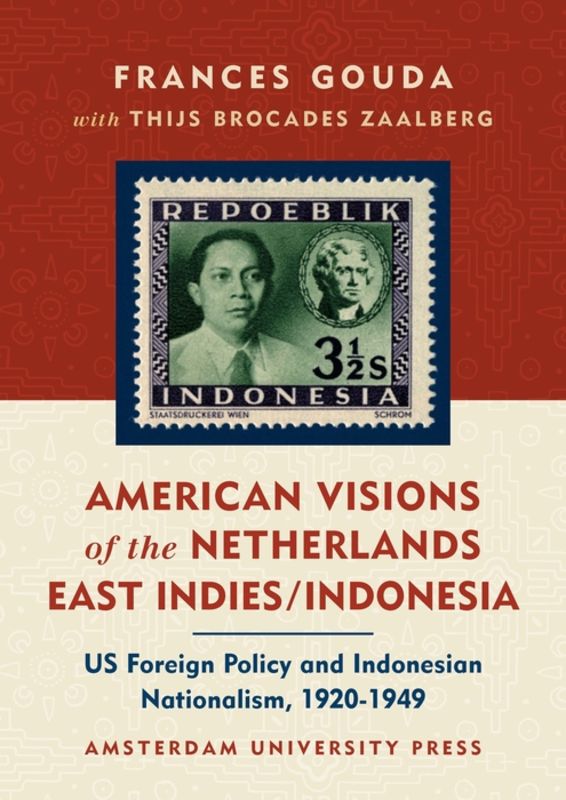
American Visions of the Netherlands East Indies/Indonesia
The authors of this book challenge the view that was current among many people in the Netherlands during the period 1945-1949 that the American government and its foreign policymakers unequivocally backed the Indonesian Republic's struggle for independence. The same myth of America's political endorsement of Indonesians' quest for independence continues to reverberate in the United States itself. In fact, ex-President Clinton repeated the story as recently as 1995 when he wrote to ex-President Suharto that in the post-World War II era, President Truman and the U.S. Congress had actively supported Indonesia 'as the nation was being born'. On the basis of research in American, Indonesian, Dutch, and Australian diplomatic records and in the archives of the United Nations, Gouda and Brocades Zaalberg describe and analyze American visions of the Dutch East Indies/Indonesia from the 1920s to December 1949, when the Kingdom of the Netherlands relinquished its sovereignty over the archipelago in southeast Asia to the United States fo Indonesia. Their historical analysis suggests that the American diplomatic establishment was not as ignorant of conditions in the Indonesian archipelago as many Dutch people assumed, both before and after World War II. They also chronicle the unfolding of America's steady but tactic backing of its faithful Dutch ally in northern Europe until early 1949, when U.S. assessments of the regions in the world where the Cold War might ignite into a 'Hot War' began to incorporate the anti-colonial, nationalist struggles in Indonesia and Vietnam. This title is available in the OAPEN Library - http://www.oapen.org.
eBook

Macroevolution of hyperdiverse flightless beetles reflects the complex geological history of the Sunda Arc
The Sunda Arc forms an almost continuous chain of islands and thus a potential dispersal corridor between mainland Southeast Asia and Melanesia. However, the Sunda Islands have rather different geological histories, which might have had an important impact on actual dispersal routes and community assembly. Here, we reveal the biogeographical history of hyperdiverse and flightless
Trigonopterus
weevils. Different approaches to ancestral area reconstruction suggest a complex east to west range expansion. Out of New Guinea,
Trigonopterus
repeatedly reached the Moluccas and Sulawesi transgressing Lydekker′s Line. Sulawesi repeatedly acted as colonization hub for different segments of the Sunda Arc. West Java, East Java and Bali are recognized as distinct biogeographic areas. The timing and diversification of species largely coincides with the geological chronology of island emergence. Colonization was not inhibited by traditional biogeographical boundaries such as Wallace’s Line. Rather, colonization patterns support distance dependent dispersal and island age limiting dispersal.
Journal Article

New evidence from East Timor contributes to our understanding of earliest modern human colonisation east of the Sunda Shelf
New dates by which modern humans reached East Timor prompts this very useful update of the colonisation of Island Southeast Asia. The author addresses all the difficult questions: why are the dates for modern humans in Australia earlier than they are in Island Southeast Asia? Which route did they use to get there? If they used the southern route, why or how did they manage to bypass Flores, where Homo floresiensis, the famous non-sapiens hominin known to the world as the ‘hobbit’ was already in residence? New work at the rock shelter of Jerimalai suggests some answers and new research directions.
Journal Article