
Catalogue Search | MBRL


Are you sure you want to remove the book from the shelf?

{{itemTitle}}
17
result(s) for
"Indonesia -- History -- 1798-1942"
Sort by:


Emerging Memory
This incisive volume brings together postcolonial studies, visual culture and cultural memory studies to explain how the Netherlands continues to rediscover its history of violence in colonial Indonesia. Dutch commentators have frequently claimed that the colonial past and especially the violence associated with it has been 'forgotten' in the Netherlands. Uncovering 'lost' photographs and other documents of violence has thereby become a recurring feature aimed at unmasking a hidden truth. The author argues that, rather than absent, such images have been consistently present in the Dutch public sphere and have been widely available in print, on television and now on the internet. Emerging Memory: Photographs of Colonial Atrocity in Dutch Cultural Remembrance shows that between memory and forgetting there is a haunted zone from which pasts that do not fit the stories nations live by keep on emerging and submerging while retaining their disturbing presence.
eBook

Images of the tropics : environment and visual culture in colonial Indonesia
\"This book critically examines Dutch colonial culture in the Netherlands Indies trough the prism of landscape art. Susie Protschky contends that visual representations of nature and landscape were core elements of how Europeans understood the tropics, justified their territorial claims in the region, and understood their place both in imperial Europe and in colonized Asia during the nineteenth and early twentieth centuries. Her book thus makes a significant contribution to studies of empire, art and environment, as well as to histories of Indonesia and Europe\"--P. [4] of cover.
Book

Images of the tropics
Images of the Tropics critically examines Dutch colonial culture in the Netherlands Indies through the prism of landscape art. Susie Protschky contends that visual representations of nature and landscape were core elements of how Europeans understood the tropics, justified their territorial claims in the region, and understood their place both in imperial Europe and in colonized Asia during the nineteenth and early twentieth centuries. Her book thus makes a significant contribution to studies of empire, art and environment, as well as to histories of Indonesia and Europe.
eBook

Islamic Nationhood and Colonial Indonesia
Drawing on previously unavailable archival material, this book argues that Indonesian nationalism rested on Islamic ecumenism heightened by colonial rule and the pilgrimage. The award winning author Laffan contrasts the latter experience with life in Cairo, where some Southeast Asians were drawn to both reformism and nationalism. After demonstrating the close linkage between Cairene ideology and Indonesian nationalism, Laffan shows how developments in the Middle East continued to play a role in shaping Islamic politics in colonial Indonesia.
eBook

The Netherlands Indies and the Great War, 1914-1918
World War I had just broken out, but colonial authorities in the Netherlands Indies heaved a sigh of relief: The colonial export sector had not collapsed and war offered new economic prospects; representatives from the Islamic nationalist movement had prayed for God to bless the Netherlands but had not seized upon the occasion to incite unrest. Furthermore, the colonial government, impressed by such shows of loyalty, embarked upon a campaign to create a ‘native militia’, an army of Javanese to assist in repulsing a possible Japanese invasion. - - Yet there were other problem: pilgrims stranded in Mecca, the pro-German disposition of most Indonesian Muslims because of the involvement of Turkey in the war, and above all the status of the Netherlands Indies as a smuggling station used by Indian revolutionaries and German agents to subvert British rule in Asia. - - By 1917 the optimism of the first war years had disappeared. Trade restrictions, the war at sea, and a worldwide lack of tonnage caused export opportunities to dwindle. Communist propaganda had radicalized the nationalist movement. In 1918 it seemed that the colony might cave in. Exports had ceased. Famine was a very real danger. There was increasing unrest within the colonial population and the army and navy. Colonial authorities turned to the nationalist movement for help, offering them drastic political concessions, forgotten as soon as the war ended. The political and economic independence gained by the Netherlands Indies, a result of problems in communications with the mother country, was also lost with the end of the war. - - Kees van Dijk examines how in 1917 the atmosphere of optimism in the Netherlands Indies changed to one of unrest and dissatisfaction, and how after World War I the situation stabilized to resemble pre-war political and economic circumstances. - - Kees van Dijk (1946) has worked as a researcher at KITLV/Royal Netherlands Institute of Southeast Asian and Caribbean Studies from 1968 to 2007 and has been professor of the history of Islam in Indonesia at Leiden University since 1985. Among his publications are Rebellion under the banner of Islam; The Darul Islam in Indonesia (Leiden, KITLV Press 1981) and A country in despair; Indonesia between 1997 and 2000 (Leiden, KITLV Press 2001).
eBook


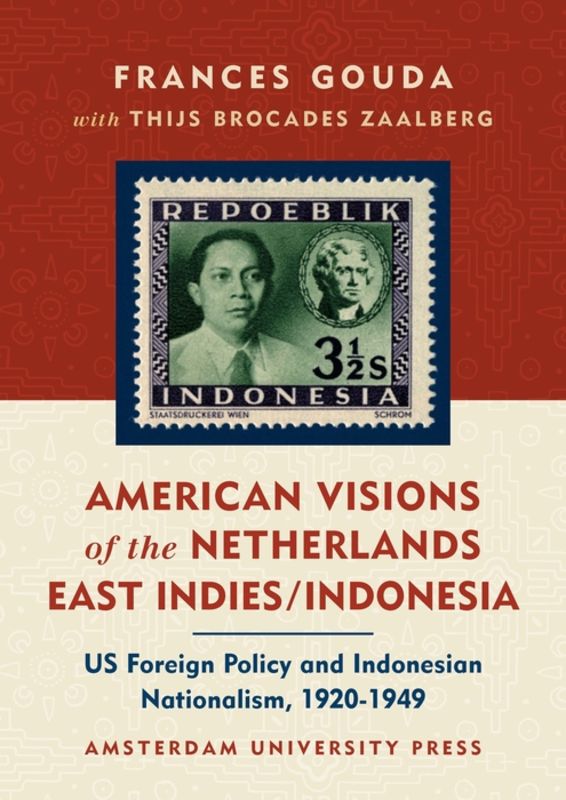
American Visions of the Netherlands East Indies/Indonesia
The authors of this book challenge the view that was current among many people in the Netherlands during the period 1945-1949 that the American government and its foreign policymakers unequivocally backed the Indonesian Republic's struggle for independence. The same myth of America's political endorsement of Indonesians' quest for independence continues to reverberate in the United States itself. In fact, ex-President Clinton repeated the story as recently as 1995 when he wrote to ex-President Suharto that in the post-World War II era, President Truman and the U.S. Congress had actively supported Indonesia 'as the nation was being born'. On the basis of research in American, Indonesian, Dutch, and Australian diplomatic records and in the archives of the United Nations, Gouda and Brocades Zaalberg describe and analyze American visions of the Dutch East Indies/Indonesia from the 1920s to December 1949, when the Kingdom of the Netherlands relinquished its sovereignty over the archipelago in southeast Asia to the United States fo Indonesia. Their historical analysis suggests that the American diplomatic establishment was not as ignorant of conditions in the Indonesian archipelago as many Dutch people assumed, both before and after World War II. They also chronicle the unfolding of America's steady but tactic backing of its faithful Dutch ally in northern Europe until early 1949, when U.S. assessments of the regions in the world where the Cold War might ignite into a 'Hot War' began to incorporate the anti-colonial, nationalist struggles in Indonesia and Vietnam. This title is available in the OAPEN Library - http://www.oapen.org.
eBook

Emerging Memory
This incisive volume brings together postcolonial studies, visual culture, and cultural memory studies to explain how the Netherlands continues to rediscover its history of violence in colonial Indonesia. Dutch commentators have frequently claimed that the colonial past and especially the violence associated with it has been “forgotten” in the Netherlands. Uncovering “lost” photographs and other documents of violence has thereby become a recurring feature aimed at unmasking a hidden truth.
The author argues that, rather than absent, such images have been consistently present in the Dutch public sphere and have been widely available in print, on television, and now on the internet. Emerging Memory shows that between memory and forgetting there is a haunted zone from which pasts that do not fit the stories nations live by keep on emerging and submerging while retaining their disturbing presence.
eBook