
Catalogue Search | MBRL


Are you sure you want to remove the book from the shelf?

{{itemTitle}}
68
result(s) for
"Indonesia Politics and government 1998-"
Sort by:


Political Change and Territoriality in Indonesia
What makes large, multi-ethnic states hang together? At a time when ethnic and religious conflict has gained global prominence, the territorial organization of states is a critical area of study.
Exploring how multi-ethnic and geographically dispersed states grapple with questions of territorial administration and change, this book argues that territorial change is a result of ongoing negotiations between states and societies where mutual and overlapping interests can often emerge. It focuses on the changing dynamics of central-local relations in Indonesia. Since the fall of Suharto's New Order government, new provinces have been sprouting up throughout the Indonesian archipelago. After decades of stability, this sudden change in Indonesia's territorial structure is puzzling. The author analyses this \"provincial proliferation\", which is driven by multilevel alliances across different territorial administrative levels, or territorial coalitions. He demonstrates that national level institutional changes including decentralization and democratization explain the timing of the phenomenon. Variations also occur based on historical, cultural, and political contexts at the regional level. The concept of territorial coalitions challenges the dichotomy between centre and periphery that is common in other studies of central-local relations.
This book will be of interest to scholars in the fields of comparative politics, political geography, history and Asian and Southeast Asian politics.
eBook

Indonesia : twenty years of democracy
This Element argues that after twenty years of democratization, Indonesia has performed admirably. This is especially so when the country's accomplishments are placed in comparative perspective. However, as we analytically focus more closely to inspect Indonesia's political regime, political economy, and how identity-based mobilizations have emerged, it is clear that Indonesia still has many challenges to overcome, some so pressing that they could potentially erode or reverse many of the democratic gains the country has achieved since its former authoritarian ruler, Soeharto, was forced to resign in 1998--Back cover.
Book
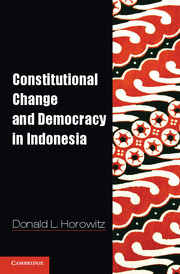
Constitutional Change and Democracy in Indonesia
How did democracy became entrenched in the world's largest Muslim-majority country? After the fall of its authoritarian regime in 1998, Indonesia pursued an unusual course of democratization. It was insider-dominated and gradualist and it involved free elections before a lengthy process of constitutional reform. At the end of the process, Indonesia's amended constitution was essentially a new and thoroughly democratic document. By proceeding as they did, the Indonesians averted the conflict that would have arisen between adherents of the old constitution and proponents of radical, immediate reform. Donald L. Horowitz documents the decisions that gave rise to this distinctive constitutional process. He then traces the effects of the new institutions on Indonesian politics and discusses their shortcomings and their achievements in steering Indonesia away from the dangers of polarization and violence. He also examines the Indonesian story in the context of comparative experience with constitutional design and intergroup conflict.
eBook


Continuity and Change after Indonesia's Reforms
This book addresses one of the most crucial questions in Southeast Asia: did the election in Indonesia in 2014 of a seemingly populist-oriented president alter the hegemony of the political and economic elites? Was it the end of the paradox that the basic social contradictions in the country's substantial capitalist development were not reflected in organized politics by any independent representation of subordinated groups, in spite of democratization? Beyond simplified frameworks, grounded scholars have now come together to discuss whether and how a new Indonesian politics has evolved in a number of crucial fields. Their critical insights are a valuable contribution to the study of this question.
eBook

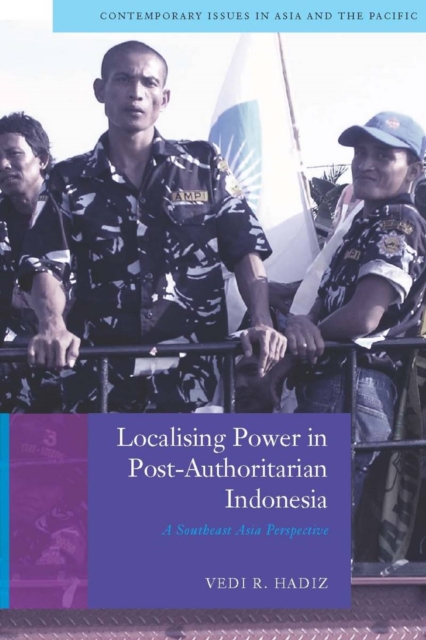
Localising power in post-authoritarian Indonesia : a Southeast Asia perspective
This book is about how the design of institutional change results in unintended consequences. Many post-authoritarian societies have adopted decentralization—effectively localizing power—as part and parcel of democratization, but also in their efforts to entrench \"good governance.\" Vedi Hadiz shifts the attention to the accompanying tensions and contradictions that define the terms under which the localization of power actually takes place. In the process, he develops a compelling analysis that ties social and institutional change to the outcomes of social conflict in local arenas of power. Using the case of Indonesia, and comparing it with Thailand and the Philippines, Hadiz seeks to understand the seeming puzzle of how local predatory systems of power remain resilient in the face of international and domestic pressures. Forcefully persuasive and characteristically passionate, Hadiz challenges readers while arguing convincingly that local power and politics still matter greatly in our globalized world.
eBook

Culture, power, and authoritarianism in the Indonesian state : cultural policy across the twentieth-century to the reform era
\"A critical history of cultural policy in one of the world's most diverse nations across the tumultuous twentieth century. It charts the influence of momentous political changes on the cultural policies of successive states, including colonial government, Japanese occupation, the killing and repression of communists, and the return of representative government, and examines broader social changes like nationalism and consumer culture. The book uses the concept of authoritarian cultural policy, or cultural policy that was premised on increased state control, tracing its presence from the colonial era until today. Tod Jones' use of historical and case study chapters captures the central state's changing cultural policies and its diverse outcomes across Indonesia\"-- Provided by publisher.
Book
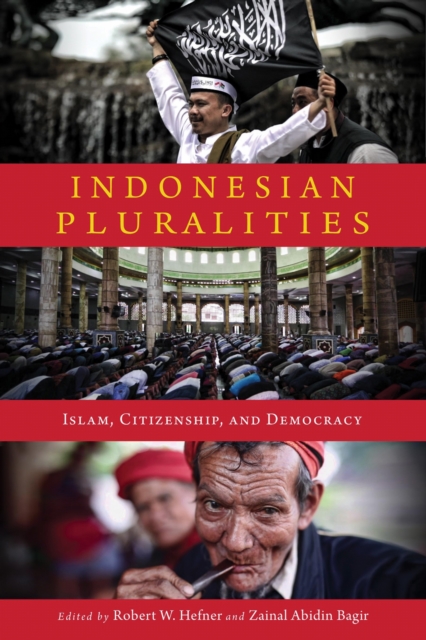
Indonesian Pluralities
The crisis of multiculturalism in the West and the failure of
the Arab uprisings in the Middle East have pushed the question of
how to live peacefully within a diverse society to the forefront of
global discussion. Against this backdrop, Indonesia has taken on a
particular importance: with a population of 265 million people
(87.7 percent of whom are Muslim), Indonesia is both the largest
Muslim-majority country in the world and the third-largest
democracy. In light of its return to electoral democracy from the
authoritarianism of the former New Order regime, some analysts have
argued that Indonesia offers clear proof of the compatibility of
Islam and democracy. Skeptics argue, however, that the growing
religious intolerance that has marred the country's political
transition discredits any claim of the country to democratic
exemplarity. Based on a twenty-month project carried out in several
regions of Indonesia, Indonesian Pluralities: Islam,
Citizenship, and Democracy shows that, in assessing the
quality and dynamics of democracy and citizenship in Indonesia
today, we must examine not only elections and official politics,
but also the less formal, yet more pervasive, processes of social
recognition at work in this deeply plural society. The contributors
demonstrate that, in fact, citizen ethics are not static discourses
but living traditions that co-evolve in relation to broader
patterns of politics, gender, religious resurgence, and ethnicity
in society.
Indonesian Pluralities offers important insights on the
state of Indonesian politics and society more than twenty years
after its return to democracy. It will appeal to political
scholars, public analysts, and those interested in Islam, Southeast
Asia, citizenship, and peace and conflict studies around the
world.
Contributors: Robert W. Hefner, Erica M. Larson, Kelli Swazey,
Mohammad Iqbal Ahnaf, Marthen Tahun, Alimatul Qibtiyah, and Zainal
Abidin Bagir
eBook