
Catalogue Search | MBRL


Are you sure you want to remove the book from the shelf?

{{itemTitle}}
56
result(s) for
"Indonesian fiction."
Sort by:

Reading contemporary Indonesian muslim women writers
Most literary analysis of the canon of Indonesian literature overlooks its religious aspect. This book is the first to discuss the construction of gender and Islamic identities in literary writing by four prominent Indonesian Muslim women writers: Titis Basino P I, Ratna Indraswari Ibrahim, Abidah El Kalieqy and Helvy Tiana Rosa. The narratives of the four writers are rich sources for revealing the construction of Indonesian Muslim women's identities. Within their feminist reading the writers understand that gender roles are negotiable rather than inherent. In representing women in a variety of discourses they draw multi-faceted women struggling against repression and domination, and resisting their status as powerless.
Dit is het eerste boek waarin de verhouding tussen geslacht en islamitische identiteit in de Indonesische literatuur wordt onderzocht. Diah Ariani Arimbi doet dit aan de hand van vier schrijfsters: Titis Basino P I, Ratna Indraswari Ibrahim, Abidah El Kalieqy en Helvy Tiana Rosa. Het verhaal van deze vier vrouwen onthult de ware identiteit van Indonesische moslima's. Vanuit hun feministisch standpunt laten deze schrijfsters zien dat verhoudingen tussen man en vrouw niet statisch zijn, maar veranderlijk en onderhandelbaar. Arimbi schetst een innemend beeld van deze veelzijdige vrouwen en hun strijd tegen onderdrukking en discriminatie. Zij blijken allesbehalve weerloze zielen te zijn.
eBook

The Birdwoman's palate
Aruna is an epidemiologist dedicated to food and avian politics. One is heaven, the other earth. The two passions blend in unexpected ways when Aruna is asked to research a handful of isolated bird flu cases reported across Indonesia. While it's put a crimp in her aunt's West Java farm, and made her own confit de canard highly questionable, the investigation does provide an irresistible opportunity. It's the perfect excuse to get away from corrupt and corrosive Jakarta and explore the spices of the far-flung regions of the islands with her three friends: a celebrity chef, a globe-trotting \"foodist,\" and her coworker Farish. From Medan to Surabaya, Palembang to Pontianak, Aruna and her friends have their fill of local cuisine. With every delicious dish, she discovers there's so much more to food, politics, and friendship. Now, this liberating new perspective on her country--and on her life--will push her to pursue the things she's only dreamed of doing.
Book
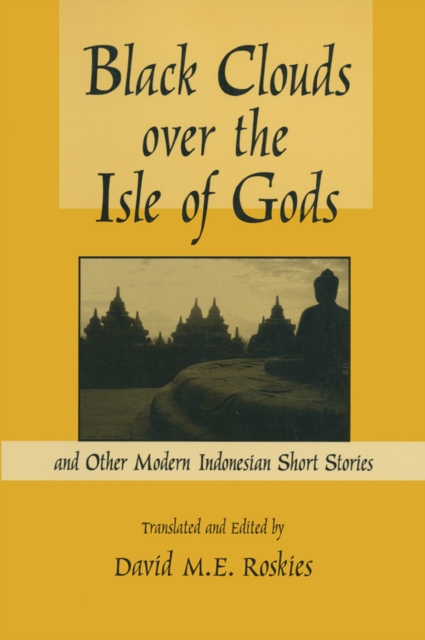
Black Clouds over the Isle of Gods
The stories in this anthology take issue with worn stereotypes and reflect both everyday life and the great upheavals that have marked modern Indonesian national life.
eBook

Women’s Cultural Practices in Madurese Novels: A Feminist Narratology Analysis
This study examines how contemporary Madurese novels construct women’s cultural subjectivities through narrative context, function, and technology in the following manner. Drawing on Schachtner’s Narrative Subject Theory and feminist narratology, the analysis focuses on six novels that depict women negotiating kinship obligations, ritual practices, and communal ethics within a patriarchal cultural framework. The results show that narrative contexts such as temporality, domestic and sacred spaces, and ritual cycles serve as cultural grammars through which women reinterpret inherited norms rather than merely obeying them. The narrative reveals that women’s agency emerges through reflective endurance, silence, and moral discernment, enabling them to influence family and community dynamics without directly challenging tradition. Meanwhile, narrative technologies, including symbolism, focalisation, and temporal fragmentation, foreground feminine interiority and transform endurance into moral authorship. This study contributes to narrative theory by demonstrating how subjectivity in non-Western literary contexts is shaped by communal ethics and religious values. It also enriches feminist narratology by highlighting culturally grounded forms of agency that rely on resilience and moral strength. Overall, Madurese fiction illustrates that transformation arises not from the rejection of tradition but from its reinterpretation through narrative.
Journal Article


Re-actualisation of Puppet Characters in Modern Indonesian Fictions of the 21st Century
Indonesian fiction works of the 21st century often intertextualise with puppet stories and characters. Puppet stories and characters, used as sources and references, inspire the creation of modern Indonesian fiction. Puppet stories are canonic works originating from mainstream Mahabharata and Ramayana, thematically narrating the heroism of good characters in defeating evil characters. Reactualisation of puppet stories and characters in literature is a redefinition and contextualisation as a response to the chalenges of time. Analyses of the intertextuality between Indonesian fiction and puppet stories and characters show the following things. First, Indonesian fiction is seen as intensively intertextualising with puppet stories and characters. Many puppet characters that are actualised originate more from the mainstream Mahabharata than from the mainstream Ramayana. Characters with good traits are made protagonists and characters with evil traits are made antagonists. Second, Indonesian fiction uses the identities of puppet characters as name references. References of puppet character identities take the form of hypograms of names with characters, names without characters, and characters without names. The most intensive identity referencing of puppet characters in the form of hypogramming to continue convention is naming with characters. Third, Indonesian fiction uses puppet stories and characters as cultural references. Puppet hypograming is taken to function as cultural references, comparison purposes, means of children education, and reincarnation sources in the Hindu religion. Cultural referencing of puppets is more efficient and communicative as it is typological, following the mainstreams and exact.
Journal Article

Abidah El Khalieqy’s novels: Challenging patriarchal Islam
Since the 1990s Islam in Indonesia has shifted in orientation and gradually shed its depoliticized position. After the fall of the New Order in 1998 many female authors came to the fore and voiced their opinions about societal expectations, gender roles and norms that regulate female sexuality. Muslim women have addressed in their fiction issues regarding Islam, modernity and how to balance Islamic teachings with globalized forces that have changed Indonesian ways of living. This article analyzes three novels by Muslim author Abidah El Khalieqy in which the protagonists search for ways to shape new female identities and forms of selfhood that are in accordance with Islam and also suit the modernized world. The novels speak openly and in great detail about sexual relations. They critique polygyny and patriarchal attitudes that treat women as sexual objects and inferior beings, and disrupt taboos such as domestic violence and (marital) rape while endorsing women’s activism to advocate gender equity and social justice. They also demonstrate how women find pleasure in sexual intimacy. Abidah's fiction does not shy away from topics such as homosexuality and pre-marital sex but eventually hetero-normativity prevails. In significant ways Abidah's fiction contributes to debates on women's rights and gender expectations within Indonesia's Muslim community.
Journal Article

Literature, Politics and the Public Imagination in the Late Colonial Netherlands Indies
The recent re-publication of a number of previously ignored and dismissed works of Indonesian fiction describe the political imagination and aspirations of literate Indonesians of the late colonial period. Two novels, 'Pacar Merah Indonesia' and 'Drama di Boven Digu' point to the possibility of imagining an Indonesia and a sense of Indonesianness outside the narrow orthodoxies and mythologies that were characteristic of this period.
Journal Article

A Road With No End
IN the Indonesian literary world there is a tendency to regard Djalan tak ada udjung (A Road with no end) as the best work of Mochtar Lubis. This evaluation was initiated by an Indonesian critic, M. S. Hutagalung, in his book, Mochtar Lubis' Road With No End. He wrote on page 18 that the novel represented a climax in Mochtar Lubis' writing: the works which preceded A Road With No End had been progressively improving, but those which followed had been on the decline.
Magazine Article