
Catalogue Search | MBRL


Are you sure you want to remove the book from the shelf?

{{itemTitle}}
145
result(s) for
"Industrial Revolution Fiction."
Sort by:

Cold magic
A novel set in an alternate Victorian Europe at the start of an industrial revolution where science and magic wage war against each other.
Book

Industrial Gothic
This volume carves out a new area of study, the 'industrial
Gothic', placing the genre in dialogue with the literature of the
Industrial Revolution. The book explores a significant subset of
transatlantic nineteenth-century literature that employs the
tropes, themes and rhetoric of the Gothic to portray the real-life
horrors of factory life, framing the Industrial Revolution as a
site of Gothic excess and horror. Using archival materials from the
nineteenth century, localised incidences of Gothic
industrialisation (in specific cities like Lowell and Manchester)
are considered alongside transnational connections and comparisons.
The author argues that stories about the real horrors of factory
life frequently employed the mode of the Gothic, while nineteenth
century writing in the genre (stories, novels, poems and stage
adaptations) began to use new settings - factories, mills, and
industrial cities - as backdrops for the horrors that once
populated Gothic castles.
eBook

Poor white
Hugh McVey moves from Missouri to the agrarian town of Bidwell, Ohio. He invents a mechanical cabbage planter to ease the burden of famers, but an investor in town exploits his product, which fails to succeed. His next invention, a corn cutter, makes him a millionaire and transforms Bidwell into a center of manufacturing. McVey, perennially lonely and ruminative, meets Clara Butterworth, who attends college at nearby Ohio State and is perennially harassed by her potential matches. Published one year after Winesburg, Ohio, in 1920, Poor White has a modernist style, an realist attention to every day life, and an eerily contemporary resonance.
Book

DO AIS DREAM OF ELECTRIC BOARDS?
When artificial intelligence (AI) acquires self-awareness, agency, and unique intelligence, it will attain ontological personhood. Management of firms by AI would be technologically and economically feasible. The law could confer upon AI the status of legal personhood, as it did upon traditional business firms in the past, thus dispensing with the need for inserting AI as property within the legal boundary of a firm. As a separate and distinct entity, AI could function independently as a manager in the way that legal or natural persons do today: i.e., AI as director, officer, partner, member, or manager. Such a future is desirable only if AI as manager creates more value than AI as tool or android serf. The principle of legal personhood is not intrinsically incompatible with the idea of machine person. This Article explores the legal, policy, and economic questions: Could we confer legal personhood on AI? Should we? This Article answers that the idea of AI as manager, qua legal person, is compelling. Economic and legal theories suggest that the conferral of AI personhood, permitting AI as manager, would create more value. With respect to law and policy, current laws of business firms suffice to provide the essential framework for the future. They mandate that corporate managers must be natural persons, but permit managers of noncorporate firms to be legal persons. This dichotomy provides the appropriate conceptual compromise. The use of AI as manager should be limited to private and noncorporate firms. This compromise, coupled with the limiting conditions identified in this Article, reflects the balances of cost and benefit as well as risk and value. Corporations have always been more consequential enterprises, and permitting AI to serve as corporate officers or directors could impose greater social and economic externalities. Legal personhood of AI would usher in a brave new world, which should be welcomed in the spirit of innovation-but the law should ensure a stable old world.
Journal Article

Cold Steel
The final volume of the Spiritwalker Trilogy finds Cat Bar ahal plagued by nonstop trouble, treachery, and magic. With revolutions to plot, enemies to crush, and handsome men to rescue, Cat and her cousin Bee have their work cut out for them.
Book

Creative Think Piece: With Apologies: W. E. B. Du Bois's \Comet\ and the Story Ray Bradbury Should Have Told but Couldn't
In Locke's text, he argues that the divine right of sovereignty and dominion was not granted just to the king, but to all descendants of Adam, which includes all those human beings of the same species and rank, which one can read specifically as race: Yet, alongside this declaration-one that would be an inspiration for the Declaration of Independence and the founding of the United States of America-was the looming presence of the trans-Atlantic Human Trade (in which Locke was a pivotal figure and a principal investor) and the irony inherent in the Declaration itself: a document which critiqued the king of England for usurping the rights of those colonialists-the right, they claimed, to the labor and the profits of the enslaved persons working the lands. Science fiction emerges to engage this world, if only obliquely-that is, analyzing and critiquing the world by escaping the world, using metaphor, irony, and satire to create an objective distance to think through the relationship between the subject/citizen and the changing world, to deal with the growing paradoxes of freedom and work, and the shifting social realities of the collapsing of the monarchies and the rise of liberal democracy. Jim can thank his race for both his social death and his new lease on life.
Journal Article

The signature of all things
\"A glorious, sweeping novel of desire, ambition, and the thirst for knowledge, from the # 1 New York Times bestselling author of Eat, Pray, Love and Committed. In The Signature of All Things, Elizabeth Gilbert returns to fiction, inserting her inimitable voice into an enthralling story of love, adventure and discovery. Spanning much of the eighteenth and nineteenth centuries, the novel follows the fortunes of the extraordinary Whittaker family as led by the enterprising Henry Whittaker-a poor-born Englishman who makes a great fortune in the South American quinine trade, eventually becoming the richest man in Philadelphia. Born in 1800, Henry's brilliant daughter, Alma (who inherits both her father's money and his mind), ultimately becomes a botanist of considerable gifts herself. As Alma's research takes her deeper into the mysteries of evolution, she falls in love with a man named Ambrose Pike who makes incomparable paintings of orchids and who draws her in the exact opposite direction-into the realm of the spiritual, the divine, and the magical. Alma is a clear-minded scientist; Ambrose a utopian artist-but what unites this unlikely couple is a desperate need to understand the workings of this world and the mechanisms behind all life. Exquisitely researched and told at a galloping pace, The Signature of All Things soars across the globe-from London to Peru to Philadelphia to Tahiti to Amsterdam, and beyond. Along the way, the story is peopled with unforgettable characters: missionaries, abolitionists, adventurers, astronomers, sea captains, geniuses, and the quite mad. But most memorable of all, it is the story of Alma Whittaker, who-born in the Age of Enlightenment, but living well into the Industrial Revolution-bears witness to that extraordinary moment in human history when all the old assumptions about science, religion, commerce, and class were exploding into dangerous new ideas. Written in the bold, questing spirit of that singular time, Gilbert's wise, deep, and spellbinding tale is certain to capture the hearts and minds of readers. \"-- Provided by publisher.
Book
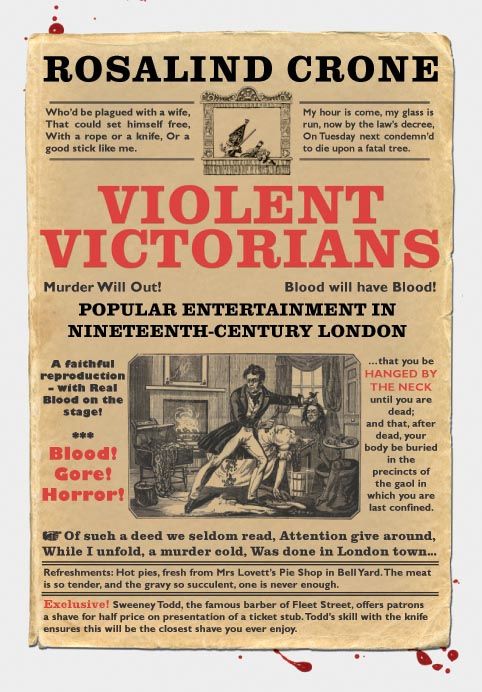
Violent Victorians
By drawing attention to the wide range of gruesome, bloody and confronting amusements patronised by ordinary Londoners this book challenges our understanding of Victorian society and culture. From the turn of the nineteenth century, graphic, yet orderly, ‘re-enactments’ of high level violence flourished in travelling entertainments, penny broadsides, popular theatres, cheap instalment fiction and Sunday newspapers. This book explores the ways in which these entertainments siphoned off much of the actual violence that had hitherto been expressed in all manner of social and political dealings, thus providing a crucial accompaniment to schemes for the reformation of manners and the taming of the streets, while also serving as a social safety valve and a check on the growing cultural hegemony of the middle class.
eBook

Rapid change, no simple solutions
In his most recent book (21 Lessons for the 21st Century, Jonathan Cape, 2018), Yuval Noah Harari sets out what he believes to be, as the title suggests, the 21 most critical lessons for this century, in the context of the current state of the world. The 21 lessons are grouped into five sections, with titles such as ‘The Technological Challenge’, and ‘Despair and Hope’. But two issues drawn from two of the sections, have messages of significance for science and education.
Journal Article
THE FOURTH INDUSTRIAL REVOLUTION IN THE CROATIAN CONTEXT: SCIENCE FICTION OR A NEW DEVELOPMENTAL PARADIGM?
The article examines prospects of directing the development of Croatian society towards the Fourth Industrial Revolution or Industry 4.0. Relations among overlapping relevant concepts are clarified in the first section. The following analysis comprises results of the qualitative study based on 12 semi-structured interviews with representatives of the entrepreneurial sector, state officials and scientists closely connected with the development and application of AI and robots. The findings suggest that respondents advocate for fostering Industry 4.0 by recognizing its potential, but also identify obstacles regarding its implementation. It is concluded that Industry 4.0 is most likely to emerge as a \"localised\" process, as: 1) the smart specialization of specific technologically most advanced products; 2) a primarily regional phenomenon that will appear in the north-west counties.
Journal Article