
Catalogue Search | MBRL


Are you sure you want to remove the book from the shelf?

{{itemTitle}}
10
result(s) for
"Industrial design History 20th century Exhibitions"
Sort by:

Cover Essay: Fusing Technology with Art in Advertising
The relationship between art and technology in the late nineteenth century was contested but increasingly characterized by a harmonious integration that reflected a progressive and optimistic view of technological innovation. This cover essay examines an advertising poster designed by the German-Italian commercial artist Adolfo Hohenstein for a public exhibition of infants in incubators, which opened in Paris in 1896. Hohenstein's poster for the Maternité Lion , with its distinctive and innovative use of an art nouveau style, captures the widespread enthusiasm for the new technologies and industries that characterized the art nouveau movement. The aesthetics of art nouveau expressed a broader cultural optimism about modernity and progress around the turn of the twentieth century. Hohenstein's poster exemplifies this by providing an aestheticized and exhibitory framework for introducing the incubator as a new technology, specifically to appeal to women.
Journal Article
Architecture of Great Expositions 1937-1959
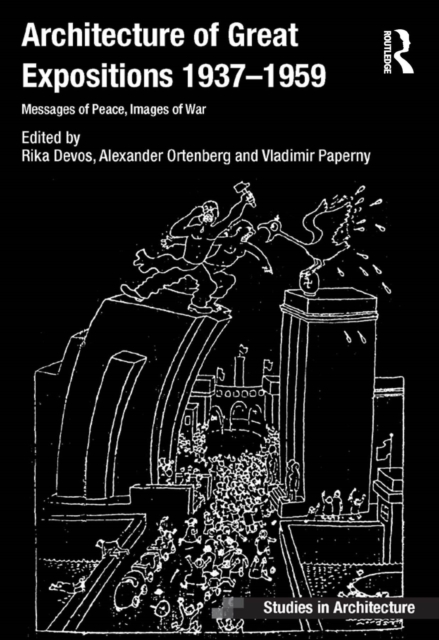
This book investigates architecture as a form of diplomacy in the context of the Second World War at six major European international and national expositions that took place between 1937 and 1959. The volume gives a fascinating account of architecture assuming the role of the carrier of war-related messages, some of them camouflaged while others quite frank. The famous standoffs between the Stalinist Russia and the Nazi Germany in Paris 1937, or the juxtaposition of the USSR and USA pavilions in Brussels 1958, are examples of very explicit shows of force. The book also discusses some less known - and more subtle - messages, revealed through an examination of several additional pavilions in both Paris and Brussels; of a series of expositions in Moscow; of the Universal Exhibition in Rome that was planned to open in 1942; and of London's South Bank Exposition of 1951: all of them related, in one way or another, to either an anticipation of the global war or to its horrific aftermaths. A brief discussion of three pre-World War II American expositions that are reviewed in the Epilogue supports this point. It indicates a significant difference in the attitude of American exposition commissioners, who were less attuned to the looming war than their European counterparts. The book provides a novel assessment of modern architecture's involvement with national representation. Whether in the service of Fascist Italy or of Imperial Japan, of Republican Spain or of the post-war Franquista regime, of the French Popular Front or of socialist Yugoslavia, of the arising FRG or of capitalist USA, of Stalinist Russia or of post-colonial Britain, exposition architecture during the period in question was driven by a deep faith in its ability to represent ideology. The book argues that this widespread confidence in architecture's ability to act as a propaganda tool was one of the reasons why Modernist architecture lent itself to the service of such different masters.
eBook
The Machine Age: Curation and Memory in Two U.S. Exhibits
Among the many complexities facing museum managers, establishing connections with new audiences and demonstrating the wider relevance of their institutions are particularly challenging. In 2018, two exhibitions-Cult of the Machine and The Train: RFK's Last Journey, both presented by institutions that do not focus specifically on the history of technology or the built environment-offered fresh readings of iconic works. This review examines these exhibitions, emphasizing the curatorial and exhibit design decisions that facilitated the presentation of innovative interpretive strategies.
Journal Article

Scandinavian Glass from Sweden, Finland, and Denmark
Glassworks throughout Scandinavia have many similarities, but each country had its own historical development. This article presents an introduction to the history of Scandinavian glass production in Sweden, Finland, and Denmark, and it demonstrates how the glassworks have a common industrial history, ranging from their initial establishment and entrepreneurship to the simultaneous closing of the factories around the year 2000. But this introduction also highlights regional differences resulting from exhibitions, sales fairs, competition between glassworks, local innovation, and the employment of great glass designers and artists.
Journal Article

California design 1930-1965 : living in a modern way
The heart of 'California Design' is the modern California home, famously characterized by open plans conducive to outdoor living. The layouts of modernist homes were intended to blur the distinction between indoors and out.
eBook

The Modern American Home as Soft Power: Finland, MoMA and the ‘American Home 1953’ Exhibition
This article uses rarely reviewed archival documentation to investigate the ‘American Home 1953’, an exhibition launched in Helsinki early in the cold war to celebrate the modern American domestic sphere. The author argues that the ‘American Home 1953’ does not conform to orthodox instances of American cultural transfer where a US donor institution might select US content for export and display in a host nation to impose certain American values or advance particular agendas. In this instance, the USA did not originate the idea for the ‘American Home 1953’. The exhibition comprised two independently organised subsections: Finland’s Finnish-American Society initiated the project to present Finnish viewers with the latest in American domestic appliances. In concert, Museum of Modern Art's Edgar Kaufmann, Jr., selected an artful display of American home wares, subtitled ‘American Design for Home and Decorative Use’ for the newly formed US Information Agency.
Journal Article

Industrial Design and the Czechoslovak Pavilion at EXPO '58: Artistic Autonomy, Party Control and Cold War Common Ground
The socialist industrial designs displayed in Czechoslovakia's EXPO '58 pavilion spoke a visual language understood on both sides of the Iron Curtain, making the pavilion a site of common ground between East and West. The showcase was also a point of convergence between Czechoslovak visual artists and Communist Party authorities who engaged in complex political negotiations in the years after Stalin's death. Visual artists vied for liberation from socialist realism's constraints, although they kept their demands within limits to avoid risking Party backlash. Communist Party leaders wanted domestic stability and saw improving the living standard as a tactic for insuring popular support. They increasingly perceived industrial design to be a visual-arts activity with special promise. Well-designed furniture, textiles, glass, ceramics and other consumer goods could generate state income useful for raising the living standard at home and earning hard currency abroad. The Party needed the designers' cooperation to achieve efficient, attractive production within the command economy. In the Brussels showcase communist authorities compromised with visual artists helping to insure the latter's support and success, demonstrating that culture in postwar Czechoslovakia was not merely imposed 'from above' by omnipotent authorities but could be the outcome of multidirectional negotiations between various competing interests.
Journal Article
Making a Spectacle of Restraint: The Deutschland Pavilion at the 1958 Brussels Exposition
The Deutschland pavilion at the 1958 Brussels World's Fair depicted West Germany not only as culturally and technologically modern but also as the antithesis of socialist East Germany and the disgraced Third Reich. International-style architecture and modernist exhibition design were mobilized as instruments of cultural soft power to convey these multiple messages. Hans Schwippert of the postwar German Werkbund choreographed exhibition design, deploying the miracle economy's modern consumer culture to celebrate the emergence of a post-Nazi society. Egon Eiermann, aided by Sep Ruf, designed the International-style pavilion, celebrated as the architecture of postwar modernity, but in fact derived from a precedent in Third Reich industrial architecture. As an exercise in cold war soft power, West Germany's Brussels pavilion celebrated the emergence of a West German consumer citizen, while suppressing the presence of a Third Reich past.
Journal Article

Sociolinguistic Interpretation of William Sumner Appleton's Building Conservation Concept in Contemporary Architectural Planning
Many of the original buildings have gradually declined because of the development of society and the adjustment of industrial structure. Protecting the classical architecture and restoring the original luster of a building to maintain its own youth has become a hot issue in the current architectural planning. In this paper, the performance of the core idea of building conservation in the specific design and planning was discussed through the in-depth understanding of William Sumner Appleton's architectural concept in building protection planning area. Moreover, the profound influence of the idea of building conservation in building conservation was summarized. The current pace of urbanization development process is rapid, thus, many of the original buildings are severely damaged because of many factors. The concept and thought of William Sumner Appleton were re-interpreted based on the design and planning method of World Expo industrial clusters in Shanghai. This study is of great significance for the promotion of historical building protection and concrete practice in our country.
Journal Article