
Catalogue Search | MBRL


Are you sure you want to remove the book from the shelf?

{{itemTitle}}
280,435
result(s) for
"Industrial management"
Sort by:


Good Jobs, Bad Jobs
Good Jobs, Bad Jobs provides an insightful analysis of how and why precarious employment is gaining ground in the labor market and the role these developments have played in the decline of the middle class. Kalleberg shows that by the 1970s, government deregulation, global competition, and the rise of the service sector gained traction, while institutional protections for workers—such as unions and minimum-wage legislation—weakened. Together, these forces marked the end of postwar security for American workers. The composition of the labor force also changed significantly; the number of dual-earner families increased, as did the share of the workforce comprised of women, non-white, and immigrant workers. Of these groups, blacks, Latinos, and immigrants remain concentrated in the most precarious and low-quality jobs, with educational attainment being the leading indicator of who will earn the highest wages and experience the most job security and highest levels of autonomy and control over their jobs and schedules. Kalleberg demonstrates, however, that building a better safety net—increasing government responsibility for worker health care and retirement, as well as strengthening unions—can go a long way toward redressing the effects of today’s volatile labor market. There is every reason to expect that the growth of precarious jobs—which already make up a significant share of the American job market—will continue. Good Jobs, Bad Jobs deftly shows that the decline in U.S. job quality is not the result of fluctuations in the business cycle, but rather the result of economic restructuring and the disappearance of institutional protections for workers. Only government, employers and labor working together on long-term strategies—including an expanded safety net, strengthened legal protections, and better training opportunities—can help reverse this trend.
eBook

The new Japanese firm as a hybrid organization
This book examines corporate reform in Japan by focusing on corporate governance and the employment system. Contrary to a prevailing assertion of radical change, it is revealed that actual change is gradual, and a new type of Japanese firm is generated by reform with gradual change. Throughout the book, Japanese firms are seen to be evolving through gradual institutional change. Chapter 1 discusses how Japanese corporate governance changed incrementally and cumulatively to rebuild management and restore corporate performance. Chapter 2 focuses on reform in work organization and discusses how performance-related pay was introduced in tandem with corporate governance reform. It is shown that the practice of long-term employment has been maintained despite the prolonged depression and mounting pressure to shift to shareholder-oriented corporate governance. Chapter 3 investigates how Japanese firms are diversified into four types, based on whether performance-related pay is introduced and whether long-term employment is maintained. The author demonstrates that major Japanese firms reconstruct their organization as hybrid structures based on a combination of long-term employment and performance-related pay. Chapter 4 investigates how performance-related pay actually operates. It is analyzed by distinguishing the three main objectives to be attained by performance pay: succeeding in individual performance, contributing to overall organization performance, and meeting the challenge of new tasks. Finally, Chapter 5 investigates how employees react to changes in corporate governance. Using survey data, the book shows that Japanese employees approve of increasing shareholder value, regarding it as corporate value. They not only approve the monitoring of management by shareholders, but also demand a part in the monitoring. Employees seek to be engaged in corporate governance--a true challenge for a Japanese corporation.
Book

Safety-I and safety-II
Much more than a technical book. Erik's work is a well documented journey into the multiple interactions between safety, work and human nature. A timely contribution to vindicate human beings and their variability from the one sided focus on the evils of human error. A groundbreaking look at 'the other story' that will certainly contribute to safer and more productive workplaces.
Dr Alejandro Morales, Mutual Seguridad, Chile
Safety needs a new maturity. We can no longer improve by simply doing what we have been doing, even by doing it better. DR Hollnagel brings forth new distinctions, interpretations, and narratives that will allow safety to progress to new unforeseen levels. Safety-II is more than just incident and accident prevention. A must read for every safety professional.
Tom McDaniel, Global Manager Zero Harm and Human Performance, Siemens Energy, Inc., USA
eBook

Health and safety : risk management
\"Health and Safety: Risk Management is the clearest and most comprehensive book on risk management available today. This newly revised fifth edition takes into account new developments in legislation, standards and good practice. ISO 45001, the international health and safety management system Standard is given comprehensive treatment, and the latest ISO 9004 and ISO 19011 have also been addressed. The book is divided into four main parts. Part 1.1 begins with a basic introduction to the techniques of health and safety risk management and continues with a description of ISO 45001. Part 1.2 covers basic human factors including how the sense organs work and the psychology of the individual. Part 2.1 deals with more advanced techniques of risk management including advanced incident investigation, audit and risk assessment, and Part 2.2 covers a range of advanced human factors topics including human error and decision making. This authoritative treatment of health and safety risk management is essential reading for both students working towards degrees, diplomas and postgraduate or vocational qualifications, and experienced health and safety professionals, who will find it invaluable as a reference\"-- Provided by publisher.
Book

Simulation modeling and analysis with Arena
Simulation Modeling and Analysis with Arena is a highly readable textbook which treats the essentials of the Monte Carlo discrete-event simulation methodology, and does so in the context of a popular Arena simulation environment.\" It treats simulation modeling as an in-vitro laboratory that facilitates the understanding of complex systems and experimentation with what-if scenarios in order to estimate their performance metrics. The book contains chapters on the simulation modeling methodology and the underpinnings of discrete-event systems, as well as the relevant underlying probability, statistics, stochastic processes, input analysis, model validation and output analysis. All simulation-related concepts are illustrated in numerous Arena examples, encompassing production lines, manufacturing and inventory systems, transportation systems, and computer information systems in networked settings. · Introduces the concept of discrete event Monte Carlo simulation, the most commonly used methodology for modeling and analysis of complex systems· Covers essential workings of the popular animated simulation language, ARENA, including set-up, design parameters, input data, and output analysis, along with a wide variety of sample model applications from production lines to transportation systems· Reviews elements of statistics, probability, and stochastic processes relevant to simulation modeling* Ample end-of-chapter problems and full Solutions Manual* Includes CD with sample ARENA modeling programs
eBook

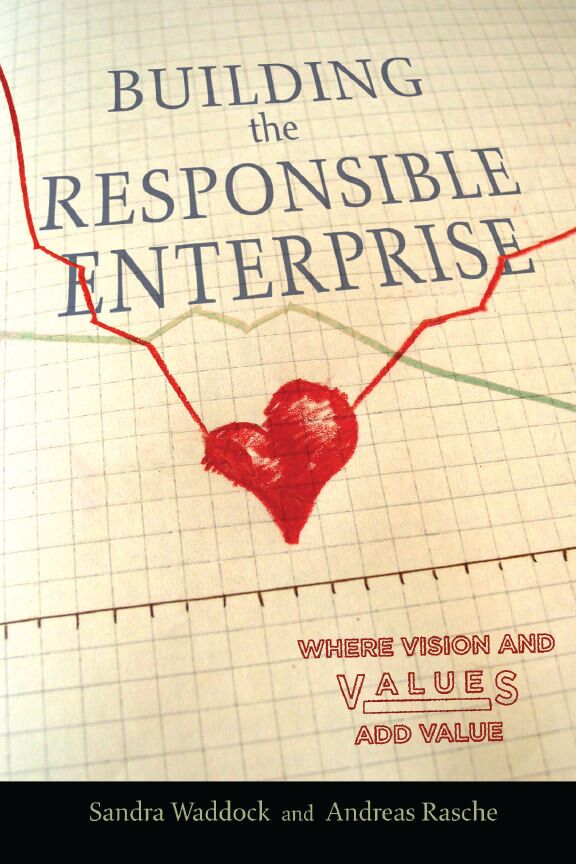
Building the responsible enterprise : where vision and values add value
Building the Responsible Enterprise provides students and practitioners with a practical, yet academically rooted, introduction to the state-of-the-art in sustainability and corporate social responsibility.
The book consists of four parts, highlighting different aspects of corporate responsibility. Part I discusses the context in which corporate responsibility occurs. Part II looks at three critical issues: the development of vision at the individual and organizational levels, the integration of values into the responsible enterprise, and the ways that these building blocks create added value for a firm. Part III highlights the actual management practices that enable enterprises to achieve excellence, focusing on the roles that stakeholder relationships play in improving performance. The book concludes with a conversation about responsible management in the global village, examining the emerging infrastructure in which enterprise finds itself today. Throughout the text, cases exemplify key concepts and highlight companies that are guiding us into tomorrow's business environment.
eBook

Rethinking Private Authority
Rethinking Private Authorityexamines the role of non-state actors in global environmental politics, arguing that a fuller understanding of their role requires a new way of conceptualizing private authority. Jessica Green identifies two distinct forms of private authority--one in which states delegate authority to private actors, and another in which entrepreneurial actors generate their own rules, persuading others to adopt them.
Drawing on a wealth of empirical evidence spanning a century of environmental rule making, Green shows how the delegation of authority to private actors has played a small but consistent role in multilateral environmental agreements over the past fifty years, largely in the area of treaty implementation. This contrasts with entrepreneurial authority, where most private environmental rules have been created in the past two decades. Green traces how this dynamic and fast-growing form of private authority is becoming increasingly common in areas ranging from organic food to green building practices to sustainable tourism. She persuasively argues that the configuration of state preferences and the existing institutional landscape are paramount to explaining why private authority emerges and assumes the form that it does. In-depth cases on climate change provide evidence for her arguments.
Groundbreaking in scope,Rethinking Private Authoritydemonstrates that authority in world politics is diffused across multiple levels and diverse actors, and it offers a more complete picture of how private actors are helping to shape our response to today's most pressing environmental problems
eBook