
Catalogue Search | MBRL


Are you sure you want to remove the book from the shelf?

{{itemTitle}}
155
result(s) for
"Inflationary universe."
Sort by:

The amazing unity of the universe : and its origin in the big bang
In the first chapters the author describes how our knowledge of the position of Earth in space and time has developed, thanks to the work of many generations of astronomers and physicists. He discusses how our position in the Galaxy was discovered, and how in 1929, Hubble uncovered the fact that the Universe is expanding, leading to the picture of the Big Bang. He then explains how astronomers have found that the laws of physics that were discovered here on Earth and in the Solar System (the laws of mechanics, gravity, atomic physics, electromagnetism, etc.) are valid throughout the Universe. This is illustrated by the fact that all matter in the Universe consists of atoms of the same chemical elements that we know on Earth. This unity is all the more surprising when one realizes that in the original Big Bang theory, different parts of the Universe could never have communicated with each other.
Book

From Cosmology to Cold Atoms: Observation of Sakharov Oscillations in a Quenched Atomic Superfluid
Predicting the dynamics of many-body systems far from equilibrium is a challenging theoretical problem. A long-predicted phenomenon in hydrodynamic nonequilibrium systems is the occurrence of Sakharov oscillations, which manifest in the anisotropy of the cosmic microwave background and the large-scale correlations of galaxies. Here, we report the observation of Sakharov oscillations in the density fluctuations of a quenched atomic superfluid through a systematic study in both space and time domains and with tunable interaction strengths. Our work suggests a different approach to the study of nonequilibrium dynamics of quantum many-body systems and the exploration of their analogs in cosmology and astrophysics.
Journal Article

Cosmic inflation explained
\"Cosmic inflation is the theory that the early universe went through fast, exponential expansion for a fraction of a second after the Big Bang and then slowed down to the current rate of expansion. Simplified explanations of complex scientific concepts such as dark energy, dark matter, and the cosmic microwave background and dynamic images will help students comprehend how the study of cosmic inflation has reshaped our understanding of how the universe was born, evolved, and might be in the future. This title correlates with the Next Generation Science Standards' emphasis on scientific collection and analysis of data and evidence-based theories. Informative sidebars explore related timely topics in depth, while a Further Reading section provides several resources for additional study.\"-- Provided by publisher.
BOOK

Observation of universal dynamics in a spinor Bose gas far from equilibrium
Predicting the dynamics of quantum systems far from equilibrium represents one of the most challenging problems in theoretical many-body physics
1
,
2
. While the evolution of a many-body system is in general intractable in all its details, relevant observables can become insensitive to microscopic system parameters and initial conditions. This is the basis of the phenomenon of universality. Far from equilibrium, universality is identified through the scaling of the spatio-temporal evolution of the system, captured by universal exponents and functions. Theoretically, this has been studied in examples as different as the reheating process in inflationary Universe cosmology
3
,
4
, the dynamics of nuclear collision experiments described by quantum chromodynamics
5
,
6
, and the post-quench dynamics in dilute quantum gases in non-relativistic quantum field theory
7
–
11
. However, an experimental demonstration of such scaling evolution in space and time in a quantum many-body system has been lacking. Here we observe the emergence of universal dynamics by evaluating spatially resolved spin correlations in a quasi-one-dimensional spinor Bose–Einstein condensate
12
–
16
. For long evolution times we extract the scaling properties from the spatial correlations of the spin excitations. From this we find the dynamics to be governed by an emergent conserved quantity and the transport of spin excitations towards low momentum scales. Our results establish an important class of non-stationary systems whose dynamics is encoded in time-independent scaling exponents and functions, signalling the existence of non-thermal fixed points
10
,
17
,
18
. We confirm that the non-thermal scaling phenomenon involves no fine-tuning of parameters, by preparing different initial conditions and observing the same scaling behaviour. Our analogue quantum simulation approach provides the basis with which to reveal the underlying mechanisms and characteristics of non-thermal universality classes. One may use this universality to learn, from experiments with ultracold gases, about fundamental aspects of dynamics studied in cosmology and quantum chromodynamics.
The emergence of universal dynamics far from equilibrium is observed by evaluating spatially resolved spin correlations in a quasi-one-dimensional spinor Bose–Einstein condensate.
Journal Article

Earth-mass dark-matter haloes as the first structures in the early Universe
Make the rough with the smooth
The early Universe was almost completely smooth and homogeneous. But tiny fluctuations were hidden in the matter distribution, and 20 million years after the Big Bang these began to undergo gravitational collapse. Key to what happened next is the nature of the dark matter that makes up the bulk of the Universe. New supercomputer calculations, based on the assumption that a hypothetical particle known as the neutralino is the main component of the dark matter, suggest that the first structures to form in the Universe were Jupiter-mass dark matter haloes the size of the Solar System. The calculations suggest there are enough of these left for our Solar System to pass through a cloud of dark matter every 10,000 years. These results have implications for the many experiments under way and in the planning stage that aim to identify the nature of the dark matter.
The Universe was nearly smooth and homogeneous before a redshift of
z
= 100, about 20 million years after the Big Bang
1
. After this epoch, the tiny fluctuations imprinted upon the matter distribution during the initial expansion began to collapse because of gravity. The properties of these fluctuations depend on the unknown nature of dark matter
2
,
3
,
4
, the determination of which is one of the biggest challenges in present-day science
5
,
6
,
7
. Here we report supercomputer simulations of the concordance cosmological model, which assumes neutralino dark matter (at present the preferred candidate), and find that the first objects to form are numerous Earth-mass dark-matter haloes about as large as the Solar System. They are stable against gravitational disruption, even within the central regions of the Milky Way. We expect over 10
15
to survive within the Galactic halo, with one passing through the Solar System every few thousand years. The nearest structures should be among the brightest sources of γ-rays (from particle–particle annihilation).
Journal Article
Dodecahedral space topology as an explanation for weak wide-angle temperature correlations in the cosmic microwave background
The current ‘standard model’ of cosmology posits an infinite flat universe forever expanding under the pressure of dark energy. First-year data from the Wilkinson Microwave Anisotropy Probe (WMAP) confirm this model to spectacular precision on all but the largest scales
1
,
2
. Temperature correlations across the microwave sky match expectations on angular scales narrower than 60° but, contrary to predictions, vanish on scales wider than 60°. Several explanations have been proposed
3
,
4
. One natural approach questions the underlying geometry of space—namely, its curvature
5
and topology
6
. In an infinite flat space, waves from the Big Bang would fill the universe on all length scales. The observed lack of temperature correlations on scales beyond 60° means that the broadest waves are missing, perhaps because space itself is not big enough to support them. Here we present a simple geometrical model of a finite space—the Poincaré dodecahedral space—which accounts for WMAP's observations with no fine-tuning required. The predicted density is
Ω
0
≈ 1.013 > 1, and the model also predicts temperature correlations in matching circles on the sky
7
.
Journal Article
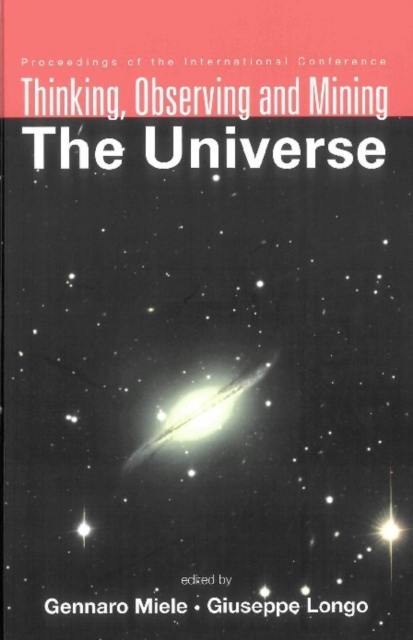
Thinking, Observing and Mining the Universe: Proceedings of the International Conference : Sorrento, Italy, 22-27 September 2003
This is a collection of review articles and more specialized papers on the main issues of early universe physics. Both theoretical and experimental fields of research are dealt with.Contents:Direct Search for Wimps (R Bernabei et al.)Ultra High Energy Cosmic Rays (P Blasi)Structure and Evolution of Cluster Galaxies (G Busarello et al.)Status of Ligo Interferometers (E D'Ambrosio)The Cosmic Renaissance: Reionization Era as the New Cosmological Frontier (S G Djorgovski)High-Energy Neutrino Astronomy (F Halzen)Microlensing Towards the LMC (P Jetzer)Present and Future Neutrino Oscillation Experiments (T Kajita)Axion Dark Matter (E Massó)Dark Matter and Supersymmetry (S Scopel)Curvature Quintessence (S Capozziello et al.)Van Der Waals Quintessence (S Capozziello et al.)Effects of BBN on Population III Stars (F Iocco)An Updated Nuclear Reaction Network for BBN (P D Serpico)Active Star-Forming Galaxies in Pairs in the 2DF (G Sorrentino et al.)and other papersReadership: Particle physicists interested in the early universe, as well as astrophysicists and cosmologists.
eBook
A correlation between the cosmic microwave background and large-scale structure in the Universe
Observations of distant supernovae and the fluctuations in the cosmic microwave background (CMB) indicate that the expansion of the Universe may be accelerating
1
under the action of a ‘cosmological constant’ or some other form of ‘dark energy’. This dark energy now appears to dominate the Universe and not only alters its expansion rate, but also affects the evolution of fluctuations in the density of matter, slowing down the gravitational collapse of material (into, for example, clusters of galaxies) in recent times. Additional fluctuations in the temperature of CMB photons are induced as they pass through large-scale structures
2
and these fluctuations are necessarily correlated with the distribution of relatively nearby matter
3
. Here we report the detection of correlations between recent CMB data
4
and two probes of large-scale structure: the X-ray background
5
and the distribution of radio galaxies
6
. These correlations are consistent with those predicted by dark energy, indicating that we are seeing the imprint of dark energy on the growth of structure in the Universe.
Journal Article

Reconstructing warm inflation
The reconstruction of a warm inflationary universe model from the scalar spectral index nS(N) and the tensor to scalar ratio r(N) as a function of the number of e-folds N is studied. Under a general formalism we find the effective potential and the dissipative coefficient in terms of the cosmological parameters nS and r considering the weak and strong dissipative stages under the slow roll approximation. As a specific example, we study the attractors for the index nS given by nS-1∝N-1 and for the ratio r∝N-2, in order to reconstruct the model of warm inflation. Here, expressions for the effective potential V(ϕ) and the dissipation coefficient Γ(ϕ) are obtained.
Journal Article