
Catalogue Search | MBRL


Are you sure you want to remove the book from the shelf?

{{itemTitle}}
18,561
result(s) for
"Information technology Quality control"
Sort by:


Operational risk management
Models and methods for operational risks assessment and mitigation are gaining importance in financial institutions, healthcare organizations, industry, businesses and organisations in general. This book introduces modern Operational Risk Management and describes how various data sources of different types, both numeric and semantic sources such as text can be integrated and analyzed. The book also demonstrates how Operational Risk Management is synergetic to other risk management activities such as Financial Risk Management and Safety Management. Operational Risk Management: a practical approach to intelligent data analysis provides practical and tested methodologies for combining structured and unstructured, semantic-based data, and numeric data, in Operational Risk Management (OpR) data analysis. Key Features: The book is presented in four parts: 1) Introduction to OpR Management, 2) Data for OpR Management, 3) OpR Analytics and 4) OpR Applications and its Integration with other Disciplines. Explores integration of semantic, unstructured textual data, in Operational Risk Management. Provides novel techniques for combining qualitative and quantitative information to assess risks and design mitigation strategies. Presents a comprehensive treatment of \"near-misses\" data and incidents in Operational Risk Management. Looks at case studies in the financial and industrial sector. Discusses application of ontology engineering to model knowledge used in Operational Risk Management. Many real life examples are presented, mostly based on the MUSING project co-funded by the EU FP6 Information Society Technology Programme. It provides a unique multidisciplinary perspective on the important and evolving topic of Operational Risk Management. The book will be useful to operational risk practitioners, risk managers in banks, hospitals and industry looking for modern approaches to risk management that combine an analysis of structured and unstructured data. The book will also benefit academics interested in research in this field, looking for techniques developed in response to real world problems.
eBook
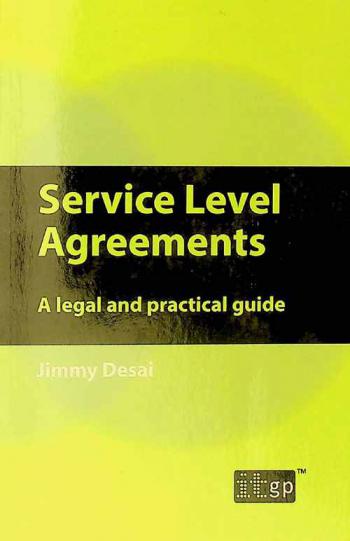
Service level agreements : a legal and practical guide
Annotation Make your SLA work for you _ Read this essential guide to SLAs today!
A wide range of industry sectors will outsource service provision (for example, banking, pharmaceuticals, and insurance companies). This can happen where an organisation outsources its IT payroll needs, its helpdesk and IT maintenance requirements, its payment processing, or its whole IT function.
The key risk
The key risk for an organisation that enters into an outsourcing transaction, are that the services that it receives from the supplier will be worse than the services they were receiving before, or that the cost savings that were anticipated or promised, are not achieved.
The SLA
To try and avoid this scenario, the outsourcing contract should include a Service Level Agreement (SLA). The SLA must be drafted to govern the standard of service that you require, including the cost of those services and the consequences of not achieving pre-agreed standards.
The wider environment
While Service Level Agreements are a key method, within ITIL, for setting out how two parties have agreed that a specific service (usually, but not necessarily, IT-related) will be delivered by one to the other, and the standards or levels to which it will be delivered, the basic concept is now far more widely applied than just in ITIL® and ITSM environments.
This pocket guide provides information and guidance on SLAs to those in the wider environment, from a legal and practical view point.
The benefits and the pitfalls
Identifying some of the benefits and the pitfalls that an organisation can encounter when negotiating and drafting SLAs, this pocket guide provides an overview of SLAs, highlighting typical scenarios that can arise, and provides information on typical solutions that have been adopted by other organisations.
Read this pocket guide to _
* Understand what an SLA is and why you need one
When negotiating any type of service-related deal (including any IT outsourcing deal), it is essential that sufficient time is devoted to ensuring that the service is of sufficient quality and that this is recorded in an SLA.
* Understand where SLAs go wrong.
SLAs can go wrong for a number of reasons. For example, the SLA may not reflect reality, your service requirements may not be defined properly, or there may be too many service levels and service level targets which can then become difficult to manage.
* Learn how to build foundations for the SLA.
There are elements that you should be considering well before even engaging with potential suppliers. This pocket guide details what your organisation should consider, in order to find the proposal which most closely matches its needs.
* Understand the issues to consider when drafting the SLA.
This pocket guide covers the issues to consider when drafting an SLA, as there are certain provisions in SLAs which either should, or should not, appear.
By reading this a short, legal and practical guide to SLAs, you should be able to quickly come up to speed with some of the legal and practical issues that might arise. Negotiating the SLA and putting the SLA into action are also discussed in the pocket guide. Whilst short and easy to digest, case references and weblinks have been provided in the text so readers can find out more information about SLAs.
A wide range of industry sectors will outsource service provision (for example, banking, pharmaceuticals, and insurance companies). This can happen where an organisation outsources its IT payroll needs, its helpdesk and IT maintenance requirements, its payment processing, or its whole IT function.
The key risk
The key risk for an organisation that enters into an outsourcing transaction, are that the services that it receives from the supplier will be worse than the services they were receiving before, or that the cost savings that were anticipated or promised, are not achieved.
The SLA
To try and avoid this scenario, the outsourcing contract should include a Service Level Agreement (SLA). The SLA must be drafted to govern the standard of service that you require, including the cost of those services and the consequences of not achieving pre-agreed standards.
The wider environment
While Service Level Agreements are a key method, within ITIL, for setting out how two parties have agreed that a specific service (usually, but not necessarily, IT-related) will be delivered by one to the other, and the standards or levels to which it will be delivered, the basic concept is now far more widely applied than just in ITIL® and ITSM environments.
This pocket guide provides information and guidance on SLAs to those in the wider environment, from a legal and practical view point.
The benefits and the pitfalls
Identifying some of the benefits and the pitfalls that an organisation can encounter when negotiating and drafting SLAs, this pocket guide provides an overview of SLAs, highlighting typical scenarios that can arise, and provides information on typical solutions that have been adopted by other organisations.
Read this pocket guide to _
* Understand what an SLA is and why you need one
When negotiating any type of service-related deal (including any IT outsourcing deal), it is essential that sufficient time is devoted to ensuring that the service is of sufficient quality and that this is recorded in an SLA.
* Understand where SLAs go wrong.
SLAs can go wrong for a number of reasons. For example, the SLA may not reflect reality, your service requirements may not be defined properly, or there may be too many service levels and service level targets which can then become difficult to manage.
* Learn how to build foundations for the SLA.
There are elements that you should be considering well before even engaging with potential suppliers. This pocket guide details what your organisation should consider, in order to find the proposal which most closely matches its needs.
* Understand the issues to consider when drafting the SLA.
This pocket guide covers the issues to consider when drafting an SLA, as there are certain provisions in SLAs which either should, or should not, appear.
By reading this a short, legal and practical guide to SLAs, you should be able to quickly come up to speed with some of the legal and practical issues that might arise. Negotiating the SLA and putting the SLA into action are also discussed in the pocket guide. Whilst short and easy to digest, case references and weblinks have been provided in the text so readers can find out more information about SLAs.
Book

Integrated Measurement - KPIs and Metrics for ITSM
Companies often turn to Key Performance Indicators (KPIs) to measure performance, but there is a common misconception that the mere act of measurement will change behavior and improve performance. This book is one of a series covering the implementation of new processes within an organization and how to facilitate behavior changes to make the project a success. This volume deals with the implementation of a KPI management system. Integrated Measurement – KPIs and Metrics for ITSM cleverly utilizes a narrative story to make the subject matter accessible and engaging for the reader. The characters are fictitious, but the story comes from the author’s own experience and real third party accounts. Each chapter ends with conclusions drawn from events in the story, giving the reader a wealth of practical advice on the pitfalls to anticipate and avoid. Readers with little or no ITIL® background will find this book interesting, entertaining and extremely useful in understanding the keys to a successful implementation of a KPI management system.
eBook


Operational risk management : a complete guide to a successful operational risk framework
Praise for Operational Risk and Regulation \"Boards, regulators, and shareholders have heightened their expectations for effective enterprise-level operational risk management. This comprehensive and practical guide will help operational risk managers at all levels develop their tools and frameworks to meet these expectations.\" -BEN GOLUB, Chief Risk Officer, BlackRock \"This high-quality text will provide a solid foundation to any student of operational risk. Once you've read this book, you'll find it will serve as an excellent reference whether you're new to the subject or an established operational risk expert.\" -BILL POPP, Operational Risk Expert \"Philippa has leveraged her vast experience in implementing operational risk management frameworks at major financial institutions to develop a practical guide for both new and tenured operational risk managers. She uses easy-to-understand examples, highlights the pros and cons of different tactical approaches, and offers a clear road map for success. This guide should be part of a core training curriculum for all operational risk managers. I will be referencing it for years to come.\" -SPYRO KARETSOS, Director of Enterprise Risk Management, The Vanguard Group \"Philippa did a skillful job at articulating Operational Risk discipline from strategic design to practical implementation. Her deep industry experiences have made this book a must read for understanding Operational Risk Management and related practices.\" -DAVID YE, Chief Risk Officer, State Street Global Markets.
eBook


Ten Steps to ITSM Success
This book provides guidance on implementing ITSM Best Practices in an organization based on the authors’ real-world experiences. Advice is delivered through a Ten-Step approach, with each step building upon the successes of its predecessors. Ten Steps to ITSM Success helps IT to prepare for this role by providing a detailed and practical guide to implementing ITSM best practices. It is aimed at ITSM practitioners and consultants, but will also be of interest to IT Directors and C-suite executives looking to transform the role of IT into a value-creating business partner, to establish a service management culture, and to drive improvements in their respective organizations. This book is a co-publication with itSMF USA and is the second book in the Thought Leadership Series
eBook