
Catalogue Search | MBRL


Are you sure you want to remove the book from the shelf?

{{itemTitle}}
87,613
result(s) for
"Infringement"
Sort by:

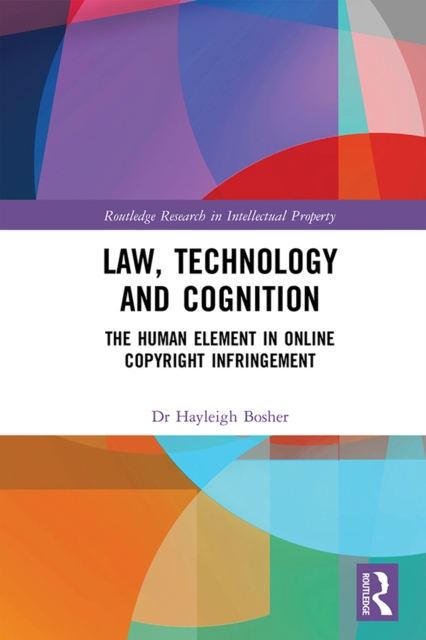
Law, Technology and Cognition
This book considers a new approach to online copyright infringement. Rather than looking at the subject within a purely technological context, it provides legal analysis from a human perspective. This book highlights that there are three key instances in which the capacity of a human mind intersects with the development of copyright regulation: (1) the development of copyright statutory law; (2) the interpretation of the copyright statutory law the judiciary; and (3) human interaction with new technology.
Using a novel framework for constructing digital perspectives, the author, Dr Hayleigh Bosher, analyses the laws relating to online copyright infringement. She provides insights into why the law appears as it does, shedding light on the circumstances of how it came to pass and demonstrates a clear malfunction in the interpretation and application of copyright law to online activities that derives from the disconnect between the technological and the human perspectives. The book proposes putting the human element back into copyright analysis to enable the return of reason where it has been lost, and provide a clearer, more consistent and fair legal regulation of online copyright infringement.
Law, Technology and Cognition: The Human Element in Online Copyright Infringement will be of interest to students, academics, researchers, as well as practitioners.
eBook


Copyright Infringement Test (Re)visited: U.S. Spillover into China Yielding a Similar Test?
One of the most pivotal doctrines in copyright law is its infringement test, which determines whether a defendant’s acts violate reproduction rights. This test, which continues to plague U.S. copyright law, includes two widely adopted and influential prongs: (1) factual copying; and (2) improper appropriation. To establish factual copying, U.S. courts allow a sliding scale of proof between the defendant’s access to the copyrighted work and similarities between the defendant’s and plaintiff’s works. The improper appropriation prong requires the similarities to reach a substantial level than is deemed improper. However, both prongs are fervently discussed, questioned, and criticized by U.S. courts, scholars, and practitioners. These critics neither form a unified understanding of each prong nor share similar viewpoints on the test’s desirability and potential reform. Despite the test’s intricate complications, its influence extends to other jurisdictions due to the global “reach” of U.S. copyright law. China, a jurisdiction that has adopted many doctrines and rules from U.S. copyright law, seemingly uses a similar copyright infringement test: the rule of “substantial similarity” plus “access.” The strikingly similar terminology, supported by anecdotal evidence, suggests a direct legal transplantation of this test from the U.S. to China. This observation implies that China essentially shares the same test as the U.S. due to this legal transplantation. However, positive discussions of China’s law in books andempirical explorations of the law in practice in this Article reveal substantial differences from the U.S. version, despite the similar terminology, which remain unnoticed and underexplored in current literature. Although some spillover from the U.S. test to China is acknowledged, the similarities noted in the current literature are quite superficial. These differences raise several unexplored questions: Should China’s test draw further from the U.S. to enhance future improvements? Does the Chinese version function effectively in practice and withstand theoretical scrutiny? If not, what should be the future direction for the Chinese version based on comparative insights? Should China consider a direct transplantation of the entire U.S. test in the future? This Article unravels the differences between the U.S. and Chinese infringement tests and addresses these questions. It delves into the history of how the “substantial similarity” plus “access” test was introduced to Chinese copyright law and its relationship with the superficially similar U.S. test, indicating the potential spillover. It also offers some empirical evidence based on Chinese court cases applying the test to see how it functions in practice, with a particular focus on whether the Chinese test achieves similar outcomes to the U.S. test. The Article attempts to reveal whether the Chinese version achieves the intended function of copyright infringement tests and withstands theoretical discussions. This Article argues that the Chinese version is more desirable than the U.S. version for China. One reason is that the Chinese version better aligns with China’s civil procedure law, which differs significantly from U.S. law. Also, the Chinese version can address the issues and problems identified in the current U.S. tests. Therefore, there should be caution about suggesting any future transplantation from the U.S. However, this Article acknowledges the vagueness and problems of the Chinese version and proposes a reformed test for Chinese law to better achieve its intended functions.
Journal Article


Hands Off My Brand! The Financial Consequences of Protecting Brands Through Trademark Infringement Lawsuits
Well-known brands are frequently imitated, misused, or tampered with. Firms facing these threats routinely turn to the legal system and file trademark infringement lawsuits in an attempt to prevent revenue losses and brand equity dilution. In this article, the authors address the largely unexplored issue of brand protection. First, they categorize all major types of trademark infringement. Second, using signaling and prospect theories, they present a conceptual model that outlines the financial consequences of defending a brand in court. The authors test the predictions of this framework using a large sample of trademark infringement lawsuits and find that although investors react negatively in the short term to firms' filing and even to firms' winning such cases, the long-term performance of firms that successfully leverage the legal system to protect their brands is positive.
Journal Article

Brand protection in the online world : a comprehensive guide
For those running e-commerce websites there are three ways to increase sales: increasing the quantity of visitors; increasing the percentage of visitors who buy from the site; and increasing the amount that visitors spend when they buy. E-commerce Website Optimization goes beyond simply increasing traffic, helping readers to improve conversion rates, increase ROI from online marketing campaigns, and generate higher levels of repeat business. It brings together usability, analytics and persuasion to offer a straightforward and detailed 5-step methodology of how to use the tools and techniques of Conversion Rate Optimization (CRO) to increase the e-commerce value of websites. Grounded in the latest theory and research, this will help readers to be well-informed and confident to make the right choices. Backed up with a range of invaluable case studies, E-commerce Website Optimization is perfect for those seeking to implement a data-driven ethos to their organization's e-commerce programme, based on market-tested and robust split-test methodology used across a range of commercial businesses. It supports all those responsible for online sales within an organization, be they the Chief Digital Officer, Head of Online Sales or E-commerce; or entrepreneurs and owners of small businesses deriving a substantial proportion of revenue from e-commerce.
Book
