
Catalogue Search | MBRL


Are you sure you want to remove the book from the shelf?

{{itemTitle}}
7,214
result(s) for
"Inheritance and succession"
Sort by:

The man must marry
Trying to escape marriage, they are snared by love. When Sam Sinclair's self-made millionaire grandfather sends Willa Kent, a woman none of the three Sinclair brothers have even heard of, as his proxy to an ultra-important meeting of the Sinclair shipping company, most people would think the old man had lost his marbles. But Sam knows his grandfather too well. For some reason, the wily old man has decided that one of his three grandsons should marry Willa, and this is his way of trying to force the issue ... So Willa and Sam team up on what seems like a wild-goose chase to find some loophole in Grandfather Sinclair's crazy notion. But as Sam crews Willa's yacht en route to Maine, he finds to his surprise that his grandfather's offbeat scheme is growing more attractive by the moment. Willa is smart, beautiful ... and has a wild streak that sends them soaring together above the clouds. But Willa isn't about to let Sam fly away with her heart until she knows his true motives. If the man wants to marry for money, then the woman in her says that first he must fall in love.
Book
Isaeus
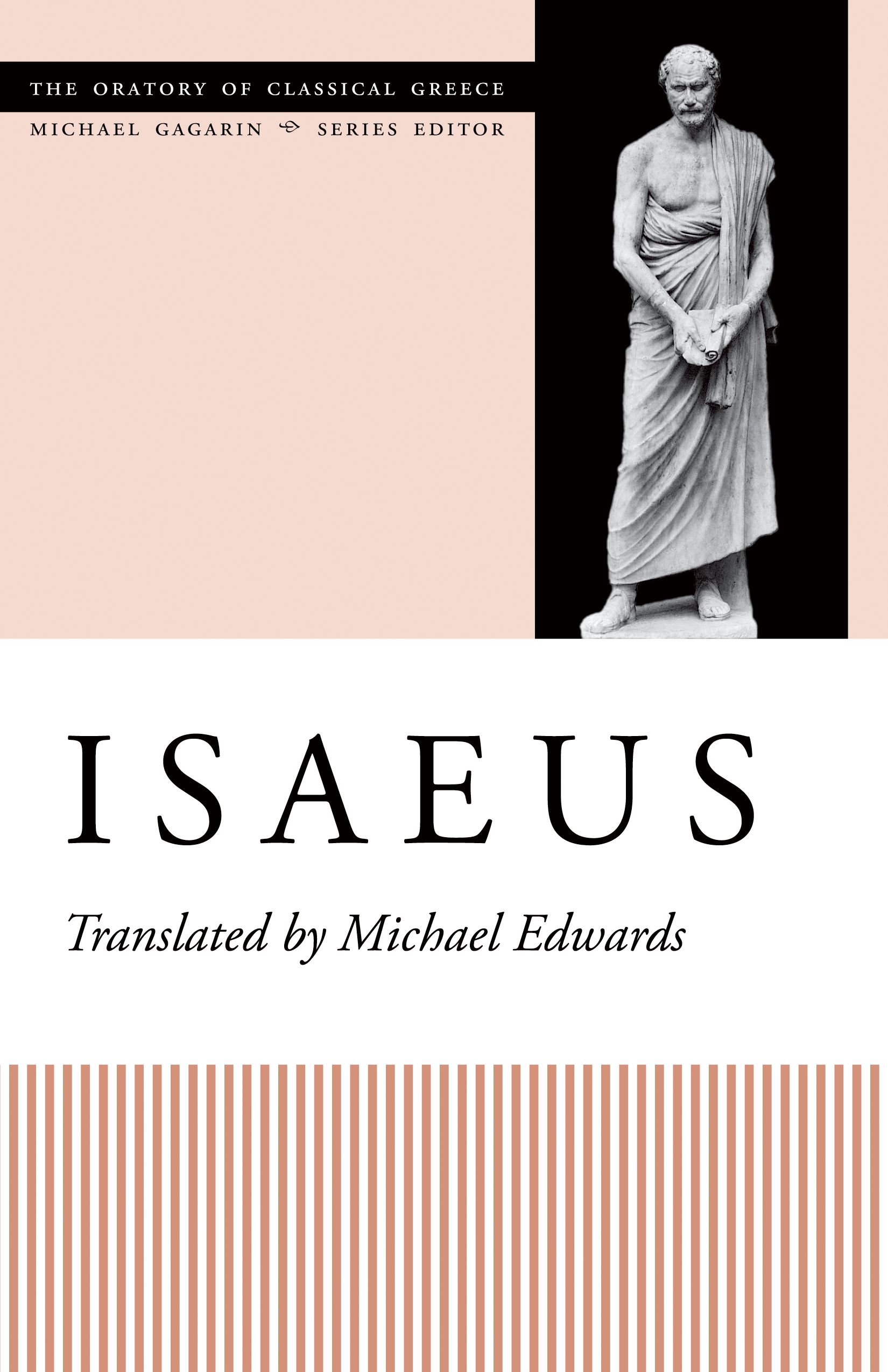
This is the eleventh volume in the Oratory of Classical Greece. This series presents all of the surviving speeches from the late fifth and fourth centuries BC in new translations prepared by classical scholars who are at the forefront of the discipline. These translations are especially designed for the needs and interests of today's undergraduates, Greekless scholars in other disciplines, and the general public. Classical oratory is an invaluable resource for the study of ancient Greek life and culture. The speeches offer evidence on Greek moral views, social and economic conditions, political and social ideology, law and legal procedure, and other aspects of Athenian culture that have recently been attracting particular interest: women and family life, slavery, and religion, to name just a few. The orator Isaeus lived during the fourth century BC and was said to be the teacher of Demosthenes, Athens' most famous orator. Of the fifty or more speeches he is believed to have written, eleven survive in whole, one as a large fragment, and others as smaller fragments. This volume presents all the surviving works of Isaeus. The speeches mainly deal with inheritances and are a vital source of information regarding Greek law in this important area. In addition to translating the speeches, Michael Edwards provides a general introduction to Isaeus and Athenian inheritance law, as well as specific introductions and notes for each speech.
eBook

A tangled web
\"It all begins with Great Aunt Becky and her infamous prized possession: a legendary heirloom jug. After her death, everyone wants it. But the name of the new owner won't be revealed for one year. In the next twelve months, scandals, quarrels and love affairs abound--with the jug at the center of it all\"-- Provided by publisher.
BOOK

Heirs, Kin, and Creditors in Renaissance Florence
This study, based on Florentine repudiations of inheritance, reveals that inheritance was not simply an automatic process where the recipients were passive, if grateful. In influential European societies of the past, it was in fact a process that continued long after the deceased's death. Heirs also had options: at the least, to reject a burdensome patrimony, but also to manoeuvre property to others and to avoid (at times deceptively, if not fraudulently) the claims of others to portions of the estate. Repudiation was a vestige of Roman law that once again became a viable legal institution with the revival of Roman law in the Middle Ages. Florentines incorporated repudiation into their strategies of adjustment after death, showing that they were not merely passive recipients of what came their way. Further, these strategies fostered family goals, including continuity across the generations.
eBook

Who is Simon Warwick?
Lord Charlton has died and left his wealth to his nephew, Simon, not seen since he was a baby (adopted by Americans after his parents were killed in an air raid). It is perhaps not surprising that multiple \"Simon Warwicks\" turn up to claim the cash. Inspector Henry Tibbett must identify the real Simon and at the same time solve the murder of one possible heir.
Book

Law, Literature, and the Transmission of Culture in England, 1837–1925
Focusing on the last will and testament as a legal, literary, and cultural document, Cathrine O. Frank examines fiction of the Victorian and Edwardian eras alongside actual wills, legal manuals relating to their creation, case law regarding their administration, and contemporary accounts of curious wills in periodicals. Her study begins with the Wills Act of 1837 and poses two basic questions: What picture of Victorian culture and personal subjectivity emerges from competing legal and literary narratives about the will, and how does the shift from realist to modernist representations of the will accentuate a growing divergence between law and literature? Frank’s examination of works by Emily Brontë, George Eliot, Charles Dickens, Wilkie Collins, Anthony Trollope, Samuel Butler, Arnold Bennett, John Galsworthy, and E.M. Forster reveals the shared rhetorical and cultural significance of the will in law and literature while also highlighting the competition between these discourses to structure a social order that emphasized self-determinism yet viewed individuals in relationship to the broader community. Her study contributes to our knowledge of the cultural significance of Victorian wills and creates intellectual bridges between the Victorian and Edwardian periods that will interest scholars from a variety of disciplines who are concerned with the laws, literature, and history of the nineteenth and early twentieth centuries.
Contents: Part I Writing the Will: Introduction: novel bequests; Writing the will: Victorian testators and legal culture; Writing the novel: Victorian testators and literary culture. Part II Proving the Will: Victorian daughters and the burden of inheritance; Edwardian sons and the burden of inheritance redux. Part III Contesting the Will: Broken trusts: Cy Près, fiction and the limits of intention; Fictions of justice: testamentary intention and the illegitimate heir; Conclusion; Works cited; Index.
Cathrine Frank is Assistant Professor of English at the University of New England, USA.
eBook

The poison throne
Wynter Moorehawke returns to her home with her dying father only to encounter a king turned despot, an heir fled into exile, and an old friend struggling to balance his new duties as heir apparent with his loyalties to Wynter and his exiled brother.
Book
Chinese Family Business and the Equal Inheritance System
This book disputes the traditional argument that the equal inheritance system hinders the growth of Chinese family business, approaching this not only in terms of economic capital, but also in terms of human capital such as education and leadership, and social networks.
Zheng argues that most of the family business patriarchs only focus on the passing on economic capital, but give little attention to human capital and social capital when the come to the stage to transfer control to the next level. It further elaborates that the equal inheritance system itself isn’t the destructive force that weakens family business competitiveness, but can assist economic development by generating dynamism and capital.
Based on extensive primary research, the work discusses how equal division encourages sibling comparison, analysing how such comparisons initially generate stress and anxiety but will ultimately galvanize competition, benefiting the business. The author also assesses how family division can offer initial economic human and social capitals that can motivate siblings to start their own businesses and be free from the subjugation sometimes associated with a family firm. Through the evaluation of these issues the book argues that the equal inheritance system can be regarded as the origin of the self-employment mentality, which not only fosters the growth of Chinese family business by plays crucial role in promoting economic development.
Providing a valuable contribution to the field, this work will be of great interest to all scholars of Chinese and Asian business.
Victor Zheng is currently Research Assistant Professor of the Centre of Asian Studies, HKU. His research interest includes: Chinese family business and inheritance, Hong Kong commercial history and society, social indicators and social development.
1. Equal Inheritance and Family Business Continuity 2. Methodology and Sketches of the Studied Families 3. The Transfer of Economic Capital 4. The Transfer of Human Capital 5. The Transfer of Social Capital 6. Equal Inheritance and Economic Development
eBook

The rebel prince
Wynter Moorehawke has finally found the exiled Prince Alberon, but is she in time to save a kingdom torn apart by strife?
Book

Race, Religion and Law in Colonial India
How did British rule in India transform persons from lower social classes? Could Indians from such classes rise in the world by marrying Europeans and embracing their religion and customs? This book explores such questions by examining the intriguing story of an interracial family who lived in southern India in the mid-nineteenth century. The family, which consisted of two untouchable brothers, both of whom married Eurasian women, became wealthy as distillers in the local community. A family dispute resulted in a landmark court case, Abraham v. Abraham. Chandra Mallampalli uses this case to examine the lives of those involved, and shows that far from being products of a 'civilizing mission' who embraced the ways of Englishmen, the Abrahams were ultimately - when faced with the strictures of the colonial legal system - obliged to contend with hierarchy and racial difference.
eBook