
Catalogue Search | MBRL


Are you sure you want to remove the book from the shelf?

{{itemTitle}}
18
result(s) for
"Innere Emigration"
Sort by:

Internal exile in Fascist Italy
Confino (i.e., internal exile) was a malleable form of imprisonment during the Fascist ventennio. Confinement allowed Mussolini to bypass the judiciary thereby placing prisoners outside magistrates’ jurisdiction. The Regime applied it to political dissidents, ethnic and religious minorities, gender nonconforming people, and mafiosi, among others. Recent political discourse in and beyond Italy has drawn on similar rationales to address perceived threats against the State. This study examines confino from a historical, political, social, and cultural perspective. It provides a broad overview of the practice and it also examines particular cases and situations. In addition to this historical assessment, it is the first to analyse confinement as a cultural practice through representations in literature (e.g., letters, memoirs, historical fiction) and film. English-language publications often overlook confino and its representations. Italian critical literature, instead, often speaks in purely historical terms or is rooted in partisan perspectives. This book demonstrates that internal exile is not purely political: it possesses a cultural history that speaks to the present. The scope of this study, therefore, is to provide a cultural reading that makes manifest aspects of confino that have been appropriated by contemporary political discourse. Although directed towards students and specialists of Italian history, literature, film, and culture, the study offers a coherent portrait of confino accessible to those with a general interest in Fascism.
eBook
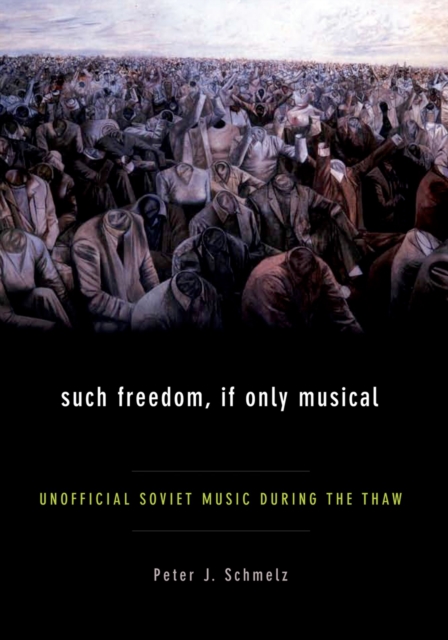
Such Freedom, If Only Musical
Drawing upon oral history, analysis, and a critical synthesis of secondary literature, this book examines the construction and reception of the “unofficial” music in the Soviet Union produced during the Thaw (roughly 1956–74) by composers including Alfred Schnittke, Arvo Pärt, Sofia Gubaidulina, Valentin Silvestrov, Andrey Volkonsky, and Edison Denisov. This book addresses “unofficial” music in all of its contradictions, and argues for a more refined understanding of its changing meanings during the Thaw (and the cold war). The book traces two interrelated phenomena. The first is the developing social function provided by “unofficial” concert life, which allowed Soviet listeners to congregate and question traditional socialist realist verities, and by extension many other facets of life in the USSR. The second is the shifting nature of the musical styles embraced by “unofficial” composers. Initially, while still conservatory students in the 1950s, they encountered music previously off‐limits, including scores by Schoenberg, Boulez, and other Western modernists. They avidly pursued the serial compositional techniques in these “new” scores. However, tiring of the limited expressive possibilities they perceived in these methods, they turned in other directions, first to aleatory devices, and then to quotations from familiar tonal works. The stylistic development of this generation thereby moved from “abstraction” to “mimesis” (borrowing musicologist Karol Berger's terminology). In their mimetic works from the end of the 1960s, the “unofficial” Soviet composers more directly engaged the contemporary situation in the USSR and in so doing received more favorable responses from listeners and Soviet critics alike. Andrey Volkonsky Edison Denisov Alfred Schnittke Sofia Gubaidulina Valentin Silvestrov Arvo Pärt serialism aleatory cold war oral history
eBook

Internal exile in Fascist Italy
This study offers a clear, concise introduction to the Fascist-era
practice, know as confino , of exiling antifascist
dissidents to parts of Italy far from the dissidents' homes, often
on islands or in tiny inland villages. The book is organised in two
sections. Part one provides a case study of the political colony on
the island of Lipari and a historical overview of internal exile.
Part two focuses on representations of confinement in literature
and film. It examines the varieties of self-expression (e.g.
memoirs, letters and literature) used by prisoners to describe
their experiences, investigates how filmmakers interpret these
events, places and people, and explores how film portrays the
repression of homosexuality. A timely examination of the birthplace
of European federalism, the book also contributes to our
understanding of the legacy of confinement from both national and
European perspectives.
eBook

Zwischen Innerer Emigration und Exil: Deutschsprachige Schriftsteller 1933-1945
Der Band sucht die bisher traditionell getrennten Forschungsgebiete 'Exilliteratur' und 'Innere Emigration' einander anzunähern und die verschiedenen Erfahrungsfelder der vertriebenen und der in Deutschland gebliebenen Schriftsteller aufeinander zu beziehen. Erörtert wird das Widerstandspotential der deutschsprachigen Literatur innerhalb und außerhalb des Deutschen Reiches und die Aussagekraft der Bezeichnungen 'innere?' und 'äußere' Emigration.
eBook

Zwischen Innerer Emigration und Exil
Der Band sucht die bisher traditionell getrennten Forschungsgebiete ,Exilliteratur' und ,Innere Emigration' einander anzunähern und die verschiedenen Erfahrungsfelder der vertriebenen und der in Deutschland gebliebenen Schriftsteller aufeinander zu beziehen.
eBook

Illegal residence and public safety in the Netherlands
Making illegal residence unattractive is a way for Western governments to limit migration from non-Western countries. Focusing on Dutch neighbourhoods with substantial levels of unauthorised migrants, Illegal Residence and Public Safety in the Netherlands examines how restrictive immigration policy influences immigrant crime and perceived neighborhood security. Salient questions arise. To what extent, and under which conditions, do illegal residence and illegal migration impact public safety? Does having illegal residence status influence how people observe or break the law and other social rules? Do their ties with established groups, such as legal migrants, employers and partners, have any sway? Answers to these issues begin surfacing in this rich combination of quantitative information, comprising police figures and surveys on victimisation, and qualitative sources, including interviews at the Dutch Aliens Custody and urban field research.
Illegal Residence and Public Safety in the Netherlands is een onderzoek naar de gevolgen van de steeds drastischere maatregelen om illegaal verblijf in Nederland tegen te gaan. EU-lidstaten als Nederland hanteren steeds zwaardere voorwaarden voor immigratie vanuit niet-westerse landen en niet-Europese landen. Arjen Leerkes onderzocht in hoeverre het verblijf en de migratie van illegale immigranten gevolgen hebben voor de publieke veiligheid en criminaliteit in Nederland. Zijn illegale immigranten eerder geneigd tot criminaliteit of weerhoudt hun juridische status hen er juist van?
eBook

Managing Ethnic Diversity after 9/11
America's approach to terrorism has focused on traditional national security methods, under the assumption that terrorism's roots are foreign and the solution to greater security lies in conventional practices. Europe offers a different model, with its response to internal terrorism relying on police procedures.Managing Ethnic Diversity after 9/11compares these two strategies and considers that both may have engendered greater radicalization--and a greater chance of home-grown terrorism. Essays address how transatlantic countries, including the United Kingdom, the United States, France, Germany, Spain, Italy, and the Netherlands have integrated ethnic minorities, especially Arabs and Muslims, since 9/11. Discussing the \"securitization of integration,\" contributors argue that the neglect of civil integration has challenged the rights of these minorities and has made greater security more remote.
eBook

Securitizing immigration : the politics of risk in the EU
Securitizing Immigration deals with the growing concern for immigration as a matter of security at the EU level. It combines an analysis of the way bureaucratic and political processes have interacted in the integration process with an analysis of how these practices are located in a context shaped by the preoccupation with risk.
eBook

Consequences of Counterterrorism, The
The 9/11 terrorist attacks opened America’s eyes to a frightening world of enemies surrounding us. But have our eyes opened wide enough to see how our experiences compare with other nations’ efforts to confront and prevent terrorism? Other democracies have long histories of confronting both international and domestic terrorism. Some have undertaken progressively more stringent counterterrorist measures in the name of national security and the safety of citizens. The Consequences of Counterterrorism examines the political costs and challenges democratic governments face in confronting terrorism.Using historical and comparative perspectives, The Consequences of Counterterrorism presents thematic analyses as well as case studies of Britain, France, Germany, Spain, Japan, and Israel. Contributor John Finn compares post-9/11 antiterrorism legislation in the United States, Europe, Canada, and India to demonstrate the effects of hastily drawn policies on civil liberties and constitutional norms. Chantal de Jonge Oudraat and Jean-Luc Marret assert that terrorist designation lists are more widespread internationally than ever before. The authors examine why governments and international organizations use such lists, how they work, and why they are ineffective tools. Gallya Lahav shows how immigration policy has become inextricably linked to security in the EU and compares the European fear of internal threats to the American fear of external ones. A chapter by Dirk Haubrich explains variation in the British government’s willingness to compromise democratic principles according to different threats. In his look at Spain and Northern Ireland, Rogelio Alonso asserts that restricting the rights of those who perpetrate ethnonationalist violence may be acceptable in order to protect the rights of citizens who are victims of such violence. Jeremy Shapiro considers how the French response to terrorist threats has become more coercive during the last fifty years. Israel’s “war model” of counterterrorism has failed, Ami Pedahzur and Arie Perliger argue, and is largely the result of the military elite’s influence on state institutions. Giovanni Cappocia explains how Germany has protected basic norms and institutions. In contrast, David Leheny stresses the significance of change in Japan’s policies. Preventing and countering terrorism is now a key policy priority for many liberal democratic states. As The Consequences of Counterterrorism makes clear, counterterrorist policies have the potential to undermine the democratic principles, institutions, and processes they seek to preserve.
eBook

Frontiers of Fear
On both sides of the Atlantic, restrictive immigration policies have been framed as security imperatives since the 1990s. This trend accelerated in the aftermath of 9/11 and subsequent terrorist attacks in Europe. InFrontiers of Fear, Ariane Chebel d'Appollonia raises two central questions with profound consequences for national security and immigration policy: First, does the securitization of immigration issues actually contribute to the enhancement of internal security? Second, does the use of counterterrorist measures address such immigration issues as the increasing number of illegal immigrants, the resilience of ethnic tensions, and the emergence of homegrown radicalization?
Chebel d'Appollonia questions the main assumptions that inform political agendas in the United States and throughout Europe, analyzing implementation and evaluating the effectiveness of policies in terms of their stated objectives. She argues that the new security-based immigration regime has proven ineffective in achieving its prescribed goals and even aggravated the problems it was supposed to solve: A security/insecurity cycle has been created that results in less security and less democracy. The excesses of securitization have harmed both immigration and counterterrorist policies and seriously damaged the delicate balance between security and respect for civil liberties.
eBook