
Catalogue Search | MBRL


Are you sure you want to remove the book from the shelf?

{{itemTitle}}
3
result(s) for
"Inquiry-based learning -- Great Britain"
Sort by:
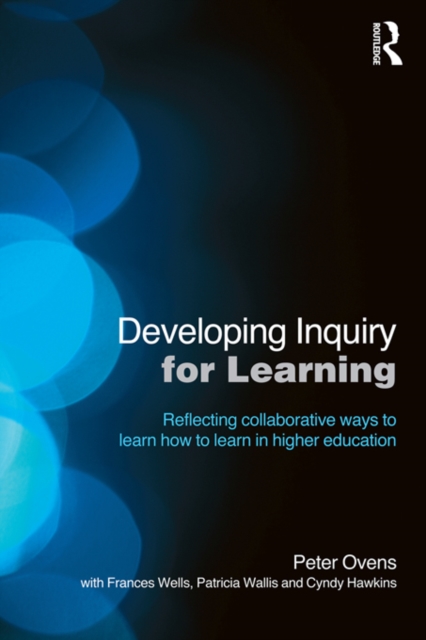
Developing Inquiry for Learning
Developing Inquiry for Learning shows how university tutors can help students to improve their abilities to learn and to become professional inquirers.
An increasing proportion of students entering higher education seem to assume that learning is a relatively passive process. This may be the largest single limitation on their achievement. University tutors need to be able to respond creatively to students' learning needs and difficulties. The modern teaching environment in higher education demands a sophisticated approach to teaching, learning and assessment i.e. the curriculum: its planning, its development and tutors' professional development. Tutors need fresh ideas about how to challenge students' spoon-fed approach, to enable them to become collaborative, yet independently motivated learners.
In the innovative and practically proven approach developed by the authors of this book, students are guided to implement action research into their learning practices and reflections. Using a rolling programme of cyclical inquiries and whole group 'conferences' on improving learning, students write 'patches' on learning development which are then shared across the year group online. Each student's cumulative set of patches, together with their regular reflective writing, provide the basis for assembling a composite final assignment, a 'Patchwork Text', for assessment. This style of curriculum and assessment organisation encourages regular peer feedback and formative assessment, as part of the whole module process. This is a dynamic approach which builds personal confidence within students, both as learners and as professionals.
Providing teaching materials and examples of students' responses, including the use of blogs, wikis and discussion boards, Developing Inquiry for Learning analyses and theorises on the deeper characteristics of the difficulties being addressed. With the provision of relevant frameworks of theory and values, readers are
eBook

Reflective Learning in Practice
This book gathers together details of seventeen case studies of learning in practice, after having set the issue of reflective learning in a theoretical context. The cases are drawn from a wide range of situations and discuss both apparent successes and failures. The cases are used as a basis to develop general findings. These general findings are expressed as themes and questions so that, as readers come across new circumstances, they are not limited by prescriptive recipes. Instead they are empowered by having both an open and focused approach: open because the starting point is questions rather than answers, and focused because the questions direct attention to factors that have been found to be influential for effective, reflective learning. The crucial factor is the ability of managers and others to extract quality learning from experience. Reflective Learning in Practice develops an approach that will help this to happen.
Anne Brockbank BSc MA (Econ) Dip Couns MCIPD. Anne is an independent consultant, specializing in learning and development in both public and private sectors. She offers staff development through action learning, mentoring and coaching, to individuals or groups, in universities, local government and the NHS. Anne also works as an associate consultant for The Oxford Group and her ideas about reflective learning are taken up by corporate clients. Ian McGill PhD Ian is a development consultant working with senior managers and staff in government agencies, higher education and the private sector. Ian works with organizations on strategic direction, organizational learning and on personal self-development. He is a leading practitioner of action learning and an advocate of collaborative working. Nic Beech BSc MA MSc PhD MCIPD ILTM Nic is a senior lecturer in human resource management at the university of Strathclyde Business School. He has a background in sociology and philosophy, and his work experience and subsequent doctoral studies were HRM. Nic is a consultant on people and organizational management in the whisky, telecommunications and finance industries, and in the health service.
eBook
