
Catalogue Search | MBRL


Are you sure you want to remove the book from the shelf?

{{itemTitle}}
1,023
result(s) for
"Inscriptions, Greek"
Sort by:

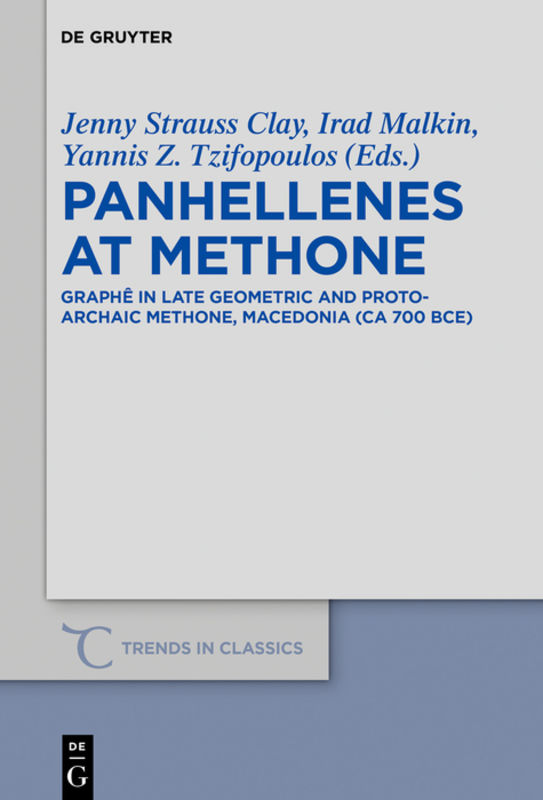
Panhellenes at Methone : graphê in late geometric and protoarchaic Methone, Macedonia (ca. 700 BCE)
Trends in Classics, a new series and journal to be edited by Franco Montanari and Antonios Rengakos, will publish innovative, interdisciplinary work which brings to the study of Greek and Latin texts the insights and methods of related disciplines such as narratology, intertextuality, reader-response criticism, and oral poetics. Both publications will seek to publish research across the full range of classical antiquity. The series Trends in Classics Studies welcomes monographs, edited volumes, conference proceedings and collections of papers; it will provide an important forum for the ongoing debate about where Classics fits in modern cultural and historical studies. The journal Trends in Classics will be published twice a year with approx. 160 pp. per issue. Each year one issue will be devoted to a specific subject with articles edited by a guest editor.
eBook

The Christian epigraphy of Egypt and Nubia
The present book collects 31 articles that Jacques van der Vliet, a leading scholar in the field of Coptic Studies (Leiden University / Radboud University, Nijmegen), has published since 1999 on Christian inscriptions from Egypt and Nubia. These inscriptions are dated between the third/fourth and the fourteenth centuries, and are often written in Coptic and/or Greek, once in Latin, and sometimes (partly) in Arabic, Syriac or Old Nubian. They include inscriptions on tomb stones, walls of religious buildings, tools, vessels, furniture, amulets and even texts on luxury garments. Whereas earlier scholars in the field of Coptic Studies often focused on either Coptic or Greek, Van der Vliet argues that inscriptions in different languages that appear in the same space or on the same kind of objects should be examined together. In addition, he aims to combine the information from documentary texts, archaeological remains and inscriptions, in order to reconstruct the economic, social and religious life of monastic or civil communities. He practiced this methodology in his studies on the Fayum, Wadi al-Natrun, Sohag, Western Thebes and the region of Aswan and Northern Nubia, which are all included in this book.
Book

Athenian Lettering of the Fifth Century B.C
This book has chapters on methodology, on the writing of the first decrees and laws of the years ca. 515 to 450 B.C., on unique examples of writing of ca. 450 to 400, on the inscribers of the Lapis Primus and Lapis Secundus (IG I3 259-280), and on those of the Attic Stelai (IG I3 421-430). These are followed by studies of 11 individual cutters arranged in chronological order.
This study brings order to the study of hands of the fifth century by setting out a methodology and by discussing the attempts of others to identify hands. Another aim is to bring out the individuality of the writing of these early inscribers. It shows that from the beginning the writing on Athenian inscriptions on stone was very idiosyncratic, for all intents and purposes individual writing. It identifies the inscribing of the sacred inventories of Athena beginning about 450 B.C. as the genesis of the professional letter cutter in Athens and traces the trajectory of the profession. While the dating of many inscriptions will remain a matter for scholarly discussion, the present study narrows the dates of many texts. It also pinpoints the origin of the mistaken idea that three-bar sigma did not occur on public documents after the year 446 in order to make those who are not expert more aware that this is not a reliable means of dating.
eBook


Honorific culture at Delphi in the Hellenistic and Roman periods
This book brings Hellenistic and Roman Delphi to life. By addressing a broad spectrum of epigraphic topics, theoretical and methodological approaches, it provides readers with a first comprehensive discussion of the Delphic gift-giving system, its regional interactions, and its honorific network.
eBook


Amheida III
This archaeological report provides a comprehensive study of the excavations carried out at Amheida House B2 in Egypt's Dakhleh Oasis between 2005 and 2007, followed by three study seasons between 2008 and 2010. The excavations at Amheida in Egypt's western desert, begun in 2001 under the aegis of Columbia University and sponsored by NYU since 2008, are investigating all aspects of social life and material culture at the administrative center of ancient Trimithis. The excavations so far have focused on three areas of this very large site: a centrally located upper-class fourth-century AD house with wall paintings, an adjoining school, and underlying remains of a Roman bath complex; a more modest house of the third century; and the temple hill, with remains of the Temple of Thoth built in the first century AD and of earlier structures. Architectural conservation has protected and partly restored two standing funerary monuments, a mud-brick pyramid and a tower tomb, both of the Roman period.
This is the second volume of ostraka from the excavations Amheida (ancient Trimithis) in Egypt. It adds 491 items to the growing corpus of primary texts from the site. In addition to the catalog, the introductory sections make important contributions to understanding the role of textual practice in the life of a pre-modern small town. Issues addressed include tenancy, the administration of water, governance, the identification of individuals in the archaeological record, the management of estates, personal handwriting, and the uses of personal names. Additionally, the chapter \"Ceramic Fabrics and Shapes\" by Clementina Caputo breaks new ground in the treatment of these inscribed shards as both written text and physical object. This volume will be of interest to specialists in Roman-period Egypt as well as to scholars of literacy and writing in the ancient world and elsewhere.
eBook


Reinventing the Amphiareion at Oropos
This book revisits the narrative of the Amphiareion through comprehensive analysis of its monuments; it exposes the sanctuary's function as an arena for political rediscovery and intercommunal association for individuals and communities within Attica and central Greece.
eBook