
Catalogue Search | MBRL


Are you sure you want to remove the book from the shelf?

{{itemTitle}}
197,837
result(s) for
"Institutional Research"
Sort by:


RESEARCH AUTHORIZATION AND PROTOCOL REVIEW (RAPR): A CENTRALIZED RESEARCH REVIEW MODEL FOR ADVOCATE HEALTH MIDWEST
Advocate Aurora Research Institute (AARI) has implemented a Research Authorization and Protocol Review (RAPR) process to streamline the review and authorization of research conducted within Advocate Health (AH) Midwest. RAPR aims to facilitate the submission and review of various types of research, coordinates scientific and administrative reviews, ensures proposals are compliant with AH policies and procedures, and, when applicable, authorizes research support services to studies that are meritorious as well as operationally and financially feasible. The process uses a Research Electronic Data Capture (REDCap) platform for submission, review, scoring, and tracking of clinical research requests. Unique REDCap workflows were customized for Academic Research, Graduate Medical Education Research, Nursing Research, and Sponsored Clinical Trials. Research studies are reviewed by scientific and clinical experts, as well as research administrators, and are evaluated based on standard scoring criteria, including organizational priority, patient impact, qualifications of the study team, funding, resource availability, research quality, contracting/legal support, and cybersecurity considerations. RAPR determinations are communicated to the study team and key personnel through REDCap notifications. RAPR authorization is a mandatory requirement at AH Midwest and a prerequisite for submitting a research study to the Institutional Review Board.
Journal Article


A reflection on the significance of researchers’ narratives in commissioned qualitative studies: A case study of four South African universities
The problem with most commissioned studies is that they are generally anchored on research protocols, guidelines and theoretical underpinnings imposed by research grant makers or the external Principal Investigator’s (PI) own research design preferences. Furthermore, the problem is that researchers who are recruited during various phases of commissioned studies have little contribution to the overall research design, methodological or theoretical framework of such studies. On 22-23 November 2022, the University of Johannesburg’s (UJ) Ali Mazrui Centre for Higher Education Studies (AMCHES) facilitated a fieldwork training and orientation workshop hosted by the Nelson Mandela University’s (NMU) Faculty of Education. The purpose of the workshop was to orient institutional research teams for a commissioned study titled: Steering Epistemic Access and Success of Historically Disadvantaged Students in South African Universities. This commissioned study was funded by the National Research Foundation (NRF) and AMCHES was the principal investigator, and it had its own prescribed research design to explore the institutional student access and success narratives and experiences of students from historically disadvantaged backgrounds. However, during this orientation workshop, it became apparent to the author that researchers recruited from the four participating universities were raising key research design-oriented narratives that were significant to the respective social contexts of the institutional case studies. The research design and theoretical framework of the entire study benefited from the inclusion of narratives describing the institutional researchers’ own experiences and their familiarity with the SEAS research sites. The four case study institutions were the universities of Cape Town (UCT), Fort Hare (UFH), Kwa Zulu-Natal (UKZN) and NMU. AMCHES held the overall ethics clearance for the study, which had been granted by UJ’s Faculty of Humanities. The author explored the pre-study narratives of the institutional research teams that emerged during the orientation workshop using a qualitative narrative analysis approach. This demonstrates the benefit of the incorporation of researchers’ narratives and perspectives of their lived experiences of the research site in commissioned studies. The author argues that the incorporation of narratives of researchers’ lived experiences of the research site adds a social context and enriches methodological approaches and theoretical framing in commissioned studies to create social relevance beyond the grant maker or the PI’s imposed approaches.
Journal Article

Google analytics of a pilot study to characterize the visitor website statistics and implicate for enrollment strategies in Medical University
Background
Taiwan’s colleges and universities are struggling to maintain their student enrollment rates owing to the declining fertility rate. Focusing on students in higher education programs, this study aims to analyze online behavioral patterns for university departmental websites and accordingly, suggests response strategies to increase the rate of enrollment.
Methods
We use Google Analytics to examine the websites of two departments in a medical university between February 1 and July 30, 2018. We study website patterns during the study periods for three college admission routes: STARS program, personal applications, and admission through examination and placement.
Results
Most website visitors during the three visiting date ranges for the two departments are 18–24 years. The visitor groups are mainly freshmen at the university and their parents. The homepage and Subject Credits, Course Planning, Teacher Lineup, and Certificate of Subjects were the most visited webpages. The overall number of daily page views varied by academic event.
Conclusions
University departments should enhance the presentation of featured courses on their webpage or distinguish course characteristics from those of competing departments in the curriculum to ensure clear market segmentation. In addition, departments should consider examining online data to identify suitable high schools that can be visited to attract potential students and to improve students’ willingness to choose their university.
Journal Article

Tracking and Assessing Undergraduate Research Campus-wide: Demographics, Academic Success, and Post-Graduation Plans
Evaluation must occur at the university level to understand the full impact of undergraduate research (UR). UR assessment is often only completed at the individual program level because of limited technology, time, and/or resources. At our large research institution, we have been documenting a wide variety of research experiences annually since the 2009–2010 academic year through an online portal. With our institutional research team and campus partners, we created interactive dashboards that display involvement in UR by semester and academic year. Here we compile data on students involved in UR compared to the university population as a whole. Consistent trends from this yearly data have shown that non-STEM (science, technology, engineering, and mathematics) students, transfer students, and part-time students are less involved in research. However, underrepresented and first-generation involvement tends to trend consistently with the university population, likely because of a wide variety of focused programming. Despite many interventions aimed at engaging students in their first three years, data show that researchers remain mostly seniors. Students are also tracked to graduation and beyond, providing a unique evaluation of UR. Grade point averages and graduation rates tend to be higher for student researchers. Time to degree is similar between researchers and nonresearchers. Students are tracked into graduate school as well and on average have an almost 50% increase in matriculation compared to nonresearchers. There are still gaps in this university-level knowledge, but this portal helps clarify campus-wide involvement and opportunities for enhancement, while serving as a comparison data set and a model system for other universities.
Journal Article

Scholarship of Teaching and Learning on Work-Integrated Learning: International and Multi-Institutional Research
This special section offers readers of Teaching & Learning Inquiry (TLI) a deep-dive into recent international, multi-institutional scholarship of teaching and learning (SoTL) on work-integrated learning (WIL). In this section introduction, we explore work-integrated learning, detail what TLI readers can glean from an intentional collection of SoTL studies on WIL and provide a brief overview of the collaborative SoTL works featured in the section.
Journal Article
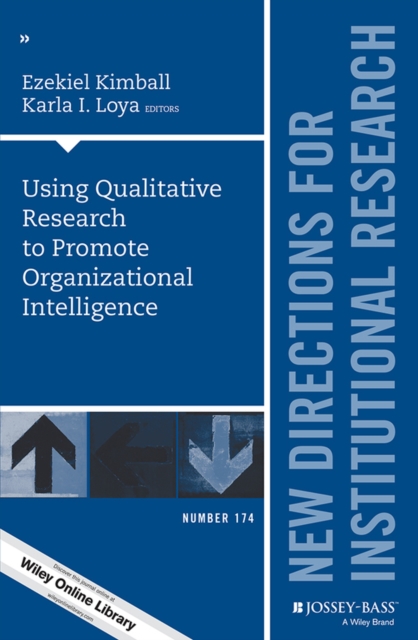
Using qualitative research to promote organizational intelligence
Learn how to use qualitative research as a tool for institutional research. Although institutional researchers often employ informal qualitative methods (their experiences and anecdotal observations), this volume argues that true organizational intelligence is facilitated by formalizing the qualitative data collection and analysis process in institutional research. To that end, it presents a systematic approach to qualitative research in institutional research that connects technical and analytical skills with issues awareness and knowledge of context. Topics covered include: Technical/analytical awareness practices Issues awareness Practices that achieve contextual awareness. This is the 174th volume of this Jossey-Bass quarterly report series. Timely and comprehensive, New Directions for Institutional Research provides planners and administrators in all types of academic institutions with guidelines in such areas as resource coordination, information analysis, program evaluation, and institutional management.
eBook

The Role of Institutional Research in a High Profile Study of Undergraduate Research
Armed with a strong toolkit of knowledge and skills, institutional research (IR) professionals often serve as collaborators with campus colleagues who may need assistance with survey design, statistical analysis, program review, and assessment of individual programs or the institution. This paper discusses the role that an IR professional played in a comprehensive and high profile study of undergraduate research. The project was grounded in educational theory and principles of academic assessment. It consumed many long hours, but it also yielded gains in IR visibility, heightened professional relationships with campus colleagues, a second sizable grant, and multiple publications. Implications for the IR practitioner, contributions to the scholarship of assessment, and institutional synergy are discussed.
Journal Article

Wild brooms and learning analytics
In this commentary we present an analogy between Johann Wolfgang Von Goethe’s classic poem, The Sorcerer’s Apprentice, and institutional learning analytics. In doing so, we hope to provoke institutions with a simple heuristic when considering their learning analytics initiatives. They might ask themselves, “Are we behaving like the sorcerer’s apprentice?” This would be characterized by initiatives lacking faculty involvement, and we argue that when initiatives fit this pattern, they also lack consideration of their potential hazards, and are likely to fail. We join others in advocating for institutions to, instead, create ecosystems that enable faculty leadership in institutional learning analytics efforts.
Journal Article