
Catalogue Search | MBRL


Are you sure you want to remove the book from the shelf?

{{itemTitle}}
85,349
result(s) for
"Institutional care"
Sort by:


Ireland's Magdalen laundries and the nation's architecture of containment
The Magdalen laundries were workhouses in which many Irish women and girls were effectively imprisoned because they were perceived to be a threat to the moral fiber of society. Mandated by the Irish state beginning in the eighteenth century, they were operated by various orders of the Catholic Church until the last laundry closed in 1996. A few years earlier, in 1993, an order of nuns in Dublin sold part of their Magdalen convent to a real estate developer. The remains of 155 inmates, buried in unmarked graves on the property, were exhumed, cremated, and buried elsewhere in a mass grave. This triggered a public scandal in Ireland and since then the Magdalen laundries have become an important issue in Irish culture, especially with the 2002 release of the film \"The Magdalene Sisters.\".
eBook


Vita
Zones of social abandonment are emerging everywhere in Brazil’s big cities—places like Vita, where the unwanted, the mentally ill, the sick, and the homeless are left to die. This haunting, unforgettable story centers on a young woman named Catarina, increasingly paralyzed and said to be mad, living out her time at Vita. Anthropologist João Biehl leads a detective-like journey to know Catarina; to unravel the cryptic, poetic words that are part of the “dictionary” she is compiling; and to trace the complex network of family, medicine, state, and economy in which her abandonment and pathology took form. An instant classic, Vita has been widely acclaimed for its bold fieldwork, theoretical innovation, and literary force. Reflecting on how Catarina’s life story continues, this updated edition offers the reader a powerful new afterword and gripping new photographs following Biehl and Eskerod’s return to Vita. Anthropology at its finest, Vita is essential reading for anyone who is grappling with how to understand the conditions of life, thought, and ethics in the contemporary world.
eBook

Youth, school, and community : participatory institutional ethnographies
\"Unlike other books about youth, this book examines how young people's experiences of inclusion and exclusion are shaped by extended social relations, coordinating thought and conduct across time and space. Working with young people, using a range of participatory institutional ethnographic strategies, this book investigates the social and institutional relations which differentially punctuate our lives. While research began with what young people know and have experienced, this starting place anchors an investigation of public sector institutions and institutional processes that remain implicated in social-historical-economic processes of global capitalism, imperialism, and colonialism. Youth, School, and Community connects the dots between the abstract objectified accounts produced by institutions and enabling institutional action and accounting practices, and the actual material conditions of young people's lives and development, which these accounts obscure. By focusing on specific policies and procedures that produce young people's experiences of racialized inclusion/exclusion, safety/risk make it particularly useful to academics, professionals, and activists who want to ensure that young people experience equitable access to public sector resources and not disproportionate exposure to public sector punishments and punitive interventions\"-- Provided by publisher.
Book

The Road to Hell
From the 1950s to the 1980s, the New Zealand government took more than 100,000 children from experiences of strife, neglect, poverty or family violence and placed them under state care in residential facilities.In homes like Epuni and Kingslea, Kohitere and Allendale, the state took over as parent.The state failed.
eBook

Disability Incarcerated
Disability Incarcerated gathers thirteen contributions from an impressive array of fields. Taken together, these essays assert that a complex understanding of disability is crucial to an understanding of incarceration, and that we must expand what has come to be called 'incarceration.' The chapters in this book examine a host of sites, such as prisons, institutions for people with developmental disabilities, psychiatric hospitals, treatment centers, special education, detention centers, and group homes; explore why various sites should be understood as incarceration; and discuss the causes and effects of these sites historically and currently.This volume includes a preface by Professor Angela Y. Davis and an afterword by Professor Robert McRuer.
eBook

Debating early child care : the relationship between developmental science and the media
\"Throughout distressing cultural battles and disputes over child care, each side claims to have the best interests of children at heart. While developmental scientists have concrete evidence for this debate, their message is often lost or muddied by the media. To demonstrate why this problem matters, this book examines the extensive media coverage of the NICHD Study of Early Child Care and Youth Development - a long-running government-funded study that provides the most comprehensive look at the effects of early child care on American children. Analyses of newspaper articles and interviews with scientists and journalists reveal what happens to science in the public sphere and how children's issues can be used to question parents' choices. By shining light on these issues, the authors bring clarity to the enduring child care wars while providing recommendations for how scientists and the media can talk to - rather than past - each other\"-- Provided by publisher.
Book
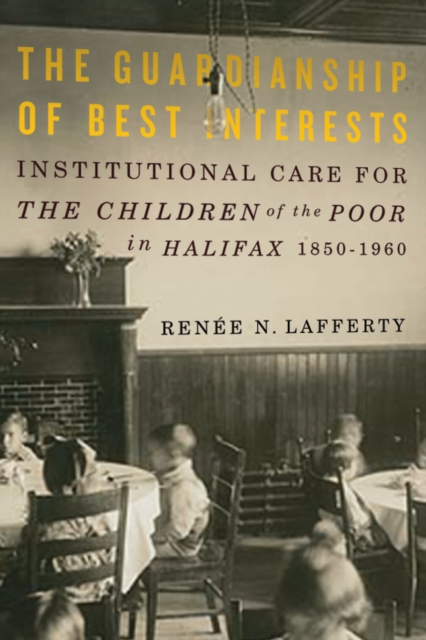
The Guardianship of Best Interests
It is difficult to imagine how orphan asylums and children's homes - often depicted as places where abuse, deprivation, and cruelty were commonplace - once presented a viable solution to child neglect. Renée Lafferty examines this response as it played out in Halifax, demonstrating how these homes reacted both creatively and valiantly to their environment, despite chronic underfunding and a narrow vision of the possibilities available to disadvantaged children. The Guardianship of Best Interests traces the creation and administration of children's homes in Halifax from the mid-nineteenth century to their closure in the mid-twentieth. Against the backdrop of a city torn apart by race and religious politics, financial challenges, two world wars, and the devastating explosion of 1917, Halifax institutions frequently represented themselves as the cutting edge of professional child welfare methods. Placing their histories at the core of this study, Lafferty challenges the common assertion that such homes were readily abandoned in favour of the foster care method promoted by the Children's Aid Society. Through the unique perspective gained by considering inter-denominational competition, along with the effects of racism and the political posturing of the province's emerging welfare bureaucracy, The Guardianship of Best Interests unearths the significant similarities between past child welfare practices and our current approaches toward neglect and dependency.
eBook