
Catalogue Search | MBRL


Are you sure you want to remove the book from the shelf?

{{itemTitle}}
2,129
result(s) for
"Insurance Great Britain."
Sort by:


Regulated Lives
Regulated Lives explores the British life insurance industry's changing assessments of the values and risks of human life between 1800 and 1914. Timothy Alborn's unique study uses insurance practices to demonstrate how Victorian ideas about the lived experience altered both to accommodate and resist elements of modernity such as statistical thinking, medicalization, and capitalist bureaucracy.
The nature of Victorian life insurance companies meant that their customers were both consuming subjects and objectified abstractions. Policyholders were active consumers of a product as well as passive objects which were evaluated for 'risk' in the objective and homogenizing terms determined by the industry. By examining how salesmen, actuaries, and doctors utilized their differing conceptions of what the various aspects of people's lives meant, Regulated Lives suggests that the very complexity of modern commercial and social institutions produces space where individuality can flourish.
eBook


The Zong
On November 29, 1781, Captain Collingwood of the British shipZongcommanded his crew to throw overboard one-third of his cargo: a shipment of Africans bound for slavery in America. The captain believed his ship was off course, and he feared there was not enough drinking water to last until landfall. This book is the first to examine in detail the deplorable killings on theZong, the lawsuit that ensued, how the murder of 132 slaves affected debates about slavery, and the way we remember the infamousZongtoday.Historian James Walvin explores all aspects of theZong's voyage and the subsequent trial-a case brought to court not for the murder of the slaves but as a suit against the insurers who denied the owners' claim that their \"cargo\" had been necessarily jettisoned. The scandalous case prompted wide debate and fueled Britain's awakening abolition movement. Without the episode of theZong, Walvin contends, the process of ending the slave trade would have taken an entirely different moral and political trajectory. He concludes with a fascinating discussion of how the case of theZong, though unique in the history of slave ships, has come to be understood as typical of life on all such ships.
eBook

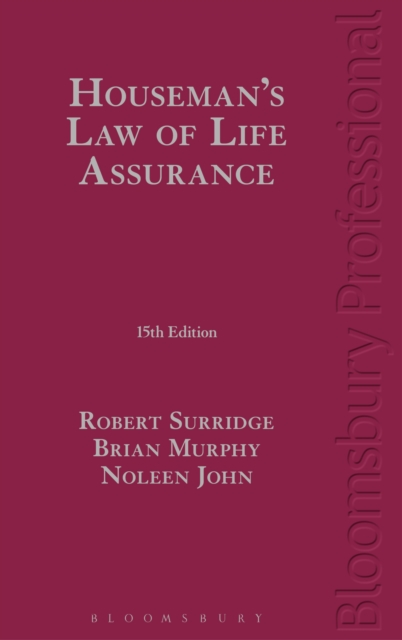
Houseman's Law of Life Assurance
Unique in its depth of coverage and currency, Houseman's Law of Life Assurance has established a well-deserved reputation as an authoritative practitioner work on life assurance and is renowned for its practical insight into the workings of the industry.
eBook


Insurance For Unemployment
First published in 1986, Insurance for Unemployment proposes a radical approach to the reform of unemployment and social insurance. The book develops the ethical, economic and actuarial case for the proposed reforms, whereby the individual pays the contributions which reflect the unemployment risk that he wishes to insure. Such ideas provide a libertarian alternative to the social security systems that have been adopted by most countries in the world based on Beveridge's conception of social insurance, and the book provides an original basis for privatising unemployment insurance. Conventional acceptance of the welfare state is challenged, while the book stands as a landmark in relating market principles to issues of social policy.
eBook

Leases for lives : life contingent contracts and the emergence of actuarial science in eighteenth-century England
Many historians of insurance have commented on the disconnect between the rise of English life insurance companies in the early eighteenth century and the mathematics behind the sound pricing of life insurance products that was developed at about the same time. Insurance and annuity promoters typically ignored this mathematical work. Bellhouse explores this issue and shows that the early mathematical work was not motivated by insurance but instead by the fair valuation of life contingent contracts related to property. Even the work of the mathematician James Dodson in the creation of the Equitable Life Assurance Society, offering sound actuarially based premiums, did not change the industry in any significant way. The tipping point was a crisis in 1770 in which the philosopher and mathematician Richard Price, as well as other mathematicians, showed that a dozen or more recently formed annuity societies could not meet their financial obligations and were inviable.
Book
