
Catalogue Search | MBRL


Are you sure you want to remove the book from the shelf?

{{itemTitle}}
24,967
result(s) for
"Insurance crimes."
Sort by:

Played! : a novel
\"Every law firm has its backroom bench of brilliant workaholic nerds ferocious in their commitment to the law and to their clients. Such a player is Milton Bernstein of Abbott & Windsor ... Milton's younger brother Hal is his polar opposite--strikingly handsome, a high-school baseball legend in St. Louis who was on his way to the major leagues until he destroyed his prospects in a motorcycle accident ... But the lives of both brothers are about to change. Cherry, the bombshell third wife of St. Louis' most shark-like litigator, Lester Pitt, unexpectedly turns Hal's advances around. They become lovers. Coincidentally, Milton becomes the attack dog behind litigation to nail Pitt for running an insurance scam on his injured clients\"--Cover flap.
Book

Reporting Crime to the Police
This paper examines how crime reporting has changed over time by comparing findings from the 2007/08 British Crime Survey with the results obtained from the last major enquiry reported in 1994. International research conducted since that date is also reviewed. The paper finds that seriousness of the offence is still the most important factor influencing victims’ decisions. But reporting rates have changed: broadly, property crime is less likely to be reported whereas violent crime is more likely to be reported. As property crime predominates, the overall trend has been downward. There has been a very notable shift in that crimes committed by family members and others well known to the victim are much more likely to be reported than previously.
Journal Article

Zong!
In November, 1781, the captain of the slave ship Zong ordered that some 150 Africans be murdered by drowning so that the ship's owners could collect insurance monies. Relying entirely on the words of the legal decision Gregson v. Gilbert the only extant public document related to the massacre of these African slaves Zong! tells the story that cannot be told yet must be told. Equal parts song, moan, shout, oath, ululation, curse, and chant, Zong! excavates the legal text. Memory, history, and law collide and metamorphose into the poetics of the fragment. Through the innovative use of fugal and counterpointed repetition, Zong! becomes an anti-narrative lament that stretches the boundaries of the poetic form, haunting the spaces of forgetting and mourning the forgotten. -- Back cover.
Book
The Dark Number of Insurance Crimes
Insurance crime makes is difficult to interpret and measure the scale of undisclosed crime. In the insurance industry, the perpetrator can easily craft a false claim by simulating, for example a traffic accident, injury, or property damage. This causes difficulties in the evidential process and measuring the scale of the phenomenon. The aim of the article is to analyse the phenomenon of the dark number of insurance crimes. This paper includes the analysis of the definition of the term ‘dark number’ and other factors, such the degree of market development, the effectiveness of detection, the level of insurance awareness, and the dimension of social consent in Poland and selected European countries. Defeating the problem of insurance crime and estimating the dark number of insurance crimes requires taking into account the specificity of individual markets and types of insurance. We prove that effective measurement and reduction of a dark number of insurance crime is not possible without the constant updating of knowledge about the phenomenon of insurance crime and the use of advanced IT tools.
Journal Article

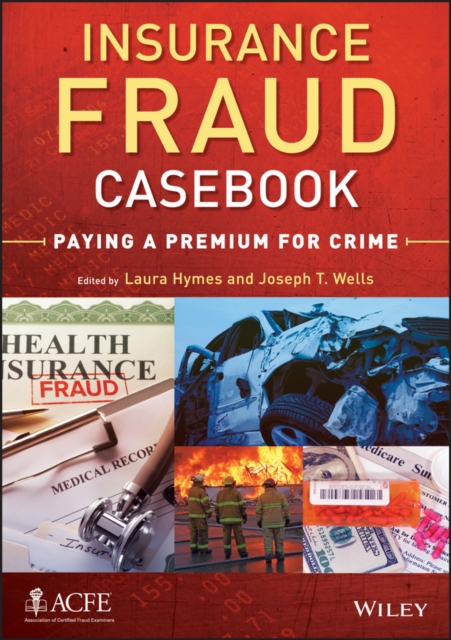
Insurance fraud casebook
Real case studies on insurance fraud written by real fraud examiners Insurance Fraud Casebook is a one-of-a-kind collection consisting of actual cases written by fraud examiners out in the field. These cases were hand selected from hundreds of submissions and together form a comprehensive picture of the many types of insurance fraud-how they are investigated, across industries and throughout the world. Entertaining and enlightening, the cases cover every type of insurance fraud, from medical fraud to counterfeiting. Each case outlines how the fraud was engineered, how it was investigated, and how perpetrators were brought to justice Written for fraud examiners, auditors, and insurance auditors Other titles by Wells: Fraud Fighter and Corporate Fraud Handbook, Third Edition Edited by Dr. Joseph T. Wells, the founder and Chairman of the Association of Certified Fraud Examiners (ACFE), the world's leading anti-fraud organization, this book reveals the dangers of insurance fraud and the measures that can be taken to prevent it from happening in the first place.
eBook
No-fault insurance anti-fraud litigation: a practitioner's guide
No-fault insurance fraud amounts to a significant fraud tax on consumers, estimated at billions of dollars each year. Residents in states where no-fault insurance fraud is endemic have experienced large increases in their automobile insurance premiums. For example, in 2011, Florida residents paid nearly $58 per vehicle as the result of no-fault insurance fraud, and in New York, policyholders paid the equivalent of $229,000,000 in increased automobile insurance policies due to this fraud. Currently, twelve states have a no-fault law, and while there are considerable variations among the no-fault laws in each of these states, they can broadly be classified by the degree to which the respective systems permit or abolish tort liability, and the type of threshold an injured party must meet before tort liability is permitted. Against this backdrop, automobile insurance companies have been the primary actors in the fight against no-fault fraud, engaging in civil litigation against no-fault insurance fraud rings. Written by practitioners who have litigated hundreds of no-fault anti-fraud cases, this is a practice-focused, general guide to no-fault insurance anti-fraud litigation from the perspective of a plaintiff-insurer, from inception of the case through to summary judgment. Although most lawsuits are resolved through settlement or dispositive motion practice, thorough preparation of the case for trial is critical. The authors provide clear guidance on how to identify corporate structure fraud as well as fraud involving medically unnecessary services, kickbacks, or illusory services. Further chapters address the critical issues involved once an anti-fraud insurance case is initiated, including selecting the defendants and the venue, preparing the complaint, motions to dismiss, counterclaims, discovery, provisional remedies, and settlements, summary judgments, and trial.
eBook
Insurance fraud casebook
Real case studies on insurance fraud written by real fraud examiners Insurance Fraud Casebook is a one-of-a-kind collection consisting of actual cases written by fraud examiners out in the field. These cases were hand selected from hundreds of submissions and together form a comprehensive picture of the many types of insurance fraud—how they are investigated, across industries and throughout the world. Entertaining and enlightening, the cases cover every type of insurance fraud, from medical fraud to counterfeiting. - Each case outlines how the fraud was engineered, how it was investigated, and how perpetrators were brought to justice - Written for fraud examiners, auditors, and insurance auditors - Other titles by Wells: Fraud Fighter and Corporate Fraud Handbook, Third Edition Edited by Dr. Joseph T. Wells, the founder and Chairman of the Association of Certified Fraud Examiners (ACFE), the world's leading anti-fraud organization, this book reveals the dangers of insurance fraud and the measures that can be taken to prevent it from happening in the first place.
eBook

Global index on financial losses due to crime in the United States
Despite the potential importance of crime rates in investments, there are no indices dedicated to evaluating the financial impact of crime in the United States. As such, this paper presents an index-based insurance portfolio for crime in the United States by utilizing the financial losses reported by the Federal Bureau of Investigation. The objective of our paper is to introduce new risk hedging financial contracts for crime, consistent with dynamic asset pricing. Underlying the index, we hedge the investments by issuing marketable European call and put options and providing risk budgets. These budgets show that real estate, ransomware, and government impersonation are the main risk contributors in our index. Next, we evaluate the performance of our index via stress testing to determine its resilience to economic crisis. Of all the factors considered in this study, unemployment rate has the potential to demonstrate the highest systemic risk to the portfolio. Our portfolio will help investors envision risk exposure in the market, gauge investment risk based on their desired risk level, and hedge strategies for potential losses due to economic crashes. In conclusion, we provide a basis for the securitization of insurance risk from certain crimes that could forewarn investors to transfer their risk to capital market investors.
Journal Article

Which Insurers Write Cyber Insurance? Evidence from the U.S. Property and Casualty Insurance Industry
This article is the first to analyze the relationship between corporate characteristics and the writing of cyber insurance in the U.S. property and casualty insurance industry. Given that cyber risk is an emerging dynamic and difficult-to-quantify risk category, we interpret the writing of cyber insurance as a risky activity, and link our results to the broad literature on insurers’ risk taking. The results show that insurers with more capital, lower asset risk, greater diversification among business lines and geographic areas, and group members are more likely to write cyber insurance. The results for different ownership types are ambiguous: although many mutual insurers are more likely to offer cyber coverage as part of existing policies, stock insurers are more likely to sell standalone cyber insurance. We also analyze the interrelationship between writing cyber risk and capital and reinsurance usage with a simultaneous equation model. Besides the positive relationship between capital and the undertaking of cyber risk, the results show that insurers writing cyber insurance policies use more reinsurance to transfer their risk.
Journal Article