
Catalogue Search | MBRL


Are you sure you want to remove the book from the shelf?

{{itemTitle}}
485
result(s) for
"Insurgency Developing countries."
Sort by:


Distant Thunder
The main locu of instability, conflict and violence in the post-Cold War world is the periphery - particularly the poorest regions of what used to be called the Third World. Internal wars of secession, struggles for power and chaos in failed or failing states are the dominant forms, expressed in intercommunal or ethnic violence, domestic and international acts of terrorism, and, increasingly, essentially criminal insurgencies with no political objective. This completely revised edition of \"Distant Thunder\" brings the problem of Third-World conflict into the post-Cold War era. Now that the periphery is no longer the site of surrogate competitions between rival political-economic systems, when and how should the developed countries intervene in internal wars outside the compass of their traditional geopolitical interest - and what can such intervention be realistically expected to accomplish? The new edition shows how secessionist and ethnic conflicts, terrorism and the drug trade fit into the context of international politics, examines the post-Cold War dynamics of political and economic decline, state failure, and the limits of interventionism, includes case studies of the Shining Path of Peru and its degeneration from a Maoist-type insurgency to a narco-terrorist ring and the Somali crisis as examples of the difficulties of international intervention in internal wars.
eBook

Development strategies and inter-group violence : insights on conflict-sensitive development
\"Throughout the world, development has been affected by armed violence - from civil wars and separatist struggles to explosions of religious and communal violence and terrorism. Ethnolinguistic and religious diversity, rivalries among regional groups and clans, and competing economic interests create a potential for acrimonious intergroup divisions. Yet some nations remain stable, while others, earlier touted as pillars of peaceful growth, have foundered badly. Development Strategies and Inter-Group Violence argues that economic development strategies, though embedded within a complex matrix of social and political conditions, have often shaped such different outcomes. Drawing on economic, political, and psychological theory, policy experiences, and case studies of the three regional volumes in the series (Economic Development Strategies and the Evolution of Violence in Latin America; Development Strategies, Identities, and Conflict in Asia; and The Economic Roots of Conflict and Cooperation in Africa), this book assesses the risks and opportunities of development strategies regarding the likelihood of inter-group violence. Policymakers and development practitioners will greatly benefit from this detailed and comprehensive analysis of how development initiatives may affect group identities, influence multiple disparities among groups, create \"conflict-opportunity structures,\" and change the dynamics of state-society relations\"-- Provided by publisher.
BOOK
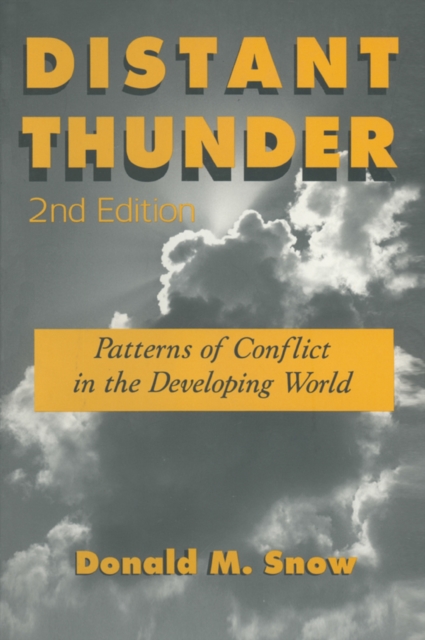
Distant Thunder
The main locu of instability, conflict and violence in the post-Cold War world is the periphery - particularly the poorest regions of what used to be called the Third World. Internal wars of secession, struggles for power and chaos in failed or failing states are the dominant forms, expressed in intercommunal or ethnic violence, domestic and international acts of terrorism, and, increasingly, essentially criminal insurgencies with no political objective. This completely revised edition of \"Distant Thunder\" brings the problem of Third-World conflict into the post-Cold War era. Now that the periphery is no longer the site of surrogate competitions between rival political-economic systems, when and how should the developed countries intervene in internal wars outside the compass of their traditional geopolitical interest - and what can such intervention be realistically expected to accomplish? The new edition shows how secessionist and ethnic conflicts, terrorism and the drug trade fit into the context of international politics, examines the post-Cold War dynamics of political and economic decline, state failure, and the limits of interventionism, includes case studies of the Shining Path of Peru and its degeneration from a Maoist-type insurgency to a narco-terrorist ring and the Somali crisis as examples of the difficulties of international intervention in internal wars.
The Changing Face of Violent Conflict; Second Tier Problems in a First Tier-Dominated World; The Venerable Foe - Insurgency; The Intractable Nemesis - Counterinsurgency; New Internal War; The Other Challenges - Counternarcotics, Counterterrorism and Regional Conflict; Cases in Point - Sendero Luminoso and Restore Hope; Distant Thunder or Siren's Call.
eBook

Shadow Wars
WarfareÆs evolution, especially since 2001, has irrevocably changed the meaning of war. In the twentieth centuryùhumankindÆs bloodiestù231 million people died in armed conflicts. Battlefield deaths since then have been steadily declining, despite the wars in Iraq and Afghanistan, and by 2012 less than 1 person in a million dies in war every year. This drastic change has led some academics to label our era one of peace, recalling the erroneously named ôHundred YearsÆ Peaceö or ôPax Britannicaö of the nineteenth century, which nonetheless saw many violent conflicts.
But war hasnÆt gone extinct. It has merely evolved . In Shadow Wars , journalist David Axe tells the story of the new war eraùone of insurgents and counterinsurgents, terrorists and their hunters, pirates, mercenaries, smugglers, and slavers wreaking havoc on regions where conditions are brutal, people are poor, governments are weak, and the world rarely pays attention. Axe shows us what war has become in our era of peace. The mainstream media, meanwhile, ignores it. This book profoundly challenges readersÆ conceptions of war and peace in the twenty-first century.
eBook
Trading away from conflict
While economic growth in developing countries over the last ten years has lifted more people out of poverty than in any previous time, more than one billion people still live in countries affected by violent conflict. Conflict weakens governance, undermines economic development and threatens both national and regional stability. Trade shocks, in particular, can have widely varying impacts on conflict. This report sets out to empirically test these linkages between trade shocks and conflict via cross-country and intra-country analysis. On the basis of the analysis, it offers trade-related policy directions to reduce this risk in fragile economies. The results provide convincing evidence that trade and trade policy have a large impact on the risk and intensity of conflict. This report is composed of three main chapters. Chapter 1 develops a conceptual framework mapping the different channels through which trade may affect conflict and political stability. The framework is based on simple economic theory and the available empirical evidence on the impact of trade related changes on conflict and stability. It then tests this framework empirically through the analysis of cross-country data and through case studies of Nigeria and the Israeli-Palestinian conflict. The hope is that these types of intra-country analyses could be replicated in other countries, since they use data that are available in different countries, especially in sub-Saharan Africa. Chapter 2 uses the same conceptual framework to show how differences in underlying conditions affect the relationship between trade-related changes and conflict. Following a review of the literature on the drivers of conflict, it examines the importance of four groups of grievances: conditions in neighboring countries, factors increasing grievance, government institutions, and policies that affect the transmission of changes in international prices to the domestic market. These relationships are tested using cross-country data and case studies of Nigeria and the Israeli-Palestinian conflict. Finally, chapter 3 uses the existing evidence, as well as evidence generated in this report, to discuss how the policies governing trade can reduce the probability and intensity of conflicts. Two appendixes include detailed information on the modeling framework, the data issues and the estimation results.
eBook
Distant Thunder
This revised edition brings the problem of Third-World conflict into the post-Cold War era. It asks when and how should the developed countries intervene in internal wars outside of their traditional geopolitical interest - and what can such intervention realistically accomplish?.
eBook

Trading Away from Conflict
While economic growth in developing countries over the last ten years has lifted more people out of poverty than in any previous time, more than one billion people still live in countries affected by violent conflict. Conflict weakens governance, undermines economic development and threatens both national and regional stability. Trade shocks, in particular, can have widely varying impacts on conflict. This book sets out to empirically test these linkages between trade shocks and conflict via cross-country and intra-country analysis
Book

Environment,scarcity,and violence
The Earth's human population is expected to pass eight billion by the year 2025, while rapid growth in the global economy will spur ever increasing demands for natural resources. The world will consequently face growing scarcities of such vital renewable resources as cropland, fresh water, and forests. Thomas Homer-Dixon argues in this sobering book that these environmental scarcities will have profound social consequences--contributing to insurrections, ethnic clashes, urban unrest, and other forms of civil violence, especially in the developing world.
Homer-Dixon synthesizes work from a wide range of international research projects to develop a detailed model of the sources of environmental scarcity. He refers to water shortages in China, population growth in sub-Saharan Africa, and land distribution in Mexico, for example, to show that scarcities stem from the degradation and depletion of renewable resources, the increased demand for these resources, and/or their unequal distribution. He shows that these scarcities can lead to deepened poverty, large-scale migrations, sharpened social cleavages, and weakened institutions. And he describes the kinds of violence that can result from these social effects, arguing that conflicts in Chiapas, Mexico and ongoing turmoil in many African and Asian countries, for instance, are already partly a consequence of scarcity.
Homer-Dixon is careful to point out that the effects of environmental scarcity are indirect and act in combination with other social, political, and economic stresses. He also acknowledges that human ingenuity can reduce the likelihood of conflict, particularly in countries with efficient markets, capable states, and an educated populace. But he argues that the violent consequences of scarcity should not be underestimated--especially when about half the world's population depends directly on local renewables for their day-to-day well-being. In the next decades, he writes, growing scarcities will affect billions of people with unprecedented severity and at an unparalleled scale and pace.
Clearly written and forcefully argued, this book will become the standard work on the complex relationship between environmental scarcities and human violence.
eBook

Inside Rebellion
Some rebel groups abuse noncombatant populations, while others exhibit restraint. Insurgent leaders in some countries transform local structures of government, while others simply extract resources for their own benefit. In some contexts, groups kill their victims selectively, while in other environments violence appears indiscriminate, even random. This book presents a theory that accounts for the different strategies pursued by rebel groups in civil war, explaining why patterns of insurgent violence vary so much across conflicts. It does so by examining the membership, structure, and behavior of four insurgent movements in Uganda, Mozambique, and Peru. Drawing on interviews with nearly two hundred combatants and civilians who experienced violence firsthand, it shows that rebels' strategies depend in important ways on how difficult it is to launch a rebellion. The book thus demonstrates how characteristics of the environment in which rebellions emerge constrain rebel organization and shape the patterns of violence that civilians experience.
eBook