
Catalogue Search | MBRL


Are you sure you want to remove the book from the shelf?

{{itemTitle}}
4,802
result(s) for
"Integrated Learning Systems"
Sort by:

The LearningWheel
Given the influence of digital technologies on the world at large education and educators are yet again being forced to consider their educational practices. Not all educators have been socialised professionally to use technologies and therefore knowledge gaps exist. This book adds to emerging conversations about the use of technologies to support and indeed replace traditional teaching methodologies in a range of educational settings. It offers an example of innovative approach 'LearningWheel' to bridge the afore mentioned knowledge gap and provides an opportunity for readers to engage with technologies for teaching and learning purposes.
eBook

Introduction to Educational Technology
Technology can be a powerful tool for transforming learning. It can help affirm and advance relationships between educators and students. This book explores the use of technology in education. The book covers a range of topics, including the history of educational technology, instructional design, multimedia and online learning, and the use of technology in assessment. Written in an accessible and engaging style, the book provides readers with a solid foundation in the theory and practice of educational technology. It also offers practical strategies for integrating technology into the classroom and enhancing the learning experience for students. Whether you are a teacher, instructional designer, or student of education, this book is an essential resource for understanding the role of technology in modern education.
eBook

Design of Technology-Enhanced Learning
This book explains how educational research can inform the design of technology-enhanced learning environments. After laying pedagogical, technological and content foundations, it analyses learning in Web 2.0, Social Networking, Mobile Learning and Virtual Worlds to derive nuanced principles for technology-enhanced learning design.
eBook

Learning to Collaborate, Collaborating to Learn
Students who know how to collaborate successfully in the classroom will be better prepared for professional success in a world where we are expected to work well with others. Students learn collaboratively, and acquire the skills needed to organize and complete collaborative work, when they participate in thoughtfully-designed learning activities.Learning to Collaborate, Collaborating to Learn uses the authors Taxonomy of Online Collaboration to illustrate levels of progressively more complex and integrated collaborative activities.- Part I introduces the Taxonomy of Online Collaboration and offers theoretical and research foundations.- Part II focuses on ways to use Taxonomy of Online Collaboration, including, clarifying roles and developing trust, communicating effectively, organizing project tasks and systems.- Part III offers ways to design collaborative learning activities, assignments or projects, and ways to fairly assess participants performance.Learning to Collaborate, Collaborating to Learn is a professional guide intended for faculty, curriculum planners, or instructional designers who want to design, teach, facilitate, and assess collaborative learning. The book covers the use of information and communication technology tools by collaborative partners who may or may not be co-located. As such, the book will be appropriate for all-online, blended learning, or conventional classrooms that infuse technology with flipped instructional techniques.
eBook
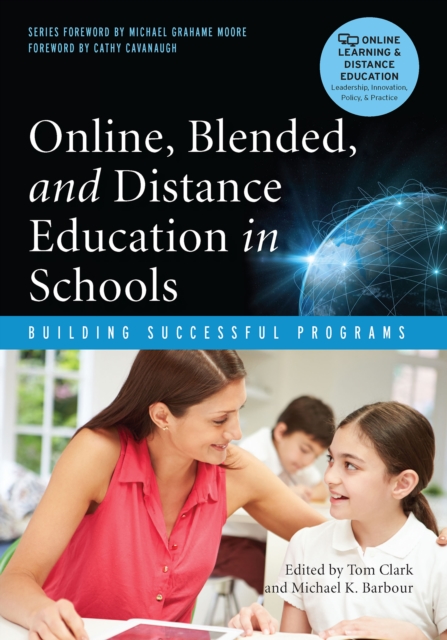
Online, Blended, and Distance Education in Schools
Co-Published with the Microsoft Corporation Online, Blended and Distance Education in Schools provides students enrolled in Education Technology, Educational Administration and related Masters and PhD programs with expert opinions and insights on the practice and policy in K-12 online, blended and distance education, online and blended programs, including curriculum, instruction, technology and management aspects. It describes the status and trends of the field, provides illustrative program examples, explores the issues and challenges that programs face and highlights ongoing research in key areas related to program effectiveness. Topics discussed:* The current status of K-12 online, distance and blended learning in the U.S.* Policy, funding, and management issues in relation to program implementation* Research on effective programs within governmental jurisdiction and various program types* Global case studies that represent the variety of ways programs are being successfully implemented * A synthesis of key findings and lessons learned, and local and global visions for the future of K-12 distance and online learningThis text is highly appropriate for students enrolled in Educational Technology, Educational Administration and related Masters and PhD programs. An online companion resource provides pedagogical features that enhance text use in a classroom setting.
eBook

Jump-Start Your Online Classroom
Jump-Start Your Online Classroom prepares a first-time online instructor to successfully manage the fi rst few weeks of a course. It offers activities to help instructors plan, manage, and facilitate online instruction, as well as resources helpful during the beginning weeks of class. Each chapter is developed around the immediate challenges instructors face when teaching online. The authors address everyday problems and suggest solutions informed by their extensive research and experience. The five challenges, which are designed to be addressed in five days, are making the transition to online teaching, building online spaces for learning, preparing students for online learning, managing and facilitating the online classroom, and assessing learner outcomes in an online classroom.
This book is based on the authors' design and facilitation model, which identifies five elements that comprise an online learning environment: digital tools, participants, social practices, learning communities, and outcomes. This book shows how each element infl uences instructional practices and interacts to create an environment for a meaningful online educational experi ence.
eBook
Digital Learning in Motion
Digital Learning in Motion provides a theoretical analysis of learning and related learning media in society. The book explores how changing media affects learning environments, which changes the learning itself, showing that learning is always in motion.
This book expounds upon the concept of learning, reconstructing how learning unfolds and analyzing the discourse around pedagogy and Bildung in the age of new digital media. It further discusses in detail the threefold relationship between learning and motion, considering how learning is based on motion, generated by new experiences and changes with the environment and through its own mediatization. The book presents a normative model that outlines how learning can be structured on the basis of society’s values and self-understanding discourses in the digital age.
This book will be of great interest for academics, postgraduate students, and researchers in the fields of digital learning and inclusion, education research, educational theory, communication and cultural studies.
eBook

Increasing Student Engagement and Retention in e-learning Environments: Web 2.0 and Blended Learning Technologies
Increasing Student Engagement and Retention in e-Learning Environments: Web 2.0 and Blended Learning Technologies examines new research on how online and blended learning technologies are being used in higher education to increase learner engagement in an era of increasing technological convergence and dependence. These enabling technologies are reshaping and reframing the practice of teaching and learning in higher education. Through case studies, surveys, and literature reviews, this volume will examine online and blended technologies are being used to improve academic literacies in students, to create engaging communities of practice, and how these technologies are being used to improve learner motivation and self-empowered learners. This volume will also discuss a framework for adopting and deploying these technologies.
eBook
Educational Data Mining with R and Rattle
Educational Data Mining (EDM) is one of the emerging fields in the pedagogy and andragogy paradigm, it concerns the techniques which research data coming from the educational domain. EDM is a promising discipline which has an imperative impact on predicting students' academic performance. It includes the transformation of existing, and the innovation of new approaches derived from multidisciplinary spheres of influence such as statistics, machine learning, psychometrics, scientific computing etc. An archetype that is covered in this book is that of learning by example. The intention is that reader will easily be able to replicate the given examples and then adapt them to suit their own needs of teaching-learning. The content of the book is based on the research work undertaken by the authors on the theme \"Mining of Educational Data for the Analysis and Prediction of Students' Academic Performance\". The basic know-how presented in this book can be treated as guide for educational data mining implementation using R and Rattle open source data mining tools. . Technical topics discussed in the book include: • Emerging Research Directions in Educational Data Mining • Design Aspects and Developmental Framework of the System • Model Development - Building Classifiers • Educational Data Analysis: Clustering Approach
eBook