
Catalogue Search | MBRL


Are you sure you want to remove the book from the shelf?

{{itemTitle}}
1,601
result(s) for
"Intelligence service -- Soviet Union"
Sort by:

Near and distant neighbors : a new history of Soviet intelligence
\"A revelatory and pathbreaking account of the highly secretive world of the Soviet intelligence services. A uniquely comprehensive and rich account of the Soviet intelligence services, Jonathan Haslam's Near and Distant Neighbors charts the labyrinthine story of Soviet intelligence from the October Revolution to the end of the Cold War. Previous histories have focused on the KGB, leaving military intelligence and the special service--which specialized in codes and ciphers--lurking in the shadows. Drawing on previously neglected Russian sources, Haslam reveals how both were in fact crucial to the survival of the Soviet state. This was especially true after Stalin's death in 1953, as the Cold War heated up and dedicated Communist agents the regime had relied upon--Klaus Fuchs, the Rosenbergs, Donald Maclean--were betrayed. In the wake of these failures, Khrushchev and his successors discarded ideological recruitment in favor of blackmail and bribery. The tactical turn was so successful that we can draw only one conclusion: the West ultimately triumphed despite, not because of, the espionage war. In bringing to light the obscure inhabitants of an undercover intelligence world, Haslam offers a surprising and unprecedented portrayal of Soviet success that is not only fascinating but also essential to understanding Vladimir Putin's power today\"-- Provided by publisher.
Book

Spy Wars
Chosen by William Safire in the New York Times to be the publishing sleeper-seller of the year for 2007.
In this rapid-paced book, a former CIA chief of Soviet bloc counterintelligence breaks open the mysterious case of KGB officer Yuri Nosenko's 1964 defection to the United States. Still a highly controversial chapter in the history of Cold War espionage, the Nosenko affair has inspired debate for more than forty years: was Nosenko a bona fide defector with the real information about Lee Harvey Oswald's stay in Soviet Russia, or was he a KGB loyalist, engaged in a complex game of deception?
As supervisor of CIA operations against the KGB at the time, Tennent H. Bagley directly handled Nosenko's case. This insider knowledge, combined with information gleaned from dozens of interviews with former KGB adversaries, places Bagley in a uniquely authoritative position. He guides the reader step by step through the complicated operations surrounding the Nosenko affair and shatters the comfortable version of events the CIA has presented to the public. Bagley unveils not only the KGB's history of merciless and bloody betrayals but also the existence of undiscovered traitors in the American camp. Shining new light on the CIA-KGB spy wars, he invites deeper thinking about the history of espionage and its implications for the intelligence community today.
eBook

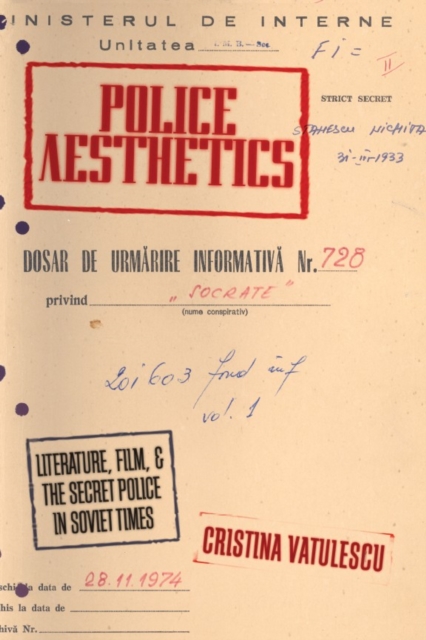
Police Aesthetics
The documents emerging from the secret police archives of the former Soviet bloc have caused scandal after scandal, compromising revered cultural figures and abruptly ending political careers.Police Aesthetics offers a revealing and responsible approach to such materials. Taking advantage of the partial opening of the secret police archives in Russia and Romania, Vatulescu focuses on their most infamous holdings-the personal files-as well as on movies the police sponsored, scripted, or authored. Through the archives, she gains new insights into the writing of literature and raises new questions about the ethics of reading. She shows how police files and films influenced literature and cinema, from autobiographies to novels, from high-culture classics to avant-garde experiments and popular blockbusters. In so doing, she opens a fresh chapter in the heated debate about the relationship between culture and politics in twentieth-century police states.
eBook

The spy in the archive : how one man tried to kill the KGB
How do you steal a library? Not just any library but the most secret, heavily guarded archive in the world. The answer is to be a librarian. To be so quiet, that no-one knows what you are up to as you toil undercover and deep amongst the files. The work goes on for decades but remains so low key, that even after your escape, aided by MI6, no-one even notices you are gone. 'The Spy in the Archive' tells the remarkable story of how Vasili Mitrokhin - an introverted archivist who loved nothing more than dusty files - ended up changing the world. As the in-house archivist for the KGB, the secrets he was exposed to inside its walls turned him first into a dissident and then a spy, a traitor to his country but a man determined to expose the truth about the dark forces that had subverted Russia, forces still at work in the country today.
BOOK

Enemy Archives
Soviet counterinsurgency officers assembled a comprehensive archive documenting the ideological worldview, operational structures, and activities of the Ukrainian nationalist movement. Viatrovych and Luciuk have curated a selection of these documents that challenges prejudices about who these Ukrainian nationalists were, whom they fought, and why.
eBook

KGB Lexicon
In this volume Mitrokhin presents two dictionaries produced by the KGB itself to define their activities in both offensive and defensive intelligence work. The translated documents tell the story of the KGB's methods and targets and should interest the general public as well as the specialist.
eBook

An impeccable spy : Richard Sorge, Stalin's master agent
\"Richard Sorge was a man with two homelands. Born of a German father and a Russian mother in Baku in 1895, he moved in a world of shifting alliances and infinite possibility. A member of the angry and deluded generation who found new, radical faiths after their experiences on the battlefields of the First World War, Sorge became a fanatical communist - and the Soviet Union's most formidable spy. Like many great spies, Sorge was an effortless seducer, combining charm with ruthless manipulation. He did not have to go undercover to find out closely guarded state secrets - his victims willingly shared them. As a foreign correspondent, he infiltrated and influenced the highest echelons of German, Chinese and Japanese society in the years leading up to and including the Second World War. His intelligence regarding Operation Barbarossa and Japanese intentions not to invade Siberia in 1941 proved pivotal to the Soviet counteroffensive in the Battle of Moscow, which in turn determined the outcome of the war. Never before has Sorge's story been told from the Russian side as well as the German and Japanese. Owen Matthews takes a sweeping historical perspective and draws on a wealth of declassified Soviet archives - along with testimonies from those who knew and worked with Sorge - to rescue the riveting story of the man described by Ian Fleming as 'the most formidable spy in history'\"--Dust jacket.
Book

The sword and the shield : the Mitrokhin archive and the secret history of the KGB
Christopher Andrew's new book is based on one of the most extraordinary intelligence coups of recent times: the discovery of a treasure-trove of highly classified documents which the FBI has described, after close examination, as the \"most complete and extensive intelligence ever received from any source.\" Though there is top-secret material on almost every country in the world, the United States is at the top of the list. The contents of the book remain embargoed until publication. As well as containing many fascinating revelations, this is a major contribution to the secret history of the twentieth century.
eBook