
Catalogue Search | MBRL


Are you sure you want to remove the book from the shelf?

{{itemTitle}}
134
result(s) for
"Interactive whiteboards"
Sort by:

Teaching languages with technology : communicative approaches to interactive whiteboard use : a resource book for teacher development
\"This book draws on theories of second language acquisition (SLA) to illustrate how interactive white board technology can be exploited to support language acquisition. It examines interaction, collaboration and negotiation of meaning and focus on form in the communicative language classroom in primary, secondary and vocational schools. In recent years new technologies have been incorporated into second and foreign language education as tools for implementing teaching methodologies. IWBs have established their role in the field of computer-assisted language learning (CALL) and are an effective and inspiring tool which motivates both teachers and learners. Although the number of IWBs in classrooms has rapidly increased over the past decade in many parts of the world, teacher training materials and pedagogical support for the design, evaluation and implementation of IWB-based materials in the foreign language classroom has not kept pace. Research also shows that language teachers do not always use IWBs in pedagogically sound ways. There is a real need for the development of training models and examples of good practice which can support teachers in developing the necessary competencies for exploiting the IWB in ways consistent with current theories of language teaching pedagogy.This book provides that best practice and gives a full account of in-depth research in an accessible manner\"-- Provided by publisher.
Book

Teachers' Belief and Use of Interactive Whiteboards for Teaching and Learning
Interactive whiteboards (IWB) are regarded as one of the most revolutionary instructional technologies for various educational levels. While the impacts of IWBs in classroom settings have been examined recently in a number of studies, this study not only looks at the perception but also examines the actual usage and behaviors associated with promising IWB features in practical settings. The main goal of this paper is to evaluate both teachers' perceptions and their use of IWBs. A questionnaire was developed based on an extensive literature review as well as related instructional theories and models. The questionnaire consisted of questions about demographics, usage, and teachers' perceptions related to IWBs. For this study, 174 teacher-participants, who have actively used IWBs for instruction, were selected from various educational levels (from grade 6 to 12). The results show that teachers believe that IWBs can be used for different subject domains. Also, teachers believe that IWBs can be used to facilitate learning and instruction under the following conditions, 1) collaboration with colleagues, 2) training about effective instructional strategies using IWB, and 3) more frequent teacher use of IWBs to improve IWB competency.
Journal Article

Interactive Whiteboard Acceptance : Applicability of the UTAUT Model to Student Teachers
A review of the literature shows that the model for the Unified Theory of Acceptance and Use of Technology (UTAUT) has received only limited validation in educational contexts. This limitation led to this study to determine the
applicability of the UTAUT model with an educational perspective and to statistically explain the factors affecting student teachers' intentions to use interactive whiteboards. The research project comprised a cohort of 159 student
teachers who undertook a questionnaire designed to measure their responses to performance expectancy, effort expectancy, social influence, facilitating condition and behavioural intention. Structural equation modelling was used as the
main technique for data analysis. According to the result of the goodness-of-fit test, the findings led to the conclusion that the model was endorsed by the data. Overall, the model accounted for 59.6 % of the variance in intention of
student teachers to use interactive whiteboards in their teaching. The findings also demonstrated the important distinction of performance expectancy, effort expectancy and user's experiences in interactive whiteboard adoption amongst
student teachers. The theoretical and practical implications of the model are discussed.
Journal Article
Interaktive Tafeln Im Physikunterricht
Long description:
In den letzten Jahren hat im traditionellen Klassenzimmer ein Wandel hin zur Nutzung moderner Informations- und Kommunikationstechnologien begonnen. Während die Entwicklung in den letzten Jahrzehnten jedoch nur langsam vorangeschritten ist, wird der Trend nun durch die großflächige Einführung interaktiver Tafeln (IAT), auch als Interactive Whiteboards (IWB) bekannt, massiv verstärkt.
Ausgehend von der Analyse der Forschungsliteratur wurden in der Dissertation die technischen und didaktischen Potentiale der IAT erarbeitet und die möglichen Einflüsse auf den Unterricht dargelegt. Anhand theoretischer Modelle wurdeninhaltliche und methodische Anforderungen an eine zu entwickelnde Fortbildung umrissen und durch die praktischen Erfahrungen aus den bisherigen Studien ergänzt.
Basierend auf diesen Vorarbeiten und den Rahmenbedingungen in Sachsen wird untersucht, wie IAT im sächsischen Physikunterricht eingesetzt werden und wie dieser Physikunterricht von Lehrern und Schülern wahrgenommen wird. Die Evaluation einer entwickelten Lehrerfortbildung bestätigt unter anderem, dass eine Beschränkung auf die grundlegende Bedienung keinesfalls ausreichend ist und der Bedarf an didaktischer Begleitung enorm ist.
Es wird deutlich, dass die Nutzung zwischen den Lehrern stark differiert und die Schüler eine differenzierte Einstellung zu IAT im Physikunterricht haben.
eBook
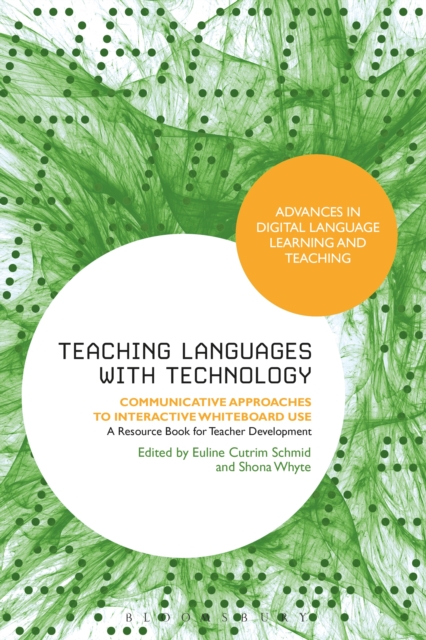
Teaching languages with technology : communicative approaches to interactive whiteboard use : a resource book for teacher development
This book draws on theories of second language acquisition (SLA) to illustrate how interactive white board technology can be exploited to support language acquisition. It examines interaction, collaboration and negotiation of meaning and focus on form in the communicative language classroom in primary, secondary and vocational schools. In recent years new technologies have been incorporated into second and foreign language education as tools for implementing teaching methodologies. IWBs have established their role in the field of computer-assisted language learning (CALL) and are an effective and inspiring tool which motivates both teachers and learners. Although the number of IWBs in classrooms has rapidly increased over the past decade in many parts of the world, teacher training materials and pedagogical support for the design, evaluation and implementation of IWB-based materials in the foreign language classroom has not kept pace. Research also shows that language teachers do not always use IWBs in pedagogically sound ways. There is a real need for the development of training models and examples of good practice which can support teachers in developing the necessary competencies for exploiting the IWB in ways consistent with current theories of language teaching pedagogy.This book provides that best practice and gives a full account of in-depth research in an accessible manner.
eBook

Technical Education Support in Pre-Primary Education by Interactive Teaching Systems
The paper deals with the possibility of interactive whiteboard (IWB) implementation to the technical education support in the frames of pre-primary education. It also presents some types of IWB, deals with problems associated with this issue and introduces teachers’ competencies needed for the work with them. The final part points out the results of the research realized in this field in the USA and in Slovakia.
Journal Article

Educational Technologies in Problem-Based Learning in Health Sciences Education: A Systematic Review
As a modern pedagogical philosophy, problem-based learning (PBL) is increasingly being recognized as a major research area in student learning and pedagogical innovation in health sciences education. A new area of research interest has been the role of emerging educational technologies in PBL. Although this field is growing, no systematic reviews of studies of the usage and effects of educational technologies in PBL in health sciences education have been conducted to date.
The aim of this paper is to review new and emerging educational technologies in problem-based curricula, with a specific focus on 3 cognate clinical disciplines: medicine, dentistry, and speech and hearing sciences. Analysis of the studies reviewed focused on the effects of educational technologies in PBL contexts while addressing the particular issue of scaffolding of student learning.
A comprehensive computerized database search of full-text articles published in English from 1996 to 2014 was carried out using 3 databases: ProQuest, Scopus, and EBSCOhost. Eligibility criteria for selection of studies for review were also determined in light of the population, intervention, comparison, and outcomes (PICO) guidelines. The population was limited to postsecondary education, specifically in dentistry, medicine, and speech and hearing sciences, in which PBL was the key educational pedagogy and curriculum design. Three types of educational technologies were identified as interventions used to support student inquiry: learning software and digital learning objects; interactive whiteboards (IWBs) and plasma screens; and learning management systems (LMSs).
Of 470 studies, 28 were selected for analysis. Most studies examined the effects of learning software and digital learning objects (n=20) with integration of IWB (n=5) and LMS (n=3) for PBL receiving relatively less attention. The educational technologies examined in these studies were seen as potentially fit for problem-based health sciences education. Positive outcomes for student learning included providing rich, authentic problems and/or case contexts for learning; supporting student development of medical expertise through the accessing and structuring of expert knowledge and skills; making disciplinary thinking and strategies explicit; providing a platform to elicit articulation, collaboration, and reflection; and reducing perceived cognitive load. Limitations included cumbersome scenarios, infrastructure requirements, and the need for staff and student support in light of the technological demands of new affordances.
This literature review demonstrates the generally positive effect of educational technologies in PBL. Further research into the various applications of educational technology in PBL curricula is needed to fully realize its potential to enhance problem-based approaches in health sciences education.
Journal Article

Teachers’ Attitudes Towards the Use of Interactive Whiteboards in the English Secondary School Classroom in Kuwait
This study aims to investigate teachers’ attitudes towards the use of interactive whiteboards (IWB) in the English secondary school classroom. The study also investigates the problems that might face teachers while using the IWB. The data were gathered using a qualitative method which included interviews with seven English teachers and four observation exercises in different cities in Kuwait. The result of this study revealed that teachers have a positive attitude towards the use of the IWB in Kuwait. The findings of this study show that the IWB can be helpful as it can save time during the lesson and reduce teachers’ efforts in writing on the board; the IWB might be helpful in simplifying the topics that teachers explain in the lesson. It was also found that the IWB might increase the level of concentration and participation in the lesson. In spite of the fact that the teachers have a positive attitude towards the use of the IWB in the lesson, there are many problems that can face teachers while using the IWB. The findings show that a lack of training, technical issues, a lack of support, restrictions in accessing some educational websites and anxiety in using governmental property could promote a gap between the IWB and the teachers using the IWB as an instructional tool.
Journal Article

The use of interactive whiteboards in urban Gauteng classrooms
There are teachers that have technology in their classrooms that is underutilised or not used at all because of factors like technical problems, lack of training or support or teachers’ negative attitudes. This study wanted to determine the impact of the use of interactive whiteboards (IWBs) in primary and secondary urban classrooms in Pretoria, Gauteng. Interactive whiteboards are one of the technologies that are most commonly used in education worldwide. Technology has taken over our lives and it is becoming more necessary for upcoming generations to become technologically proficient. The overall purpose of the study was to determine the external factors, perceived ease of use, perceived usefulness, the attitudes of educators and learners towards technology, the behavioural intention to use the technology and the actual use of the technology according to the technology acceptance model (TAM). This was a qualitative case study and the researcher collected data from three secondary and six primary schools in Gauteng. She sent questionnaires to the schools and obtained answers from 30 secondary school and 99 primary school teachers. It was determined that more primary school teachers use the IWBs than secondary school teachers and they also use it more effectively. Most of the teachers find the IWBs easy to use and integrate the technology in their lessons. Teachers also indicated that the IWBs are very useful for saving their work, it helps them make lessons more interactive, visual and interesting and that the use of the technology motivates learners to participate.
Journal Article

Enhancing Statistical Thinking in Higher Education Through Pedagogically Designed Use of Interactive Whiteboards
Although interactive technologies such as interactive whiteboards are increasingly used in higher education, empirical evidence regarding their pedagogical role in statistics education remains limited. Existing studies often focus on technology adoption rather than instructional design. This study examines the effectiveness of interactive whiteboards when embedded within a pedagogically designed instructional framework aimed at supporting statistical thinking. A mixed-methods, quasi-experimental design with pre- and post-test measures (N = 126) was employed to compare learning outcomes and student perceptions in an introductory university statistics course taught either through traditional lectures or through an interactive approach emphasizing dynamic visualization, collective interpretation, and formative feedback. Mediation was tested using bootstrapped indirect effects and complemented by qualitative thematic analysis. Students in the interactive condition demonstrated significantly greater gains in statistical reasoning (Cohen’s d = 0.94, 95% CI [0.57, 1.31]), particularly in tasks involving data interpretation and reasoning about variability. Mediation analysis indicated that two student self-report measures—perceived clarity of instruction and formative feedback quality—together accounted for 63% of the total effect. The interactive format was especially beneficial for students with lower prior knowledge, reducing achievement gaps by 34%. These findings are consistent with the view that interactive technologies support conceptual learning most effectively when embedded in deliberate pedagogical designs promoting visualization, collective reasoning, and real-time feedback, highlighting the central role of instructional design over technological presence.
Journal Article