
Catalogue Search | MBRL


Are you sure you want to remove the book from the shelf?

{{itemTitle}}
3,909
result(s) for
"Intergovernmental Organizations"
Sort by:

Governing the global polity
What does globalization mean for the principle of state sovereignty and for the power and functioning of states? Whereas realists assert the continued importance of states, constructivists contend that various political entities as well as the logic of globalization itself undermine state sovereignty. Drawing on the state formation literature and on social theory, particularly the works of Weber and Foucault, Iver B. Neumann and Ole Jacob Sending question the terms of the realist-constructionist debate. Through detailed case studies, they demonstrate that states use nongovernmental organizations and international organizations indirectly to enforce social order and, ultimately, to increase their own power. At the same time, global politics is dominated by a liberal political rationality that states ignore at their peril. While states remain as strong as ever, they operate within a global polity of new hierarchies among states and between states and other actors.
eBook

Routledge History of International Organizations
This is a definitive and comprehensive history of international organizations from their very beginning at the Congress of Vienna in 1815 up to the present day, and provides the reader with nearly two centuries of world history seen from the perspective of international organizations. It covers the three main fields of international relations: security, economics and the humanitarian domain which often overlap in international organizations. As well as global and intercontinental organizations, the book also covers regional international organizations and international non-governmental organizations in all continents.
The book progresses chronologically but also provides a thematic and geographical coherence so that related developments can be discussed together. A series of detailed tables, figures, charts and information boxes explain the chronologies, structures and relationships of international organizations. There are biographies, histories and analysis of hundreds of international organizations.
This is an essential reference work with direct relevance to scholars in international relations, international political economy, international economics and business and security studies.
1. International organizations as a cooperation between governments and citizens 2. 1815: the invention of the multilateral conference plus follow-up conference 3. The Central Commission for the Navigation of the Rhine and burgeoning free trade 4. Citizens organizing transnationally 5. The International Red Cross made responsible for the Geneva Convention 6. Arbitration and international law as normative powers 7. The 1899 and 1907 peace conferences: the Hague system 8. Creation of public international unions 1865-1914 9. Standardization and intellectual property recognized internationally 10. Regulation of international shipping, railway and road traffic 11. International organizations and continental markets 1860-1910 12. International business 13. Rising international emancipation movements 14. The international foundation of the welfare state 15. World war and the creation of the League of Nations 16. Great powers and collective security during the interwar period 17. The workings of the International Labour Organization 18. The League of Nations’ economic and social activities 19. International cooperation during the Second World War 20. The United Nations: an improved security organization with economic coordination 21. The United Nations system 22. Collective security in a bipolar world 23. Regional alliances of the 1940s and 1950s 24. The Bretton Woods institutions and their laborious beginnings 25. Early European economic cooperation 26. Decolonization, anti-apartheid and peaceful coexistence 27. The UN Development Decade: North versus South 28. The G7 undermining the UN system 29. Influence of non-governmental organizations 30. Human rights as normative power 31. Highlighting the Cold War 32. Reagonomics, IMF and economic adjustment 33. The end of the Cold War 34. A new world order and an agenda for peace? 35. From GATT to World Trade Organization 36. Free trade versus environment and the welfare state 37. IMF, IBRD and WTO criticized 38. Continued and new regionalism 39. Harming collective security 40. International Organizations since 1815 Appendix: Nation-states in the international system since 1815
'This magnum opus will become the standard text on the history of international organizations for years to come. Bob Reinalda provides the most comprehensive overview of the development, strengths and weaknesses of international organizations since the early days of the Concert of Europe. The volume's interdisciplinary scope, combining international relations, history and international law, is simply unmatched. It will be an essential reference guide for scholars and practitioners alike.' Dennis Dijkzeul, Ruhr-University Bochum, Germany
'An Indispensable reference for the student of international affairs interested in diplomatic history or contemporary politics, from the Congress of Vienna to the age of globalization. Analysis of context plus documentary texts renders the book particularly attractive.' Ilter Turan, Professor, Department of International Relations, Istanbul Bilgi University, Turkey
'This thorough and comprehensive history will be the starting point for historians of international organizations for many years to come.' Craig N. Murphy, Wellesley College, USA
\"Summing Up: Recommended. Upper-level undergraduates and above.\" - D. Liestman, CHOICE (May 2010)
Bob Reinalda is Senior Lecturer in International Relations at the Department of Political Science, Nijmegen School of Management at Radboud University Nijmegen, The Netherlands. He has written extensively about the history of social movements, non-governmental organizations, autonomous policy making by, decision making within and implementation by intergovernmental organizations, and the Bologna Process.
eBook

International Institutions and National Policies
The proliferation of international institutions and their impact has become a central issue in international relations. Why do countries comply with international agreements and how do international institutions influence national policies? Most theories focus on the extent to which international institutions can wield 'carrots and sticks' directly in their relations with states. Xinyuan Dai presents an alternative framework in which they influence national policies indirectly by utilizing non-state actors (NGOs, social movements) and empowering domestic constituencies. In this way, even weak international institutions that lack 'carrots and sticks' may have powerful effects on states. Supported by empirical studies of environmental politics, human rights and economic and security issues, this book sheds fresh light on how and why international institutions matter. It will be of interest to students, scholars and policymakers in both international relations and international law.
eBook

The Urbanization of Forced Displacement
UNHCR, the world's largest humanitarian organization charged with assisting displaced people globally, estimates over 60 per cent of refugees now live in urban areas. This book explores how UNHCR's approach to urban displacement has changed since the 1990s through an in-depth study of how UNHCR works and conceives its role in global politics today.
eBook
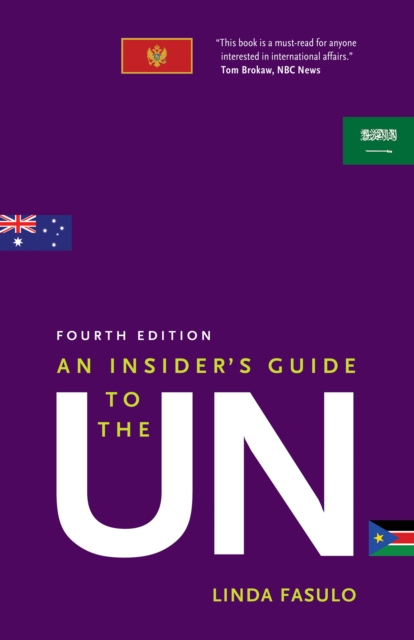
An Insider's Guide to the UN
Thoroughly revised and updated, a new edition of the most
popular guide to the UN for students and interested
readers Prominent NPR journalist Linda Fasulo's guide to
the United Nations has established a reputation as the most lively,
authoritative, and insightful book on its subject. The fourth
edition comes at a time when nuclear proliferation has moved to the
top of the Security Council's agenda, followed closely by the
Syrian crisis, the effects of climate change, and international
terrorism. Thoroughly revised and updated, with many new profiles
and interviews with the organization's current diplomats, this
edition remains an indispensable resource for anyone wishing to
understand the role and structure of the UN.
eBook
The Institutional Veil in Public International Law
This book deals with the nature of international organisations and the tension between their legal nature and the system of classic, state-based international law. This tension is important in theory and practice, particularly when organisations are brought under the rule of international law and have to be conceptualised as legal subjects, for example in the context of accountability. The position of organisations is complicated by what the author terms 'the institutional veil', comparable to the corporate veil found in corporate law. The book focuses on the law of treaties, as this pre-eminently 'horizontal' branch of international law brings out the problem particularly clearly. The first part of the book addresses the legal phenomenon of international organisations, their legal features as independent concepts, the history of international organisations and of legal thought in respect of them, and the development of contemporary law on international organisations. The second part deals with the practice of international organisations and treaty-making. It discusses treaty-making practice within organisations, judicial practice in interpretation of organisations' constitutive treaties, and the practice of treaty-making by organisations. The third and final part analyses the process by which international organisations have been brought under the rule of the written law of treaties, offering a practical application of the conceptual framework as previously set out. Part three is at the same time an analytic overview of the drafting history of the 1986 Vienna Convention on the Law of Treaties between States and International Organizations or between International Organizations. This is a profound and penetrating examination of the character of international organisations and their place in international law, and will be an important source for anyone interested in the future role of organisations in the international legal system.
eBook

Walking the Extra Mile
It is August 26, 2015.A crucial day during the Conference of State Parties in Cancún, Mexico.67 of the 69 member states of the Arms Trade Treaty vote for a location of the new Secretariat.Three candidate host states and their cities are bidding: Austria (Vienna), Switzerland (Geneva), and Trinidad and Tobago (Port of Spain).
eBook

Controlling Institutions
How is the United States able to control the IMF with only 17 per cent of the votes? How are the rules of the global economy made? This book shows how a combination of formal and informal rules explains how international organizations really work. Randall W. Stone argues that formal rules apply in ordinary times, while informal power allows leading states to exert control when the stakes are high. International organizations are therefore best understood as equilibrium outcomes that balance the power and interests of the leading state and the member countries. Presenting a new model of institutional design and comparing the IMF, WTO, and EU, Stone argues that institutional variations reflect the distribution of power and interests. He shows that US interests influence the size, terms, and enforcement of IMF programs, and new data, archival documents, and interviews reveal the shortcomings of IMF programs in Mexico, Russia, Korea, Indonesia, and Argentina.
eBook

Digital Diplomacy and International Organisations
This book examines how international organisations (IOs) have struggled to adapt to the digital age, and with social media in particular.
The global spread of new digital communication technologies has profoundly transformed the way organisations operate and interact with the outside world. This edited volume explores the impact of digital technologies, with a focus on social media, for one of the major actors in international affairs, namely IOs. To examine the peculiar dynamics characterising the IO-digital nexus, the volume relies on theoretical insights drawn from the disciplines of International Relations, Diplomatic Studies, Media, and Communication Studies, as well as from Organisation Studies. The volume maps the evolution of IOs' \"digital universe\" and examines the impact of digital technologies on issues of organisational autonomy, legitimacy and contestation. The volume's contributions combine engaging theoretical insights with newly compiled empirical material and an eclectic set of methodological approaches (multivariate regression, network analysis, content analysis, sentiment analysis), offering a highly nuanced and textured understanding of the multifaceted, complex, and ever-evolving nature of the use of digital technologies by international organisations in their multilateral engagements.
This book will be of much interest to students of diplomacy, media, and communication studies, and international organisations.
eBook