
Catalogue Search | MBRL


Are you sure you want to remove the book from the shelf?

{{itemTitle}}
11,392
result(s) for
"Internal structure"
Sort by:

Into the heart of our world : a journey to the center of the earth : a remarkable voyage of scientific discovery
The journey to the center of the earth is a voyage like no other we can imagine. Over 6300 km below the earth's surface, an extraordinary inner world the size of Mars awaits us. Dive through the molten iron of the outer core and eventually you will reach a solid sphere-- an iron-clad world held within a metal sea and unattached to anything above. At the earth's core is the history of our planet written in temperature and pressure, crystals and minerals. Our planet appears tranquil from outer space. And yet the arcs of volcanoes, the earthquake zones and the auroral glow rippling above our heads are testimony to something remarkable happening inside. For thousands of years, these phenomena were explained in legend and myth. Only in recent times has the brave new science of seismology emerged. One hundred and fifty years after the extraordinary, imaginative feat of Jules Verne's Journey to the center of the Earth, David Whitehouse embarks on a voyage of scientific discovery into the heart of our world. Seismologists today reveal a planet astonishingly buried within a planet. We watch as supercomputers convert signals from the ground into three-dimensional scans of subterranean continents, visit laboratories where scientists attempt to reproduce the intense conditions at the center of the Earth, travel down the throat of a volcano, look into the deepest hole ever drilled, and imagine a voyage through enormous crystals of iron. Whitehouse's enthralling journey vividly charts all we are able to understand about the mysteries of the deep Earth. His book encompasses the history of our planet and the latest findings about its inner core, allowing us to embark on an adventure that brings us closer to the enigma of our existence.
Book
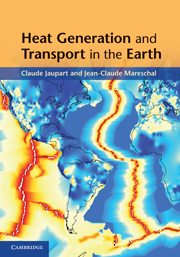
Heat Generation and Transport in the Earth
Heat provides the energy that drives almost all geological phenomena and sets the temperature at which these phenomena operate. This book explains the key physical principles of heat transport with simple physical arguments and scaling laws that allow quantitative evaluation of heat flux and cooling conditions in a variety of geological settings and systems. The thermal structure and evolution of magma reservoirs, the crust, the lithosphere and the mantle of the Earth are reviewed within the context of plate tectonics and mantle convection - illustrating how theoretical arguments can be combined with field and laboratory data to arrive at accurate interpretations of geological observations. Appendices contain data on the thermal properties of rocks, surface heat flux measurements and rates of radiogenic heat production. This book can be used for advanced courses in geophysics, geodynamics and magmatic processes, and is a reference for researchers in geoscience, environmental science, physics, engineering and fluid dynamics.
eBook


Early Earth systems
Early Earth Systems provides a complete history of the Earth from its beginnings to the end of the Archaean. This journey through the Earth's early history begins with the Earth's origin, then examines the evolution of the mantle, the origin of the continental crust, the origin and evolution of the Earth's atmosphere and oceans, and ends with the origin of life. - Looks at the evidence for the Earth's very early differentiation into core, mantle, crust, atmosphere and oceans and how this differentiation saw extreme interactions within the Earth system. - Discusses Archaean Earth processes within the framework of the Earth System Science paradigm, providing a qualitative assessment of the principal reservoirs and fluxes in the early Earth. “The book would be perfect for a graduate-level or upper level undergraduate course on the early Earth. It will also serve as a great starting point for researchers in solid-Earth geochemistry who want to know more about the Earth’s early atmosphere and biosphere, and vice versa for low temperature geochemists who want to get a modern overview of the Earth’s interior.” Geological Magazine, 2008
eBook

The street beneath my feet
Constructed on one continuous folded page, this book explores the layers of the Earth from human-made structures like sewers, subways, and archeological finds, down through various formations of rock, to the Earth's core and back up again.
Book

Equity Concentration, Internal Equity Structure and Company Performance
Under the background of improving the modern enterprise system with Chinese characteristics and accelerating the development of new quality productive forces, discussing the equity structure and salary incentive mechanism of listed companies in hydrogen energy, an emerging energy source, can provide reasonable and effective development paths for improving the performance of hydrogen energy companies. Based on the research sample of 289 hydrogen energy companies listed on the A-share market from 2013 to 2023, this paper analyzes effectiveness using the coefficient of variation method, conducts empirical research using multiple linear regression, and tests the robustness, endogeneity, and heterogeneity of the results. Research Findings: There is a positive correlation between the shareholding ratio of the largest shareholder and company performance, but it is not significant; the shareholding ratios of the top five and top ten shareholders are significantly positively correlated with company performance, respectively; the shareholding ratio of the supervisory board is significantly positively correlated with company performance; and the remuneration of the supervisory board is significantly positively correlated with company performance.
Journal Article

Peeking underground
\"Illustrates the layers below Earth's surface, from crust to core, and the plants and animals that live within\"-- Provided by publisher.
Book

Best practices for your confirmatory factor analysis: A JASP and lavaan tutorial
Confirmatory factor analysis (CFA) is a fundamental method for evaluating the internal structural validity of measurement instruments. In most CFA applications, the measurement model serves as a means to an end rather than an end in itself. To select the appropriate model, prior validity evidence is crucial, and items are typically assessed on an ordinal scale, which has been used in the applied social sciences. However, textbooks on structural equation modeling (SEM) often overlook this specific case, focusing on applications estimable using maximum likelihood (ML) instead. Unfortunately, several popular commercial SEM software packages lack suitable solutions for handling this ‘typical CFA’, leading to confusion and suboptimal decision-making when conducting CFA in this context. This article conceptually contributes to this ongoing discussion by presenting a set of guidelines for conducting a typical CFA, drawing from recent empirical research. We provide a practical contribution by introducing and developing a tutorial example within the JASP and
lavaan
software platforms. Supplementary materials such as videos, files, and scripts are freely available.
Journal Article


Assessing the representation of tropical cyclones in ERA5 with the CNRM tracker
The ERA5 dataset from the European Center for Medium-Range Weather Foreceasts is the first global reanalysis to reach a horizontal resolution of 31 km and thus provides a unique opportunity to look at tropical cyclones (TC), and in particular at the 3D fields associated with observed TCs. To that end, a specifically calibrated TC tracking scheme is applied on ERA5 along with a track pairing algorithm to match the detected tracks with the IBTrACS catalog in order to investigate how well TCs are represented in the reanalysis. After tuning of the tracking scheme and the application of a dynamic mid-latitude system filtering technique, it is shown that the majority of IBTrACS TCs are detected in ERA5 and that the amount of false alarms is kept reasonably low in most regions. By comparing detected tracks with their IBTrACS counterparts, it is found that TC intensity is still strongly underestimated in ERA5 but that the minimum sea-level pressure distribution is better represented than maximum wind speed. The comparison between the life cycles from both datasets highlights key differences between ERA5 and the best-track catalog, showing in particular that the delay with which TCs from ERA5 reach their peak intensity compared to IBTrACS increases significantly with real TC intensity increase. Finally, the internal structure of TCs in the reanalysis for each intensity class are analyzed and reveal distinct intensification patterns up to Category 3.
Journal Article