
Catalogue Search | MBRL


Are you sure you want to remove the book from the shelf?

{{itemTitle}}
15,744
result(s) for
"International Criminal Court."
Sort by:


The Reparation System of the International Criminal Court
Dedicated to one of the great innovations in the proceedings before the International Criminal Court, this book offers a comprehensive analysis of the Court's power to order a convicted person to make reparations to victims, possibilities for its implementation and its potential to bring justice to victims.
eBook


Negotiating the International Criminal Court
This book is for those who want to know and understand the reasons and the story behind these historic negotiations or for those who may wonder how apparently conventional United Nations negotiations became so unusual and successful. This book is both for those who seek detailed legislative history, scholars or practitioners in international law and relations and those simply curious about how the Court came about.
eBook

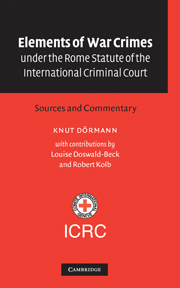
Elements of War Crimes under the Rome Statute of the International Criminal Court
The Elements of War Crimes will assist the International Criminal Court (ICC) in the interpretation and application of the articles of the ICC Statute defining the crimes under its jurisdiction. These will not only be necessary for the future work of the ICC in interpreting the crimes provisions, but also for national courts, which have primary responsibility in the prosecution of international crimes under the Rome Statute. This commentary provides a critical insight into the travaux préparatoires of the Preparatory Commission leading to the adoption of the elements of war crimes. It contains an analysis of existing case law related to each war crime in the Statute. It will provide States, judges, prosecutors and international and national lawyers with key background information to implement international humanitarian law in future cases dealing with war crimes under the ICC. A unique, indispensable tool for prosecuting and defense lawyers working in international criminal law.
eBook

Rough justice : the International Criminal Court in a world of power politics
\"Ten years ago, in the wake of massive crimes in central Africa and the Balkans, the first permanent international criminal court was established in The Hague despite resistance from some of the world's most powerful states. In the past decade, the court has grown from a few staff in an empty building to a bustling institution with more than a thousand lawyers, investigators, and administrators from around the world. Despite its growth and the backing of more than 120 nations, the ICC is still struggling to assert itself in often turbulent political crises. The ICC is generally autonomous in its ability to select cases and investigate crimes, but it is ultimately dependent on sovereign states, and particularly on the world's leading powers. These states can provide the diplomatic, economic, and military clout the court often needs to get cooperation-and to arrest suspects. But states don't expend precious political capital lightly, and the court has often struggled to get the help it needs. When their interests are most affected, moreover, powerful states usually want the court to keep its distance. Directly and indirectly, they make their preferences known in The Hague. Rough Justice grapples with the court's basic dilemma: designed to be apolitical, it requires the support of politicians who pursue national interests and answer to domestic audiences. Through a sharp analysis of the dynamics at work behind the scenes, Bosco assesses the ways in which powerful states have shaped the court's effort to transform the vision of international justice into reality. This will be the definitive account of the Court and its uneven progress toward advancing accountability around the world\"-- Provided by publisher.
Book

THE CREATION OF THE AFRICAN CRIMINAL COURT: CHALLENGES AND PERSPECTIVES OF AN ALTERNATIVE JUSTICE TO THE INTERNATIONAL CRIMINAL COURT / LA CREATION DE LA COUR PENALE AFRICAINE : DEFIS ET PERSPECTIVES D’UNE JUSTICE ALTERNATIVE A LA COUR PENALE INTERNATIONALE
The creation of the future African Criminal Court (ACC) was envisaged by the African Union (AU) as the African states’ collective response to the \"politicization\" of the International Criminal Court (ICC). Eight years following its signature, the Maloba Protocol has never obtained the fifteen ratifications required to spearhead the operationalisation of the ACC. This article attempts to address two fundamental questions: - what are the challenges hindering the creation of the CCA? - and how effective will the CCA be in trying Africans for crimes they have committed on their own soil? It reveals, on the one hand obstacles that hinder the implementation of the Malabo protocol; and on the other hand, challenges that could hamper the CCA's effectiveness as soon as it becomes operational.
Journal Article

Complementarity in the line of fire : the catalysing effect of the international criminal court in Uganda and Sudan
\"Of the many expectations attending the creation of the first permanent International Criminal Court, the greatest has been that the principle of complementarity would catalyse national investigations and prosecutions of conflict-related crimes and lead to the reform of domestic justice systems. Sarah Nouwen explores whether complementarity has had such an effect in two states subject to ICC intervention: Uganda and Sudan. Drawing on extensive empirical research and combining law, legal anthropology and political economy, she unveils several effects and outlines the catalysts for them. However, she also reveals that one widely anticipated effect - an increase in domestic proceedings for conflict-related crimes - has barely occurred. This finding leads to the unravelling of paradoxes that go right to the heart of the functioning of an idealistic Court in a world of real constraints\"-- Provided by publisher.
Book

The Politics of Genocide
Beginning with the negotiations that concluded with the unanimous
adoption of the United Nations Convention on the Prevention and
Punishment of the Crime of Genocide on December 9, 1948, and
extending to the present day, the United States, Soviet
Union/Russia, China, United Kingdom, and France have put forth
great effort to ensure that they will not be implicated in the
crime of genocide. If this were to fail, they have also ensured
that holding any of them accountable for genocide will be
practically impossible. By situating genocide prevention in a
system of territorial jurisdiction; by excluding protection for
political groups and acts constituting cultural genocide from the
Genocide Convention; by controlling when genocide is meaningfully
named at the Security Council; and by pointing the responsibility
to protect in directions away from any of the P-5, they have
achieved what can only be described as practical impunity for
genocide. The Politics of Genocide is the first book to
explicitly demonstrate how the permanent member nations have
exploited the Genocide Convention to isolate themselves from the
reach of the law, marking them as \"outlaw states.\"
eBook