
Catalogue Search | MBRL


Are you sure you want to remove the book from the shelf?

{{itemTitle}}
1,528,393
result(s) for
"International Economics"
Sort by:


The Economic Weapon
The first international history of the emergence of
economic sanctions during the interwar period and the legacy of
this development Economic sanctions dominate the landscape
of world politics today. First developed in the early twentieth
century as a way of exploiting the flows of globalization to defend
liberal internationalism, their appeal is that they function as an
alternative to war. This view, however, ignores the dark paradox at
their core: designed to prevent war, economic sanctions are modeled
on devastating techniques of warfare. Tracing the use of economic
sanctions from the blockades of World War I to the policing of
colonial empires and the interwar confrontation with fascism,
Nicholas Mulder uses extensive archival research in a political,
economic, legal, and military history that reveals how a coercive
wartime tool was adopted as an instrument of peacekeeping by the
League of Nations. This timely study casts an overdue light on why
sanctions are widely considered a form of war, and why their
unintended consequences are so tremendous.
eBook

Macroeconomic performance in a globalising economy
\"The process of globalisation has been ongoing for centuries, but few would doubt that it has accelerated and intensified in recent decades. This acceleration is evidenced as much by the strong synchronicity in the rapid transmission of financial crises starting in late 2007 as it is by the decade of almost unprecedented growth in international trade and financial market liberalisation that preceded it. This book shows how the international economy has become more connected via increased production, trade, capital flows and financial linkages. Using a variety of methodologies, including both panel econometrics and DSGE modelling, a team of experts from academia, central banks and the IMF examine how this increased globalisation has affected competitiveness, productivity, inflation and the labour market. This timely contribution to the globalisation literature provides a longer-term perspective while also evaluating some of the potential implications for policy makers, particularly from a European perspective\"-- Provided by publisher.
Book
Liberal Protectionism
What does organized trade portend for the future of the post-World
War II trading order? Are we seeing a transition from liberalism to
protectionism? These questions are central to Vinod K. Aggarwal's
penetrating analysis of conflict and cooperation in trade among
developed and less developed countries. In his examination of the
evolution of organized trade, Aggarwal specifically analyses
international regimes in textile and apparel trade. The author uses
an original theoretical approach to investigate international
regimes. Why are regimes desirable? Aggarwal shows how such accords
can protect broader arrangements, allow countries to control one
another's behavior, and minimize information and organization costs
in negotiations. Several factors account for the form of regimes.
The strength of regimes is enhanced by an asymmetry of
international power. A hegemon is more willing and able to maintain
a regime. Both the nature and scope of regimes are determined by
the relative degree of trade competition and cognitive consensus
among actors. As trade competition increases, and actors decide to
link related issues, regimes become more protectionist in their
goals and wider in their coverage. Aggarwal's theory successfully
accounts for the transformation of international regimes in textile
trade, demonstrating the importance of systematically incorporating
international level factors into our theories. His empirical work
is based on extensive archival research and interviews with key
negotiators. Aggarwal concludes that the pattern of international
cooperation which evolved in textile trade provides a portrait of
the future for trade in other industrial sectors. He finds the
trend of arrangements in textile trade disturbing and argues that
organized trade will not prevent-and may in fact promote a slide
from liberalism to protectionism. Regimes originally developed to
counter protectionism may evolve into systems of organized
protection that encourage neither efficiency nor equity. A lucid
analysis of recent historical developments in textile trade, this
study sheds light on the movement toward increasing protection in
other sectors of trade as well. It is a significant work that will
prove valuable to those who study international trade and regimes.
This title is part of UC Press's Voices Revived program,
which commemorates University of California Press's mission to seek
out and cultivate the brightest minds and give them voice, reach,
and impact. Drawing on a backlist dating to 1893, Voices
Revived makes high-quality, peer-reviewed scholarship
accessible once again using print-on-demand technology. This title
was originally published in 1986.
eBook

Management of international institutions and NGOs : frameworks, practices and challenges
\"International Institutions (IIs), International NGOs (INGOs) and Transnational Hybrid Organizations (THOs) play a hugely important role in the modern world economy. Despite having been studied by scholars from a range of disciplines, these organizations have never been approached from a management perspective before this book. This ambitious book analyzes the management challenges associated with international cooperation and sheds light on how these organizations have evolved as the political, economic and business environments have changed around them. The authors cover an admirably broad canvas by including topics such as strategic implementation, big data and human resource management. Each chapter benefits from an integrative case study to aid understanding - cases used include The Bill & Melinda Gates Foundation, the Haiti Earthquake and the World Bank. This comprehensive textbook is a must-own resource for students and academics involved with studying and working with international organizations\"-- Provided by publisher.
BOOK

Global Capital Markets
This book presents an economic survey of international capital mobility from the late nineteenth century to the present. The authors examine the theory and empirical evidence surrounding the fall and rise of integration in the world market. A discussion of institutional developments focuses on capital controls and the pursuit of macroeconomic policy objectives in shifting monetary regimes. The Great Depression emerges as the key turning point in recent history of international capital markets, and offers important insights for contemporary policy debates. Its principal legacy is that the return to a world of global capital is marked by great unevenness in outcomes regarding both risks and rewards of capital market integration. More than in the past, foreign investment flows largely from rich countries to other rich countries. Yet most financial crises afflict developing countries, with costs for everyone.
eBook


Dynamic Modeling and Applications for Global Economic Analysis
A sequel to Global Trade Analysis: Modeling and Applications (Cambridge University Press, 1996, edited by Thomas W. Hertel), this new volume presents the technical aspects of the Global Trade Analysis Program's global dynamic framework (GDyn) and its applications within important global policy issues. The book covers a diverse set of topics including trade reform, growth, investment, technology, demographic change and the environment. Environmental issues are particularly well-suited for analysis with GDyn, and this volume covers its uses with climate change, resource use and technological progress in agriculture. Other applications presented in the book focus on integration issues such as rules governing foreign investment, e-commerce regulations, trade in services, harmonization of technical standards, sanitary and photo-sanitary regulations, streamlining of customs procedures, and demographic change and migration.
eBook

From global to local : the making of things and the end of globalization
\"This brilliantly original book dismantles the underlying assumptions that drive the decisions made by companies and governments the world over to show that our shared narrative of the global economy is deeply flawed and, if left unexamined, will lead corporations and countries astray, with dire consequences for us all. For the past fifty years or so, the global economy has been run on three big assumptions: that globalization will continue to spread; that trade is the engine of growth and development; and that economic power is moving from the West to the East. More recently, it has also been taken as a given that our interconnectedness--both physical and digital--will increase without limit. But what if all these assumptions are wrong? What if everything is about to change? Indeed, what if it has already started to change but we just haven't noticed? Increased automation, the advent of additive manufacturing (3D printing, for example), changes in shipping and environmental pressures, among other factors, are coming together to create a fast-changing global economic landscape in which the rules are being rewritten--at once a challenge and an opportunity for companies and countries\"-- Provided by publisher.
Book
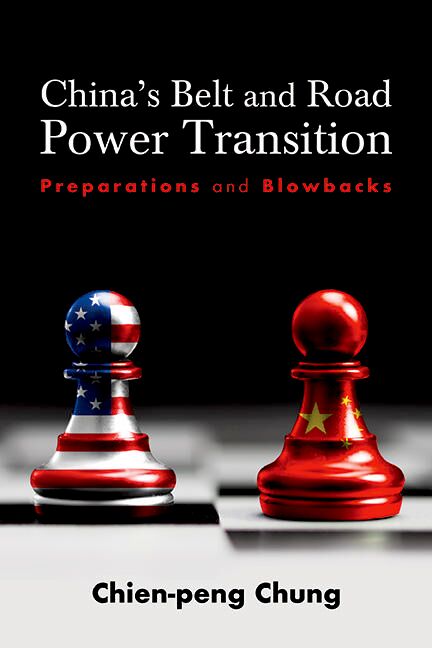
China's Belt and Road Power Transition
Details the Belt and Road global infrastructure
development initiative as the most important instrument for
China's leadership under Xi Jinping to create an alternative
global economic and geopolitical order to challenge the United
States.
In the opening decades of the twenty-first century the
Chinese Communist Party (CCP) leadership under Xi Jinping has
created a worldwide Sino-centric network, the Belt and Road
Initiative (BRI), to challenge American dominance in world
affairs. Encompassing economic, financial, political, and
strategic relations, the CCP's belief is that the funds,
construction projects, and promises offered by the BRI will
generate a widespread perception of the inexorability,
legitimacy, and thus acceptability of a Chinese world order.
Consisting initially of a land-based \"Silk Road Economic Belt,\"
an oceangoing \"Maritime Silk Road,\" and the China-Pakistan
Economic Corridor, the BRI has expanded to involve more than
140 countries and includes a Health Silk Road, Digital Silk
Road, and Polar Silk Road, but it has also experienced serious
challenges. Using power transition theory, Chien-peng Chung
carefully investigates and evaluates the enterprise's benefits
and shortcomings, concluding that it is still too early to
consider the BRI a success.
eBook