
Catalogue Search | MBRL


Are you sure you want to remove the book from the shelf?

{{itemTitle}}
64
result(s) for
"International business enterprises -- Taxation -- United States -- Congresses"
Sort by:

Borderline Case
The growing integration of world markets for capital and goods, coupled with the rise of instantaneous worldwide communication, has made identification of corporations as \"American,\" \"Dutch,\" or \"Japanese\" extremely difficult. Yet tax treatment does depend of where a firm is chartered. And, as Borderline Case documents, there is little doubt that tax rules for firms doing business in several nations-firms that account for more than three-quarters of corporate R&D spending in the United States-have substantial effects on corporate decisionmaking and, ultimately, U.S. competitiveness.
This book explores the impact of the U.S. tax code and its incentives on the international activities of U.S.- and foreign-based firms: basic research outlays, expenditures on product and process development, and plant and equipment investment. The authors include industry experts from large multinational firms in technology and pharmaceuticals, academic researchers who have explored the quantitative impact of tax provisions on R&D, and tax policy analysts who have examined international tax rules in the broader context of tax reform.
These experts look at how corporate investment and R&D are shaped by specific tax provisions, such as the definition of taxable income, relative tax burdens on domestic and foreign business, taxation of earnings repatriated to the United States, deductibility of expenses of worldwide operations, and U.S. corporate taxes relative to other countries. The volume explores prescriptions and prospects for tax reform and reviews major reform proposals and their implications for the behavior of multinational business.
eBook
The effects of taxation on multinational corporations
The tax rules of the United States and other countries have intended and unintended effects on the operations of multinational corporations, influencing everything from the formation and allocation of capital to competitive strategies. The growing importance of international business has led economists to reconsider whether current systems of taxing international income are viable in a world of significant capital market integration and global commercial competition. In an attempt to quantify the effect of tax policy on international investment choices, this volume presents in-depth analyses of the interaction of international tax rules and the investment decisions of multinational enterprises. Ten papers assess the role played by multinational firms and their investment in the U.S. economy and the design of international tax rules for multinational investment; analyze channels through which international tax rules affect the costs of international business activities; and examine ways in which international tax rules affect financing decisions of multinational firms. As a group, the papers demonstrate that international tax rules have significant effects on firms' investment and other financing decisions.
eBook
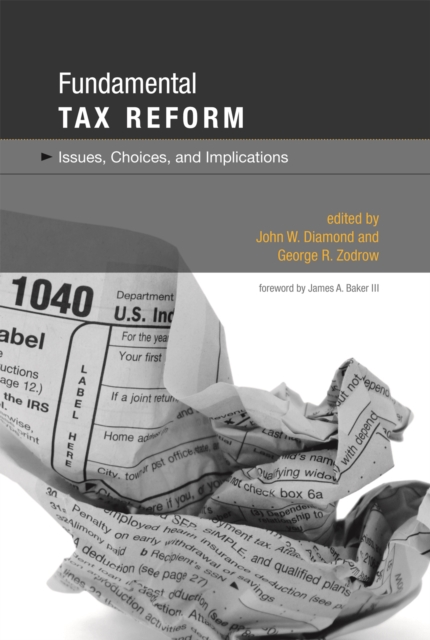
Fundamental Tax Reform
Leading experts on tax policy examine the complex issues involved in fundamental tax reform, including the relative merits of income-based and consumption-based taxation.
Reform of the federal income tax system has become a perennial item on the domestic policy agenda of the United States, although there is considerable uncertainty over specifics. Indeed the recent report of the President's Advisory Panel on Federal Tax Reform recommended not one but two divergent policy directions (and included extensive discussion of a third).
In Fundamental Tax Reform, top experts in tax policy discuss a wide range of issues raised by the prospect of significant tax reform, identifying the most critical questions and considering whether the answers are known, unknown—or unknowable. The debates over tax reform usually concern the advantages and disadvantages of income-based taxation as opposed to any of the several alternative forms of consumption-based taxation. The book opens with chapters that discuss the strengths, weaknesses, and political feasibility of these options. Other chapters consider the effect of tax reform on businesses, especially their investment behavior, and include a discussion of possible problems in any transition to a consumption-based tax; international taxation issues arising in an era of globalization; and individual behavioral response to tax reform, including a view of the topic from the perspective of the relatively new field of behavioral economics.
Contributors
Rosanne Altshuler, Alan J. Auerbach, John W. Diamond, Harry Grubert, Arnold C. Harberger, Kevin A. Hassett, Thomas J. Kniesner, Laurence J. Kotlikoff, Edward J. McCaffery, Kathryn Newmark, David Rapson, Daniel Shaviro, Joel Slemrod, James P. Ziliak, George R. Zodrow
Discussants
James Alm, Henry J. Aaron, Charles L. Ballard, Leonard E. Burman, Robert S. Chirinko, Robert D. Dietz, Malcolm Gillis, Roger H. Gordon, Jane G. Gravelle, Timothy S. Gunning, James M. Poterba, Thomas S. Neubig, Alan Viard, George Yin
eBook
