
Catalogue Search | MBRL


Are you sure you want to remove the book from the shelf?

{{itemTitle}}
13,529
result(s) for
"International law Cases."
Sort by:

International law in domestic courts : a casebook
The application of international law by domestic courts has gained increasing attention in recent years. In an ever-more interconnected world, domestic courts now make reference to judgments by foreign courts when faced with similar or identical legal problems involving international law. Their judgments see increasing recognition of their pivotal role in shaping and interpreting international law. Understanding them will be of use for any practitioner and scholar in international law. 0International Law in Domestic Courts, Oxford's online collection of domestic court decisions which apply international law, has been providing scholars with at-your-fingertips access to analysis and commentary for more than a decade. First established in 2006, it now includes over 1,700 judgments of cases involving international law-related aspects from nearly 100 countries and continues to expand. This Casebook is the perfect companion, presenting a selection of the most important cases along with a commentary to give a holistic overview of the use of international law in national courts, and how the jurisprudence has developed international law itself. Practitioners, students, and academics will find this an invaluable resource when faced with the complex questions of applying international law in domestic courts.
Book

Why rivals intervene : international security and civil conflict
Rivals – states with acrimonious, militarized histories – often intervene on opposing sides of civil conflicts. These interventions are known to exacerbate and prolong civil wars, but scholars have yet to fully understand why states engage in them, given the significant costs and countervailing strategic interests.
Why Rivals Intervene argues that rivals are driven by security considerations at the international level – specifically, the prospect of future confrontations with their rival – to intervene in civil conflicts. Drawing on a theory of rivalry which accounts for this strategic rationale, John Mitton explores three case studies: Indian and Pakistani intervention in Afghanistan, Israeli and Syrian intervention in Lebanon, and US and Soviet intervention in Angola. The book examines a range of evidence, including declassified memoranda, meeting transcripts, government reports, published interviews, memoirs of political leaders, and other evidence of the thought process, rationale, and justifications of relevant decision-makers.
The book claims that the imperatives for intervention are consistent across time and space, as rivals are conditioned by a history of conflict to worry about future confrontations. As a result, Why Rivals Intervene illuminates an important driver of civil conflict, with implications for how such conflicts might be solved or mitigated in the future. At the same time, it offers new insight into the nature of long-standing, acrimonious international relationships.
eBook


Reassuring the Reluctant Warriors
Why did American leaders work hard to secure multilateral
approval from the United Nations or NATO for military interventions
in Haiti, Bosnia, and Kosovo, while making only limited efforts to
gain such approval for the 2003 Iraq War? In Reassuring the
Reluctant Warriors , Stefano Recchia draws on declassified
documents and about one hundred interviews with civilian and
military leaders to illuminate little-known aspects of U.S.
decision making in the run-up to those interventions. American
leaders, he argues, seek UN or NATO approval to facilitate
sustained military and financial burden sharing and ensure domestic
support. However, the most assertive, hawkish, and influential
civilian leaders in Washington tend to downplay the costs of
intervention, and when confronted with hesitant international
partners they often want to bypass multilateral bodies. In these
circumstances, America's senior generals and admirals-as reluctant
warriors who worry about Vietnam-style quagmires-can play an
important restraining role, steering U.S. policy toward
multilateralism.
Senior military officers are well placed to debunk the civilian
interventionists' optimistic assumptions regarding the costs of
war, thereby undermining broader governmental support for
intervention. Recchia demonstrates that when the military expresses
strong concerns about the stabilization burden, even hawkish
civilian leaders can be expected to work hard to secure
multilateral support through the UN or NATO-if only to reassure the
reluctant warriors about long-term burden sharing. By contrast,
when the military stays silent, as it did in the run-up to the 2003
Iraq War, the most hawkish civilians are empowered; consequently,
the United States is more likely to bypass multilateral bodies and
may end up shouldering a heavy stabilization burden largely by
itself. Recchia's argument that the military has the ability to
contribute not only to a more prudent but also to a more
multilateralist U.S. intervention policy may be counterintuitive,
but the evidence is compelling.
Why did American leaders work hard to secure multilateral
approval from the United Nations or NATO for military interventions
in Haiti, the Balkans, and Libya, while making only limited efforts
to gain such approval for the 2003 Iraq War? In Reassuring the
Reluctant Warriors , Stefano Recchia addresses this important
question by drawing on declassified documents and about one hundred
interviews with civilian and military leaders.The most assertive,
hawkish, and influential civilian leaders, he argues, tend to
downplay the costs of intervention, and when confronted with
hesitant international partners they often want to bypass
multilateral bodies. America's top-level generals, by contrast, are
usually \"reluctant warriors\" who worry that intervention will
result in open-ended stabilization missions; consequently, the
military craves international burden sharing and values the
potential exit ramp for U.S. forces that a handoff to the UN or
NATO can provide.Recchia demonstrates that when the military speaks
up and clearly expresses its concerns, even strongly
pro-intervention civilian leaders can be expected to work hard to
secure UN or NATO approval-if only to reassure the military about
the likelihood of sustained burden sharing. Conversely, when the
military stays silent, as it did in the run-up to the 2003 Iraq
War, bellicose civilian leaders are empowered; the United States is
then more likely to bypass multilateral bodies, and it may end up
carrying a heavy stabilization burden largely by itself. Recchia's
argument that the military has the ability to contribute not only
to a more prudent but also to a more multilateralist U.S.
intervention policy may be counterintuitive, but the evidence is
compelling.
eBook

EU environmental principles and scientific uncertainty before national courts : the case of the Habitats Directive
\"This comparative book explores the dynamics driving how courts across Europe and beyond understand and analyse scientific information in nature conservation. The Habitats and the Birds Directive-the core of EU nature conservation law-are usually seen as the most 'uniform' parts of EU environmental law. This book analyses the case law from 11 EU current and former Member States' courts and explores the dynamics of how, and crucially why, their understandings of scientific uncertainty on the one hand, and EU environmental principles on the other, vary. The courts' scope and depth of review, access to scientific knowledge, and scientific literacy all influence such decisions-as does their interpretation of norms and principles. How have the courts evaluated scientific evidence, encompassing its essential uncertainties? This book answers this and many more questions pertinent to EU environmental law, comparative environmental law, administrative law, and STS studies. Co-edited by experienced leaders in the field, and with outstanding contributors, this book is an essential guide to the dynamics of nature conservation law.\"-- Provided by publisher.
BOOK

Democracys Blameless Leaders
From the American and British counter-insurgency in Iraq to the bombing of Dresden and the Amristar Massacre in India, civilians are often abused and killed when they are caught in the cross-fire of wars and other conflicts. In Democracy's Blameless Leaders, Neil Mitchell examines how leaders in democracies manage the blame for the abuse and the killing of civilians, arguing that politicians are likely to react in a self-interested and opportunistic way and seek to deny and evade accountability. Using empirical evidence from well-known cases of abuse and atrocity committed by the security forces of established, liberal democracies, Mitchell shows that self-interested political leaders will attempt to evade accountability for abuse and atrocity, using a range of well-known techniques including denial, delay, diversion, and delegation to pass blame for abuse and atrocities to the lowest plausible level. Mitchell argues that, despite the conventional wisdom that accountability is a 'central feature' of democracies, it is only a rare and courageous leader who acts differently, exposing the limits of accountability in democratic societies. As democracies remain embroiled in armed conflicts, and continue to try to come to grips with past atrocities, Democracy's Blameless Leaders provides a timely analysis of why these events occur, why leaders behave as they do, and how a more accountable system might be developed.
eBook

A conviction in question : the first trial at the International Criminal Court
\"An engrossing narrative of the first case to appear at the International Criminal Court, 'A Conviction in Question' documents the trial of Union of Congolese Patriots leader and warlord Thomas Lubanga Dyilo. Although Lubanga's crimes - including murder, rape, and the forcible conscription of child soldiers - were indisputable, legal wrangling and a clash of personalities caused the trial to be prolonged for an unprecedented six years. This book offers an accessible account of the rapid evolution of international law and the controversial trial at the foundation of the International Criminal Court. A Conviction in Question examines the legal issues behind each of the trial's critical moments, including the participation of Lubanga's victims at the trial and the impact of witness protection. Through eye-witness observation and analysis, Jim Freedman shows that the trial suffered from all the problems associated with ordinary criminal law trials, and uses the Lubanga case to further comment on the role of international courts in a contemporary global context.\"--Book jacket.
Book
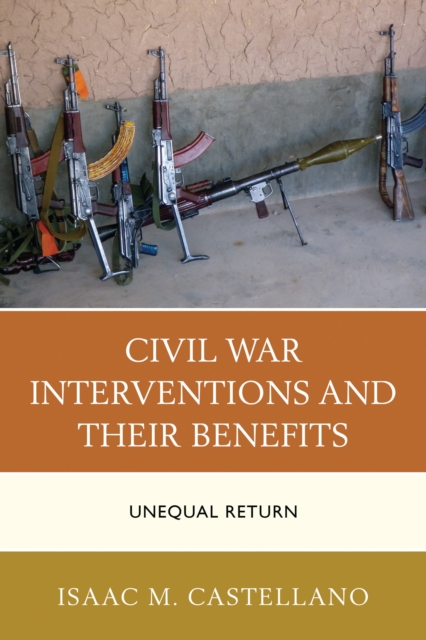
Civil war interventions and their benefits
The 2013 debate over whether the United States should intervene in the Syrian conflict raised important questions regarding the benefits countries receive when they intervene in civil wars, and how those benefits are distributed to the citizens of the intervening country. To address these lingering questions this book offers readers a comprehensive examination of the intervention process, examining the decision to intervene, what motivates states, and how their intervention shapes the conflict process.
Most, importantly, the book examines how states benefit from their interventions and the distribution of intervenor benefits. Specially two questions are addressed: What are the benefits of intervention for intervening countries? And, how are benefits distributed within the intervenors society? Using evidence compiled from three case studies (El Salvador, The Philippines, and Sri Lanka), this book examines what motivated states to intervene, how they intervened, what they got from their intervention, and how the benefits of the intervention were distributed among the public. Arguing that foreign policy and security decision making is isolated from the general public, this book argues that citizens gain little from indirect interventions into civil wars.
eBook


Stabilization Operations, Security and Development
This edited volume provides a critical overview of the new stabilization agenda in international relations.
The primary focus of so-called stability operations since 9/11 has been Afghanistan, Pakistan and Iraq. Covering the wider picture, this volume provides a comprehensive assessment of the new agenda, including the expansion of efforts in Latin America, the Caribbean, Sub-Saharan Africa and South and Southeast Asia. By harnessing the findings of studies undertaken in Brazil, Colombia, Haiti, Jamaica, Kenya, Democratic Republic of the Congo (DRC), Sudan and Sri Lanka, the volume demonstrates the impacts - intended and otherwise - of stabilization in practice.
The book clarifies the debate on stabilization, focusing primarily on the policy, practice and outcomes of such operations. Rather than relying exclusively on existing military doctrine or academic writings, the volume focuses on stabilization as it is actually occurring. Drawing on the reflections of scholars and practitioners, the volume identifies the origins and historical antecedents of contemporary operations, and also examines how the practice is linked to other policy spheres - ranging from peacebuilding to statebuilding. Finally, the volume reviews eight practical cases of stabilization in disparate regions around the globe.
This book will be of much interest to students of war and conflict studies, peacekeeping and peacebuilding, statebuilding, development studies and international relations in general.
eBook