
Catalogue Search | MBRL


Are you sure you want to remove the book from the shelf?

{{itemTitle}}
393
result(s) for
"Internet videos Fiction."
Sort by:

The girl on the porch
\"When the Tuckers' next door neighbor mentions someone rang their doorbell late the previous night, Sarah and Kenny Tucker check their home's security camera and discover something shocking: the doorbell ringer also visited their house-- and it was a terrified young woman with a shackle hanging from her right wrist. Almost overnight, she becomes known as The Girl on the Porch. There is national coverage on CNN and Fox News, and the video goes viral. As days pass and no one comes forward to identify the woman, fresh footprints appear in the garden next to their house; a neighbor's pet is viciously killed; and a man starts following their daughter Natalie....\"--Provided by publisher.
Book
Economist video. Our top five novels of the year (so far)
Here are The Economist's top 5 fiction reads of the year, so far.
Streaming Video

An absolutely remarkable thing : a novel
\"Coming home from work at three AM, twenty-three-year-old April May stumbles across a giant sculpture. Delighted by its appearance and craftsmanship--like a ten-foot-tall Transformer wearing a suit of samurai armor--April and her friend Andy make a video with it, which Andy uploads to YouTube. The next day April wakes up to a viral video and a new life. News quickly spreads that there are 'Carls' in dozens of cities around the world--everywhere from Beijing to Buenos Aires--and April, as their first documentarian, finds herself at the center of an intense international media spotlight\"-- Provided by publisher.
BOOK
Economist video. The best fiction of 2024 -- so far
Looking for your next summer read? Our deputy culture editor, Rachel Lloyd, shares five of The Economist's top fiction books of 2024 — so far.
Streaming Video

Boomer1
\"Bluegrass musician, former journalist and editor, and now PhD in English, Mark Brumfeld has arrived at his thirties with significant debt and no steady prospects. His girlfriend Cassie--a punk bassist in an all-female band, who fled her Midwestern childhood for a new identity--finds work at a 'new media' company. When Cassie refuses his marriage proposal, Mark leaves New York and returns to the basement of his childhood home in the Baltimore suburbs. Desperate and humiliated, Mark begins to post a series of online video monologues that critique Baby Boomers and their powerful hold on the job market\"-- Provided by publisher.
Book
Economist video. Our favourite novels of 2024
Looking for a literary gift this Christmas? These are five of our favourite novels from 2024.
Streaming Video
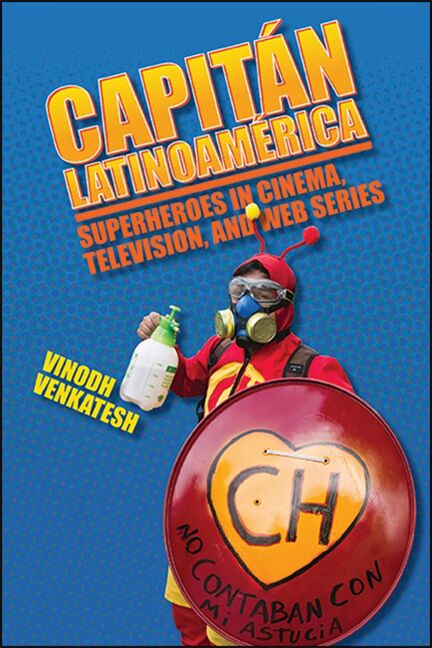
Capitán Latinoamérica
Capitán Latinoamérica is the first study to examine the
unique contribution of Latin American cinema, television, and web
series to the global superhero boom. Through an analysis of
superhero-themed media from Mexico to Argentina, Vinodh Venkatesh
argues that contemporary Latin American superheroes are a hybrid of
regional tropes and figures such as the famed luchador , El
Chapulín Colorado, and North American blockbuster characters from
the DC and Marvel universes. These superheroes channel anxieties
specific to their respective national contexts. In Chile, for
example, Mirageman rehashes and works through the Pinochet
dictatorship and its traumatic aftermath; in Honduras, Chinche Man
confronts neoliberalism and gang violence. In Colombia's El
Man , in turn, rapid urbanization and drug cartels are the
central concerns, whereas corruption and the political machinations
of the state feature most prominently in the television and web
series Capitán Centroamérica . While the Latin American
superhero genre may be superficially characterized by low budgets
and kitsch aesthetics, it also poses profound challenges to the
social, political, and economic status quo. Covering a wide variety
of media bookended by wrestling films from the early 1960s and
multimedia productions from the 2010s, Capitán
Latinoamérica offers a comprehensive introduction to, and
assessment of, the state of the superhero in Latin America.
eBook

Second Language Use, Socialization, and Learning in Internet Interest Communities and Online Gaming
In recent years, there has been a great deal of research and pedagogical experimentation relating to the uses of technology in second (L2) and foreign language education. The majority of this research has usefully described and examined the efficacy of in-class and directly classroom-related uses of technology. This article broadens the scope of inquiry to include L2 and foreign language-related uses of technology that extend into the interstitial spaces between instructed L2 contexts and entirely out-of-school noninstitutional realms of freely chosen digital engagement. Two demographically and sociologically significant phenomena are examined in detail; the first focuses on participation in Internet interest communities such as fan fiction and virtual diaspora community spaces and the second describes a continuum of three-dimensional graphically rendered virtual environments and online games. A review of research in each of these areas reveals extended periods of language socialization into sophisticated communicative practices and demonstrates the salience of creative expression and language use as tools for identity development and management. In the final section of the article, we suggest a number of possibilities for synergistically uniting the analytic rigor of instructed L2 education with the immediacy and vibrancy of language use in digital vernacular contexts.
Journal Article

Role of science fiction in conceptualising the reproductive future: a linguistic and literary perspective
In this paper, we explore how members of the public invoke science fiction tropes and references in response to the topic of complete ectogenesis (where the entire development of a fetus takes place outside of the human body in an artificial womb environment) and, to a lesser extent, genome editing. This paper addresses a critical research gap as fiction is central to how the public make sense of new technologies. This research is timely, as human clinical trials of artificial placenta and womb technology are expected to start within the next few years. We argue that gauging public opinion on this technology is a critical early step in understanding how the public might respond to such new technologies, should they become available in the near future and be presented in a particular fashion.Using corpus linguistic techniques, we analysed a large dataset of 15 548 YouTube comments (382 057 words) made in response to a video that depicts a fictional artificial womb facility, which went viral in December 2022 when some viewers believed it to be real. We identified several statistically significant trends, as commenters associated the video with science fiction, horror and dystopian fiction, while also making specific reference to Aldous Huxley, Brave New World and Star Wars (Clone Wars). These observations reveal how popular science fiction narratives serve as a key point of reference and that they stand as a powerful warning in the public imagination, and as a potential barrier to public acceptance of new reproductive technologies—despite the potential benefits for social justice and reproductive rights. Our findings therefore have implications for how scientific developments are communicated to the general public.
Journal Article

The Tunneling Metaphor in Networked Technologies
This article explores the metaphor of tunneling to illustrate how the emancipatory language of border resistance can become co-opted in transnational technocultures. Drawing on specific instances of tunneling in science fiction film, video games, and digital platforms, I reveal how this metaphor has been mobilized to cast vanguard forms of online connectivity and networked transgression in terms that are distinctly white, masculine, upper class, and adhering to liberal tenets of individual mastery. This analysis suggests why we must question what kinds of politics and which subjects are privileged or undervalued in the metaphorical discussions of online borders and so-called border resistance. Only then can we respond to dominant and reactionary forms of transmission and connectivity across the internet.
Journal Article