
Catalogue Search | MBRL


Are you sure you want to remove the book from the shelf?

{{itemTitle}}
1,031
result(s) for
"Internship programs United States."
Sort by:


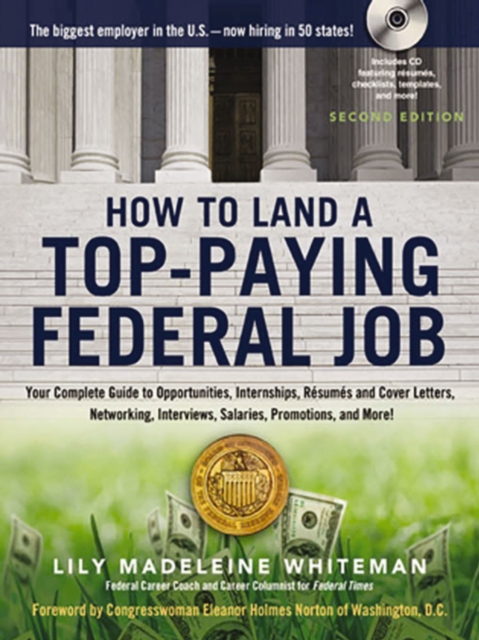
How to land a top-paying federal job : your complete guide to opportunities, internships, résumés and cover letters, networking, interviews, salaries, promotions, and more!
Written by successful career coach Lily Whiteman, who herself has climbed the federal career ladder and served as a hiring manager, this indispensable book is the ultimate guide to securing a job in government work. How to Land a Top-Paying Federal Job steers federal applicants through every stage of their job search--from finding unadvertised openings and getting interviews to sealing enviable deals and even getting promoted. You'll gain insights from more than one hundred federal hiring managers, and learn the secrets to impressing these gatekeepers online, on paper, and in person. The updated second edition of How to Land a Top-Paying Federal Job includes more get-ahead tips, the latest hiring advice on writing winning applications, expanded directories for internships, listings of fast-track management training programs and fellowships, and information on emerging helpful websites and other resources. Complete with a companion CD filled with sample resumes, checklists, and templates, the book gives readers in all fifty states with big dreams of climbing the federal career ladder the inside scoop on landing some of the nation's most secure, well-paying, and rewarding jobs.
eBook
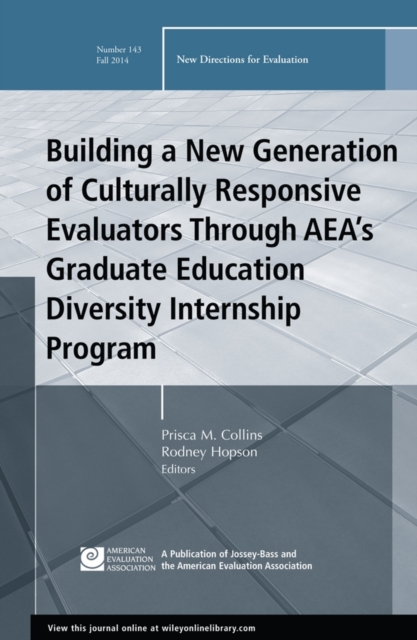
Building a new generation of culturally responsive evaluators through AEA's Graduate Education Diversity Internship program
This issue coincides with the 10th anniversary of the American Evaluation Association's (AEA's) Graduate Education Diversity Internship (GEDI) program. It emphasize core decisions and developments of the GEDI program and feature key participants who have participated in and contributed to the development and implementation of the program. Together, the chapters focus on: Factors that contributed to the design and organization of the program Critical components and aspects of the program that guide its implementation, characterized by the leadership training, mentorship and professional socialization, and the practical project placements Lessons learned, which reveal the opportunities and challenges of expanding pipelines and pathways of diversity and social justice through professional associations. This is the 143rd issue in the New Directions for Evaluation series from Jossey-Bass. It is an official publication of the American Evaluation Association.
eBook
How to Land a Top-Paying Federal Job
With over 40 per cent of the federal government's 1.6 million employees retiring over the next 10 years, now is the time for anyone seeking a government job to take advantage of the massive retirement wave that has already begun. Yet until now, no truly up-to-date or comprehensive book has existed to give readers the tools and guidance they need to get hired for a government job, internship, or fellowship. Entertainingly written by a successful career coach who has climbed the federal career ladder herself as a hiring manager, this reader-friendly book steers prospective applicants through every stage of their job search. This book draws on interviews with more than 100 other hiring managers. Including a companion CD filled with sample resumes and worksheets, this is the book to have when seeking out employment with the federal government.
eBook

WetFeet Insider Guide to Getting Your Ideal Internship
Table of Contents -- From Internship to Offer -- Overview -- Good Market/ Bad Market -- The Bottom Line -- Get Ready: Identifying the Value of Internships -- Do You Know What You Don't Know? -- Benefits of Internships -- Aim: Targeting Opportunities -- Timing the Search -- Which Track Should I Take? -- Making Your Own Internship -- Get Hired: The Process -- Be the Ideal Candidate -- Getting the \"Yes\" -- International Students' Challenges -- Americans Pursuing Opportunities Abroad -- Refusing to Take \"No\" as the Final Answer -- Stay Hired: Turn Your Internship into a Job
eBook

Student trainee and paid internship programs have positive results but do little to influence long-term employee diversity in the USDA forest service
Women and Black, Indigenous, and People of Color (BIPOC) employees are underrepresented in science and natural resource management institutions. Student and recent graduate trainee and internship programs have been used to try to address this in United States federal agencies over the last few decades. Our study evaluates how effective such programs are at improving U.S. federal workforce diversity. We used a comprehensive employee dataset from the United States Department of Agriculture (USDA) Forest Service–which has the largest natural resource management workforce in the country–to analyze the demographic characteristics and career paths of paid interns from 1996–2017. We found that a majority of employees who started as interns later converted to permanent employment with the USDA Forest Service. In addition, Black and Hispanic interns were, respectively, 5 and 3 times more likely than White interns to work for the agency in permanent positions after their internships. However, people who started as interns had significantly shorter USDA Forest Service careers than those who started in permanent positions. White women entering directly into permanent positions typically advanced to higher pay grades through promotion faster than White women who entered as interns. Finally, male BIPOC interns involuntarily separated ( i . e ., were fired) at significantly higher rates than all other employees. Our study suggests that while internship employment programs can be an effective tool for hiring a diverse workforce, they are not sufficient to close the overall workforce diversity gap. In addition, only a small percentage of new hires every year are interns. To achieve a level of representation that mirrors the civilian labor force, our study suggests that internship programs need to focus on long-term employee retention and be of significantly larger scale.
Journal Article
Benefits of a non-traditional science communication and internship experience based on research from the National Science Foundation Research Traineeship at a Research Intensive University
Effective science communication and stakeholder engagement are crucial skills for climate scientists, yet formal training in these areas remains limited in graduate education. The National Science Foundation Research Traineeship (NRT) at Auburn University (AU) addresses this gap through an innovative program combining science communication training with co-production approaches to enhance climate resiliency of built, natural, and social systems within the Southeastern United States (US). This paper evaluates the effectiveness of two novel graduate-level courses: one focused on science communication for non-technical audiences and another combining co-production methods with practical internship experience. Our research employed a mixed-methods approach, including a comprehensive analysis of course catalogs from 146 research-intensive universities and qualitative assessment of student experiences through surveys and descriptive exemplars. Analysis revealed that AU’s NRT program is unique among peer institutions in offering both specialized science communication training and co-production internship opportunities to graduate students across departments. Survey data from 11 program participants and detailed case studies of three program graduates demonstrated significant professional development benefits. Key outcomes included enhanced stakeholder engagement capabilities, improved science communication skills, and better preparation for both academic and non-academic careers. These findings suggest that integrating structured science communication training with hands-on co-production experience provides valuable preparation for climate scientists. The success of AU’s program model indicates that similar curriculum structures could benefit graduate programs nationwide, particularly in preparing students to effectively communicate complex scientific concepts to diverse audiences and engage with stakeholders in climate resilience efforts.
Journal Article