
Catalogue Search | MBRL


Are you sure you want to remove the book from the shelf?

{{itemTitle}}
48,098
result(s) for
"Interpretation and construction"
Sort by:


Becoming the People of the Talmud
InBecoming the People of the Talmud, Talya Fishman examines ways in which circumstances of transmission have shaped the cultural meaning of Jewish traditions. Although the Talmud's preeminence in Jewish study and its determining role in Jewish practice are generally taken for granted, Fishman contends that these roles were not solidified until the late eleventh and early twelfth centuries. The inscription of Talmud-which Sefardi Jews understand to have occurred quite early, and Ashkenazi Jews only later-precipitated these developments. The encounter with Oral Torah as a written corpus was transformative for both subcultures, and it shaped the roles that Talmud came to play in Jewish life.
What were the historical circumstances that led to the inscription of Oral Torah in medieval Europe? How did this body of ancient rabbinic traditions, replete with legal controversies and nonlegal material, come to be construed as a reference work and prescriptive guide to Jewish life? Connecting insights from geonica, medieval Jewish and Christian history, and orality-textuality studies,Becoming the People of the Talmudreconstructs the process of cultural transformation that occurred once medieval Jews encountered the Babylonian Talmud as a written text. According to Fishman, the ascription of greater authority to written text was accompanied by changes in reading habits, compositional predilections, classroom practices, approaches to adjudication, assessments of the past, and social hierarchies. She contends that certain medieval Jews were aware of these changes: some noted that books had replaced teachers; others protested the elevation of Talmud-centered erudition and casuistic virtuosity into standards of religious excellence, at the expense of spiritual refinement. The book concludes with a consideration of Rhineland Pietism's emergence in this context and suggests that two contemporaneous phenomena-the prominence of custom in medieval Ashkenazi culture and the novel Christian attack on Talmud-were indirectly linked to the new eminence of this written text in Jewish life.
eBook


Translating law
The book examines legal translation, covering both theoretical and practical grounds and linguistic as well as legal issues. It analyses the basic skills and competence of the legal translator and various types of legal texts and is useful for translators, lawyers, linguistic and legal scholars working in a bilingual/multilingual legal context.
eBook

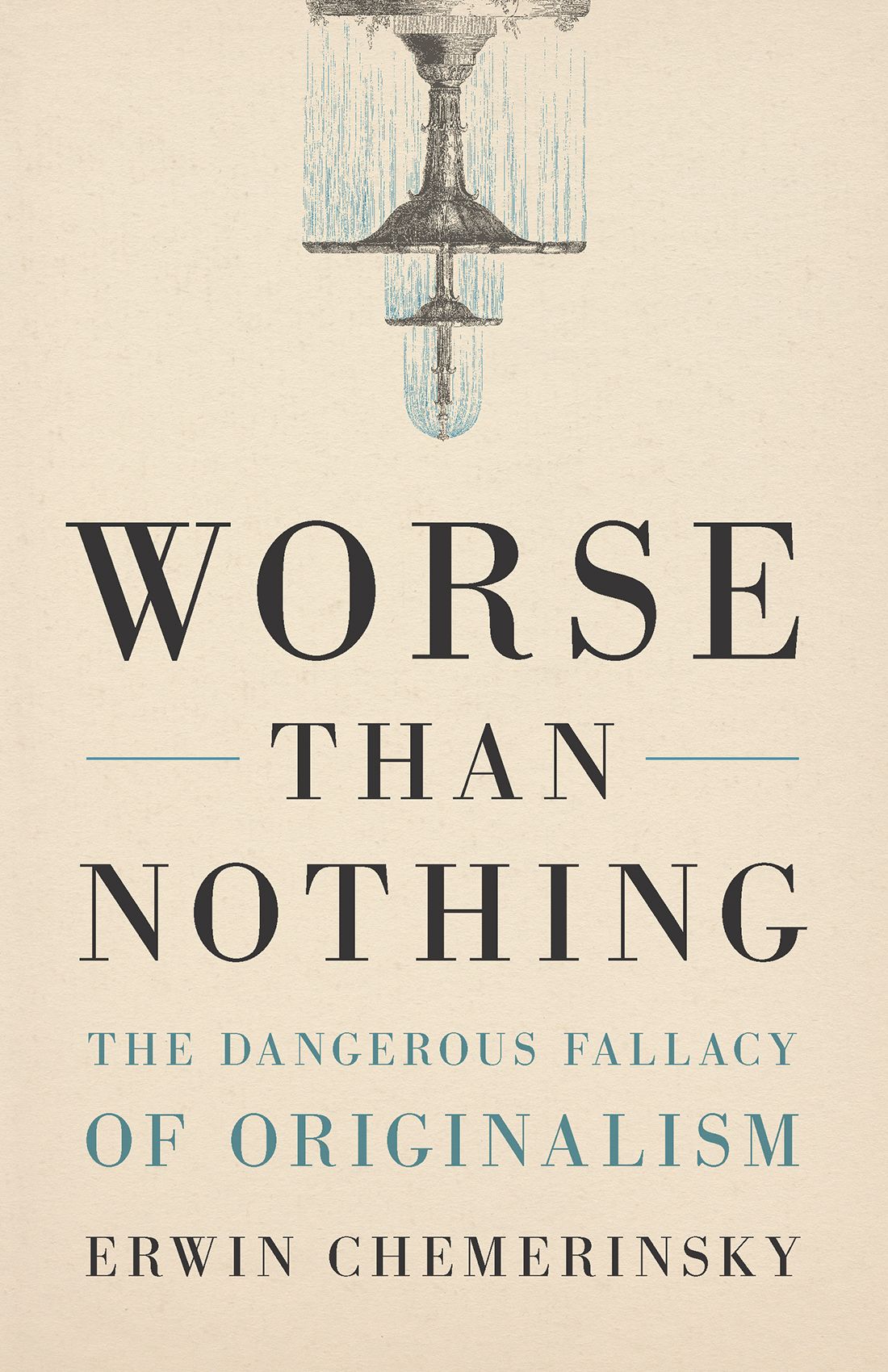
Worse Than Nothing
Why originalism is a flawed, incoherent, and dangerously
ideological method of constitutional interpretation
Originalism, the view that the meaning of a constitutional
provision is fixed when it is adopted, was once the fringe theory
of a few extremely conservative legal scholars but is now a
well-accepted mode of constitutional interpretation. Three of the
Supreme Court's nine justices explicitly embrace the originalist
approach, as do increasing numbers of judges in the lower courts.
Noted legal scholar Erwin Chemerinsky gives a comprehensive
analysis of the problems that make originalism unworkable as a
method of constitutional interpretation. He argues that the framers
themselves never intended constitutional interpretation to be an
inflexible and shows how it is often impossible to know what the
\"original intent\" of any particular provision was. Perhaps worst of
all, though its supporters tout it as a politically neutral and
objective method, originalist interpretation tends to disappear
when its results fail to conform to modern conservative ideology.
eBook

The Limits of Legal Reasoning and the European Court of Justice
The European Court of Justice is widely acknowledged to have played a fundamental role in developing the constitutional law of the EU, having been the first to establish such key doctrines as direct effect, supremacy and parallelism in external relations. Traditionally, EU scholarship has praised the role of the ECJ, with more critical perspectives being given little voice in mainstream EU studies. From the standpoint of legal reasoning, Gerard Conway offers the first sustained critical assessment of how the ECJ engages in its function and offers a new argument as to how it should engage in legal reasoning. He also explains how different approaches to legal reasoning can fundamentally change the outcome of case law and how the constitutional values of the EU justify a different approach to the dominant method of the ECJ.
eBook


Worse Than Nothing
Why originalism is a flawed, incoherent, and dangerously
ideological method of constitutional interpretation
Originalism, the view that the meaning of a constitutional
provision is fixed when it is adopted, was once the fringe theory
of a few extremely conservative legal scholars but is now a
well-accepted mode of constitutional interpretation. Three of the
Supreme Court's nine justices explicitly embrace the originalist
approach, as do increasing numbers of judges in the lower courts.
Noted legal scholar Erwin Chemerinsky gives a comprehensive
analysis of the problems that make originalism unworkable as a
method of constitutional interpretation. He argues that the framers
themselves never intended constitutional interpretation to be an
inflexible and shows how it is often impossible to know what the
\"original intent\" of any particular provision was. Perhaps worst of
all, though its supporters tout it as a politically neutral and
objective method, originalist interpretation tends to disappear
when its results fail to conform to modern conservative ideology.
eBook