
Catalogue Search | MBRL


Are you sure you want to remove the book from the shelf?

{{itemTitle}}
2,458
result(s) for
"Interrogative"
Sort by:
Academic Writing and Reader Engagement
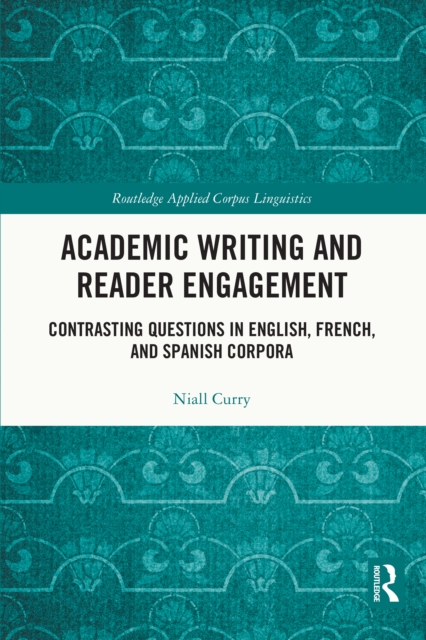
Academic Writing and Reader Engagement offers a concise linguistic description of the use and functions of questions in English, French, and Spanish and discusses their value to the teaching of academic writing. This book:
Enables a better understanding of how writers engage readers in academic writing in English, French, and Spanish and where each language behaves similarly or differently;
Explains how authors express opinions, organise discourse, and create relationships with readers via questions in their academic writing and the various functions questions perform;
Brings together research on corpus and contrastive linguistics, highlighting how these two fields can support one another;
Offers a thorough investigation of reader engagement markers from a range of linguistic perspectives and considers how knowledge of these markers could be applied to the teaching and learning of academic writing in each language;
Employs corpus data totalling approximately 1.2 million words from all three languages to illustrate the varying roles and representations of questions in each language.
Providing an invaluable resource for scholars learning to communicate successfully within their academic community, as well as teachers of English, French, and/or Spanish for academic purposes, this book is key reading for students and researchers of academic discourse, contrastive linguistics, and corpus linguistics.
eBook
Questions in discourse. Volume 2, pragmatics
The volume 'Questions in Discourse - Vol. 2 Pragmatics' collects original research on the role of questions in understanding text structure and discourse pragmatics. The in-depth studies discuss the effects of focus, questions and givenness in unalternative semantics, as well as the role of scalar particles, question-answer pairs and prosody from the perspective of Questions under Discussion. Two contributions compare the discourse-structuring potential of Questions under Discussion and rhetorical relations, whereas another adds a perspective from inquisitive semantics. Some contributions also look at understudied languages. Together, the contributions allow for a better understanding of question-related pragmatic and discourse-semantic phenomena, and they offer new perspectives on the structure of texts and discourses.
Book
Romance interrogative syntax : formal and typological dimensions of variation
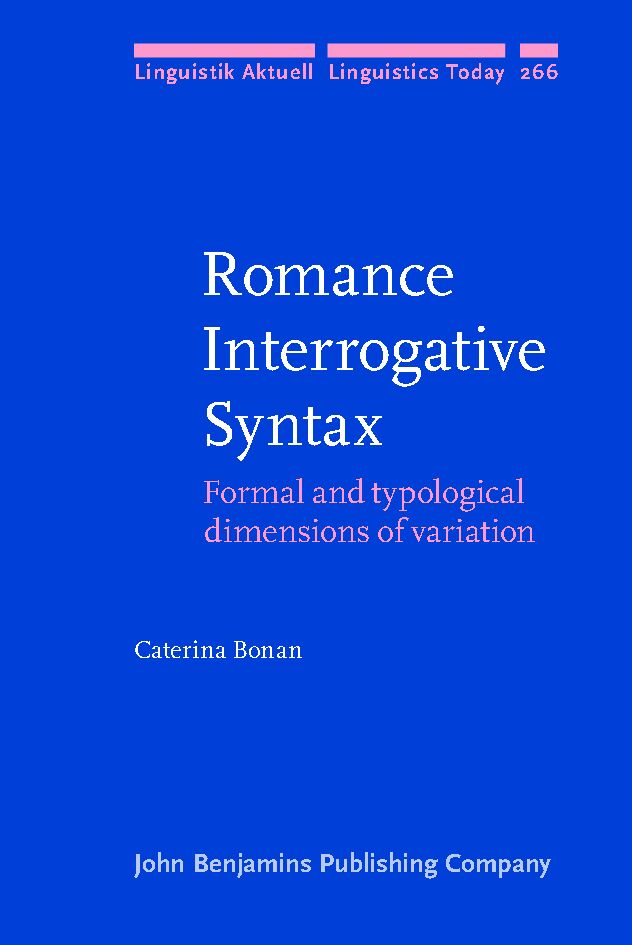
This monograph offers an innovative understanding of the mechanisms involved in Romance 'optional' wh-in situ. New supporting evidence in favour of Cable's (2010) Grammar of Q is presented, as well as novel implementations of his original theory. In particular, it is claimed that wh-in situ idioms are characterised not only by language-specific choices between QP-projection and Q-adjunction, and between overt and covert movement of Q, but also in terms of the locus where they check the features relevant to wh-questions: while some languages check both [q] and [focus] in C, others make use of the clause-internal vP-periphery to check [focus]. Thanks to the vast amount of data presented and discussed, along with the predictions and theoretical contributions made, this monograph will be of interest to a wide range of specialists in human language, from typologists to Romance specialists and formal syntacticians, but also to the many experts in languages with overt Q-particles who wonder why Romance specialists have long been so resistant to the implementation of silent Q-particles in their theoretical models.
eBook


La structure comment que P à l’oral spontané et représenté
This article takes stock of the comment que P structure. It gives an overview of interrogative structures in direct or indirect use, based on examples attested in several corpora of spontaneous speech. It shows that, towards the end of the twentieth century, there was a clear decline in the use of this structure in French in interrogatives. It seems that exclamatory use is less in decline. Analysis of the data for represented speech shows the informal nature of this structure, its decline in interrogatives, particularly indirect interrogatives, and suggests that the exclamative use is better preserved.
Journal Article


Fictive questions in the Zhuangzi : a cognitive rhetorical study
Rhetoric is intimately related to interaction and cognition. This book explores the cognitive underpinnings of rhetoric by presenting a case study of the rhetorical use of interactional structures, namely expository questions and rhetorical questions, in the classical Chinese tradition.
eBook

Japanese questions : discourse, context and language
\"Questions and interrogatives in Japanese discourse have attracted considerable interest from grammarians, but the communicative aspect has received little attention. This book fills this gap. Through detailed analyses of formal and informal interactions, it demonstrates that the inherent multi-functional and polysemous aspect of language can also be observed in the use of questions. The book shows how questions are used to perform a wide range of social actions and how varied in form they are. Similarly, it demonstrates the importance of the context on the speakers' choice of question types, which, in turn, contribute to creating a particular stance that characterizes those interactions.The data used in the book shows that speakers prefer questions that are not canonical. When speakers do use canonical questions, they are overwhelmingly accompanied by some mollifiers. This phenomenon suggests that in Japanese communication the illocutionary force of canonical questions is too strong. To soften the interaction, speakers tend to use other types of interrogative forms such as statements with rising intonation, or at least, leave questions grammatically unfinished. The findings in this book contribute to the understanding of how Japanese speakers use questions in different communicative interactions and provide new evidence of the gap between prescriptive grammar and actual communication\"-- Provided by publisher.
Book
Comment et l’expression de la quantité en français québécois de tous les jours. Je me demande comment ça coûte, comment il y a de neige, ça fait comment de temps
This article investigates the quantitative use of COMMENT ‘how’ (comment-Q ‘how much’) in Quebec French, used in a sentence such as j’ai hâte de voir comment ça va coûter ‘I can’t wait to see how much it will cost’. In this type of context, comment-Q commutes with the quantitative COMBIEN (combien-Q ‘how much’). The study is based on data taken from the Corpus de français parlé au Québec (CFPQ), a database of casual conversations recorded on audiovisual support between 2006 and 2019 in various regions of Quebec. The study has four objectives. The aim is 1) to determine the frequency of comment-Q within the set of meanings expressed by the marker COMMENT in synchrony, 2) to determine whether comment-Q and combien-Q are exact synonyms, 3) to identify the factors likely to have concurred in the emergence of comment-Q in the variety of French being studied, 4) to position comment-Q in relation to other meanings expressed by COMMENT, in particular those referring to intensity and manner.
Journal Article