
Catalogue Search | MBRL


Are you sure you want to remove the book from the shelf?

{{itemTitle}}
4,004
result(s) for
"Intonation"
Sort by:

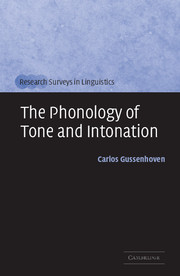
The Phonology of Tone and Intonation
Tone and Intonation are two types of pitch variation, which are used by speakers of all languages in order to give shape to utterances. More specifically, tone encodes segments and morphemes, and intonation gives utterances a further discoursal meaning that is independent of the meanings of the words themselves. In this comprehensive survey, Carlos Gussenhoven provides an overview of research into tone and intonation, discussing why speakers vary their pitch, what pitch variations mean, and how they are integrated into our grammars. He also explains why intonation in part appears to be universally understood, while at other times it is language-specific and can lead to misunderstandings. After eight chapters on general topics relating to pitch modulation, the book's central arguments are illustrated with comprehensive phonological descriptions - partly in Optimality Theory - of the tonal and intonational systems of six languages, including Japanese, Dutch, and English.
eBook

Second language teacher prosody
\"Second Language Teacher Prosody focuses on the prosodic characteristics of input in L2 Spanish classrooms. Readers are lead through descriptions and interpretations of prosodic behaviors based upon teachers' training and experience, their native or near-native speaker status, and their own comments about their teaching. The analysis culminates with several key discoveries and methodological implications with regard to didactic prosody, research design and methodology, and data interpretation. The conclusion offers future lines of research on SDS prosody including reception studies exploring the relative salience and effectiveness of prosodic cues. Educators can intentionally utilize these tools to achieve pedagogical goals. This book will be of interest to scholars in Applied Linguistics and Instructed Second Language Acquisition\"-- Provided by publisher.
Book
Prosodic and intonational patterns in Mirandese
This study examines the phonological and intonational patterns of Mirandese, a minority Astur-Leonese language spoken in northeastern Portugal. Despite increasing research interest, intonation in Mirandese remains understudied. Drawing on the Autosegmental-Metrical framework and using ToBI-based annotation, this research presents an instrumental phonetic analysis of intonation contours across sentence types in two Mirandese varieties (central and frontier). Data were collected through a Discourse Completion Task (DCT) and analysed acoustically with Praat. The results reveal both convergent and divergent prosodic strategies between the varieties, with specific nuclear contours employed to distinguish focus types, question modalities, and pragmatic meanings. Mirandese aligns with broader Romance intonational patterns but also exhibits unique configurations influenced by language contact and internal variation. These findings contribute to the typology of Romance intonation and underscore the importance of documenting endangered linguistic systems.
Journal Article

Tonal change and neutralization
\"This is the first book on tonal change and neutralization. It covers a wide range of tone and pitch-accent languages in Asia, Africa and Europe, with a main focus on Japanese and Chinese dialects many of which are now endangered. In addition to presenting unpublished data, the book provides novel typological analyses of tone and neutralization\"-- Provided by publisher.
Book

A Contrastive Analysis of English and Chinese Intonation Systems: An Auto-Segmental Metrical Framework
Intonation refers to the use of supra-segmental features to convey pragmatic meanings at the sentence level in a linguistically structured way. The difference in intonation between the native language and a foreign language may influence second language learners’ acquisition of intonation. The purpose of this study is to explore the similarities and differences at the level of phonological representation between English and Chinese intonation systems. This study investigated English and Chinese intonation systems, respectively, from both form and meaning under the Auto-Segmental Metrical framework by referring to previous studies and illustrating examples. The results showed that in terms of form, there were notable differences in the structural elements and their inventories between the intonation systems of English and Chinese. In terms of meaning, assertions were represented by different structural elements in English and Chinese intonation systems; the types of structural elements in English intonation possessed the capability to convey complex and subtle meanings, contrasting with the comparatively simpler nature of Chinese intonation.The results reveal that Chinese EFL learners demonstrate considerable difficulties in the production of the structural elements of English intonation and their combinations due to L1 intonation interference.
Journal Article

Spanish–English Cross-Linguistic Influence on Heritage Bilinguals’ Production of Uptalk
The present study examines the production of uptalk in Spanish and in English by Spanish heritage speakers in Southern California. Following the L2 Intonation Learning Theory, we propose that cross-linguistic influence in heritage bilinguals’ uptalk may occur along multiple dimensions of intonation. In this study, we examined the systemic dimension (i.e., presence of uptalk and presence of uptalk with IP-final deaccenting), the frequency dimension (i.e., frequency of uptalk and frequency of uptalk with IP-final deaccenting), and the realizational dimension (i.e., pitch excursion and rise duration) of heritage bilinguals’ uptalk. Our data showed that the three dimensions of intonation demonstrate varying degrees of cross-linguistic influence. The heritage bilinguals produced uptalk with IP-final deaccenting in both languages (i.e., systemic dimension), but produced it more in English than in Spanish (i.e., frequency dimension). That is, IP-final deaccenting emerges in heritage bilinguals’ uptalk in Spanish, but heritage bilinguals seem to recognize that this is an English feature that is not allowed in Spanish and try to suppress it as much as possible when producing uptalk in Spanish. However, in the realizational dimension, the heritage bilinguals demonstrated either phonetic assimilation to English (i.e., pitch excursion) or individual variability conditioned by language learning experience (i.e., rise duration). The asymmetry found across the dimensions suggests that, when bilinguals’ two languages are in competition for finite online resources, such as in the case of spontaneous speech production, phonological distinctions between L1 and L2 prosodic structures are kept, whereas phonetic differences that do not lead to any change in meaning are more prone to undergo cross-linguistic influence in order to reduce online processing cost. This study attempts to fill a gap in the literature on the cross-linguistic influence of intonation by bringing attention to heritage bilinguals. Heritage bilingualism introduces bilingual contexts that are often left unnoticed in traditional L2 acquisition scenarios (e.g., transfer from L2 to L1 intonation, asymmetry between order of acquisition and language dominance). Given that many aspects of cross-linguistic influence are shared across bilinguals, the investigation of heritage bilinguals’ intonation will contribute to building robust models of bilingual intonation.
Journal Article

Akan tone encoding across musical modalities
Musical surrogate languages like talking drums remain understudied in the linguistics literature, despite their close connection with the phonetics and phonology of the spoken language. African surrogate languages tend to be based on tone, making them a unique angle for studying a language’s tonal system. This paper looks at the encoding of Akan tone in three instrumental surrogate languages: the atumpan drums, the seperewa harp, and the abɛntia horn trumpet. Each instrument presents different organological constraints that could shape how the tone system is transposed to musical form. Drawing on novel data elicited with musicians in Ghana, we show that all three systems are built on a two-tone foundation mirroring the Akan tone system, but with subtle differences in the treatment of downstep and intonational effects like phrase-final lowering and lax question intonation.
Journal Article

Planning intonation under cognitive constraints of speaking
Pitch peaks tend to be higher at the beginning of longer utterances than in shorter ones (e.g., ‘The Santa is decorating the Christmas trees’ vs. ‘The Santa is decorating the Christmas tree and the window’). Given that a rise in pitch frequently occurs in response to increased mental effort, we explore the link between higher pitch at the beginning of an utterance and the cognitive demands of sentence planning for speech production. To modulate the cognitive resources available for generating a message in a visual world speech production task, the study implemented a dual-task paradigm. Participants described pictures depicting events with multiple actors. In one-half of these descriptions, the participants memorized three nouns, later recalling them and answering related questions. The results demonstrate both cognitive and linguistic influences on sentence intonation. Specifically, intonation peaks at the beginning of longer utterances were higher than in shorter ones, and they were lower under the condition of memory load than under no load. Measurements of eye gaze indicated a very short processing delay at the outset of processing the picture and the sentence, which was rapidly overcome by the start of speech. The short time frame of restricted cognitive resources thus was manifested in the lowering of the intonation peaks. These findings establish a novel link between language-related memory span and sentence intonation and warrant further study to investigate the cognitive mechanisms of the planning of intonation.
Journal Article
Intonation Patterns Used in Non-Neutral Statements by Czech Learners of Italian and Spanish: A Cross-Linguistic Comparison
The objective of the study is to contribute to our understanding of the acquisition of second language intonation by comparing L2 Italian and L2 Spanish as produced by L1 Czech learners. Framed within the L2 Intonation Learning theory, the study sheds light on which tonal events tend to be successfully learnt and why. The study examines different types of non-neutral statements (narrow focus, statements of the obvious, what-exclamatives), obtained by means of a Discourse Completion Task. The findings show that the two groups diverge significantly in producing the nuclear pitch accents L+H* (L2 Spanish) and (L+)H*+L (L2 Italian), which is indicative of a target-like realization in each language. However, the learners struggle with the acquisition of the target boundary tones HL% and L!H% in L2 Spanish and prenuclear pitch accents in both Romance varieties. It is speculated that this is due not only to difficulties in acquiring semantic or systemic dimensions, but also to perceptual salience and frequency effects. In addition, the study explores individual differences and reveals no significant effects of the time spent in an L2-speaking country, the age of learning and the amount of active use of a foreign language on accuracy in L2 production.
Journal Article