
Catalogue Search | MBRL


Are you sure you want to remove the book from the shelf?

{{itemTitle}}
45,173
result(s) for
"Inuit."
Sort by:


Inuit Shamanism and Christianity
Using archival material and oral testimony collected during workshops in Nunavut between 1996 and 2008, Frédéric Laugrand and Jarich Oosten provide a nuanced look at Inuit religion, offering a strong counter narrative to the idea that traditional Inuit culture declined post-contact. They show that setting up a dichotomy between a past identified with traditional culture and a present involving Christianity obscures the continuity and dynamics of Inuit society, which has long borrowed and adapted \"outside\" elements. They argue that both Shamanism and Christianity are continually changing in the Arctic and ideas of transformation and transition are necessary to understand both how the ideology of a hunting society shaped Inuit Christian cosmology and how Christianity changed Inuit shamanic traditions.
eBook

Annie Pootoogook : cutting ice = Ini Putugu : tukisitittisimavuq takusinnggittunik
\"When Annie Pootoogook won the Sobey Art Award in 2006, she cracked the glass ceiling for Inuit art, securing its place in contemporary Canadian art discourse and establishing herself as an artist of international importance. Her achievement sparked critical discussion around contemporary art as well as the absence, and growing presence, of Inuit art: an important conversation that continues to this day. The life and death of Annie Pootoogook is a story of national significance. The complex narratives weaving through her short life speak to possibility and heartbreak, truth and reconciliation, the richness of community, and the depths of tragedy. These complexities are recorded in her arresting pencil crayon compositions. Her frank, sometimes challenging, sometimes amusing images of everyday life, acutely observed and marked by a linear control as taut as a wire, declare her as a major contributor to the landscape of contemporary Inuit art. Annie Pootoogook: Cutting Ice accompanies an exhibition organized by the McMichael Canadian Art Collection, the gallery of record for works on paper from Annie Pootoogook's Inuit community of Kinngait (Cape Dorset). Under the direction of Nancy Campbell, this publication and the exhibition serve to commemorate the life and work of a remarkable artist a year after her tragically early death\" -- Provided by publisher's website.
Book
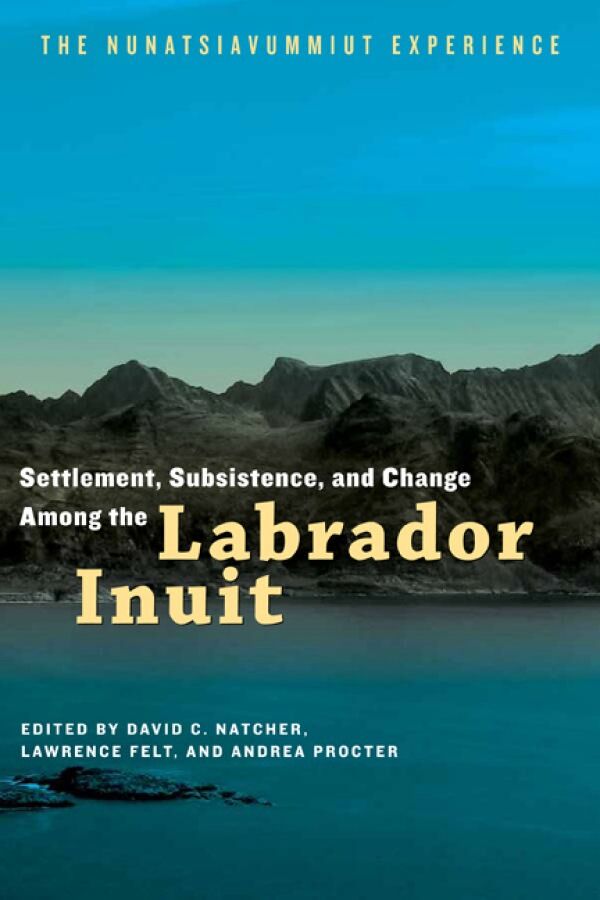
Settlement, Subsistence, and Change Among the Labrador Inuit
On January 22, 2005, Inuit from communities throughout northern and central Labrador gathered in a school gymnasium to witness the signing of the Labrador Inuit Land Claim Agreement and to celebrate the long-awaited creation of their own regional self-government of Nunatsiavut. This historic agreement defined the Labrador Inuit settlement area, beneficiary enrollment criteria, and Inuit governance and ownership rights. Settlement, Subsistence, and Change Among the Labrador Inuit explores how these boundaries—around land, around people, and around the right to self-govern—reflect the complex history of the region, of Labrador Inuit identity, and the role of migration and settlement patterns in regional politics. Comprised of twelve essays, the book examines the way of life and cultural survival of this unique indigenous population, including: household structure, social economy of wildfood production, forced relocations and land claims, subsistence and settlement patterns, and contemporary issues around climate change, urban planning, and self-government.
eBook

Arctic Migrants/Arctic Villagers
Damas shows that while there were cases of government-directed relocation to centres, centralization was largely voluntary as the Inuit accepted the advantages of village living.In examining archives, anthropological writings, and the results of field research from an anthropological perspective, Damas provides fresh insights into the policies and developments that led to the centralization of Inuit settlement during the 1950s and 1960s.
eBook

Life beside itself : imagining care in the Canadian Arctic
\" In Life Beside Itself, Lisa Stevenson takes us on a haunting ethnographic journey through two historical moments when life for the Canadian Inuit has hung in the balance: the tuberculosis epidemic (1940s to the early 1960s) and the subsequent suicide epidemic (1980s to the present). Along the way, Stevenson troubles our common sense understanding of what life is and what it means to care for the life of another. Through close attention to the images in which we think and dream and through which we understand the world, Stevenson describes a world in which life is beside itself: the name-soul of a teenager who dies in a crash lives again in his friend's newborn baby, a young girl shares a last smoke with a dead friend in a dream, and the possessed hands of a clock spin uncontrollably over its face. In these contexts, humanitarian policies make little sense because they attempt to save lives by merely keeping a body alive. For the Inuit, and perhaps for all of us, life is \"somewhere else,\" and the task is to articulate forms of care for others that are adequate to that truth\"-- Provided by publisher.
Book

Quaqtaq
Dorais examines how the Inuit community of Quaqtaq, a small village on Hudson Strait, has managed to preserve its identity in the modern world. He points to three things: kinship, religion, and language.
eBook

Annie Muktuk and other stories
\"Eskimo, now that's a word. White word. White word for white people to wrap around their pink tongues. Esquimaux. Spell it any way you want and it still comes out the same, skid row and all. - from \"Kabloona Red\" In Annie Muktuk and Other Stories, Norma Dunning portrays the unvarnished realities of northern life through gritty characters who find themselves in difficult situations. Dunning grew up in a silenced form of Aboriginality, experiencing racism, assimilation, and colonialism; as she began exploring her Inukness, her writing bubbled up to the surface. Her stories challenge southern perceptions of the north and Inuit life through evocative, nuanced voices accented with Inuktitut words and symbolism. As with Alootook Ipellie's work, these short stories bring Inuit life into the reality of the present.\"-- Provided by publisher.
BOOK

(2021) van Michaeleen Doucleff
SamenvattingDit artikel bespreekt Jagen, verzamelen, opvoeden van Michaeleen Doucleff. Op grond van haar ervaringen met de opvoeding van haar eigen dochter onderzoekt ze de wijze waarop de Maya’s in Mexico, de Inuit in Canada en de Hadzabe in Tanzania hun kinderen opvoeden. Op grond daarvan geeft ze pedagogische handreikingen. In het artikel worden die handreikingen vervolgens nader onderzocht en beoordeeld vanuit de pedagogiek, resp. de opvoedingsfilosofie.
Journal Article