
Catalogue Search | MBRL


Are you sure you want to remove the book from the shelf?

{{itemTitle}}
410
result(s) for
"Inventions Fiction."
Sort by:

Sky jumpers
\"Twelve-year-old Hope lives in a post World War III town called White Rock where everyone must participate in Inventions Day, though Hope's inventions always fail. Her unique skill set comes in hand when a group of bandits invades the town\"-- Provided by publisher.
Book

Love and the incredibly old man
“It was the best of times, it was the worst of times” begins one chapter of critically acclaimed Lee Siegel’s new novel, Love and the Incredibly Old Man. “In the beginning” starts another. What else can a novelist do when hired as a ghostwriter by an elderly, irascible, conquistador-costumed man claiming to be the 540-year-old Juan Ponce de León? The fantastic life of that legendary explorer—inventor of rum, cigars, Coca-Cola, and popcorn—is the frame for Siegel’s fourth chronicle of love, lies, luck, loss, and labia. Summoned with cold hard cash and a pinch of flattery, a professor and novelist named Lee Siegel finds himself in Eagle Springs, Florida, attempting to give form to the life of the man who, contrary to popular and historical opinion, did indeed find the Fountain of Youth. Spending humid days listening to the romantic ramblings of the old man and sleepless nights doubting yet trying to craft these reminiscences into a narrative that will satisfy the literary aspirations of his subject, Siegel the ghostwriter spins an improbable tale filled with Native Americans, insatiable monarchs, philandering cantors, deliriously passionate nuns, delicate actresses, androgynous artists, and deceptions small and large. For de León, and for Siegel too, centuries of conquest and colonialism, fortune and identity, are all refracted through the memories of the conquistador’s lovers, each and every one of them adored “more than any other woman ever.” Comic, melancholic, lusty, and fully engaged with the act of invention, whether in love or on the page, Love and the Incredibly Old Man continues the real Lee Siegel’s exuberant exploration of that sentiment which Ponce de León confesses has “transported me to the most joyous heights, plunged me to the most dismal depths, and dropped me willy-nilly and dumbfounded at all places in between.”
eBook

Hooey Higgins and the tremendous trousers
The inventive skills of Hooey Higgins and his friends are put to the test in an adventure that compels them to invent super-protective pants that they hope will safeguard them from crocodiles, flying toffee apples, and log-flume malfunctions.
Book
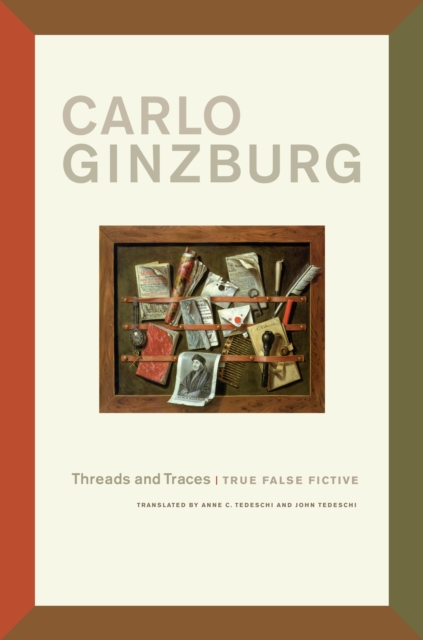
Threads and traces
Carlo Ginzburg's brilliant and timely new essay collection takes a bold stand against naive positivism and allegedly sophisticated neo-skepticism. It looks deeply into questions raised by decades of post-structuralism: What constitutes historical truth? How do we draw a boundary between truth and fiction? What is the relationship between history and memory? How do we grapple with the historical conventions that inform, in different ways, all written documents? In his answers, Ginzburg peels away layers of subsequent readings and interpretations that envelop every text to make a larger argument about history and fiction. Interwoven with compelling autobiographical references, Threads and Traces bears moving witness to Ginzburg's life as a European Jew, the abiding strength of his scholarship, and his deep engagement with the historian's craft.
eBook


Folklore of Lake Erie
Welcome to a very different Lake Erie-where ghost ships sail
silently, a Black Dog brings doom to sailors who see it, and sea
monsters swirl in the murky depths above a UFO base. In
Folklore of Lake Erie , Judith S. Neulander presents these
captivating tales and many more from the smallest, yet arguably the
most peculiar, of the Great Lakes in North America.
Whether you are embarking on a discovery of the vampire crypt
that lurks in the shadows while Lincoln's ghost train speeds past
on its eternal journey or reminiscing about the tall tales your
grandfather used to share, this delightful treasure trove of
folklore and local traditions from the Lake Erie region contains
legends and stories that are both astonishing and entertaining.
Endlessly captivating and easily accessible, Folklore of
Lake Erie is a distinctive compilation of eerie and enchanting
narratives from across the years that will surprise and delight
readers. Just be sure to keep an eye out for any peculiar Black
Dogs that may cross your path along the way.
eBook

Stealing air
Three sixth-grade boys band together to build an experimental aircraft, enduring social and practical difficulties in the process.
Book

The Patent Law Origins of Science Fiction
This Article reveals the surprising role of patent law in shaping the literary genre of science fiction. Drawing on previously unpublished sources, the Article shows that Hugo Gernsback— the so-called “father” of science fiction who started the first all-science-fiction magazine in 1926—believed that works of science fiction are analogous to patents. Like patents, science fiction stories can disclose useful information to the public about new inventions. Like patents, science fiction stories can influence future inventors and drive innovation. Gernsback went even further, positing that some of the inventions depicted in science fiction should themselves be patentable. In 1952, he urged Congress to reform the Patent Act to make so-called “Provisional Patents” available to science fiction authors who depicted major technological developments before their time. He argued that science fiction authors who filed for Provisional Patents should get an extra thirty years in which to show their invention worked. If they could do so, they would thereafter be able to obtain an ordinary patent, to last another twenty years. Many will find Gernsback’s proposal deeply problematic from the perspective of patent policy, and rightly so. Granting patent rights too early in an invention’s lifecycle creates new and unjustified opportunities to hold up innovation. A science fiction author who obtained a Provisional Patent for a theoretical invention could crawl out of the woodwork half a century later and sue the very people who figured out how to make the invention work. Gernsback’s ideas for patent reform were half-baked and, the Article shows, probably self-serving. Nonetheless, exploring the connection he cultivated between patents and science fiction yields many surprising insights for science fiction and for innovation policy. Science fiction has more in common with patents than it might seem. Although science fiction does not typically impart enough information to “enable” others to make and use the inventions it describes, science fiction can inspire readers and supply them with a motivation—in Gernsback’s words, a “stimulus”—to implement science fictional inventions in the real world. Science fiction, like patents, can play a role in promoting innovation.
Journal Article

The runaway robot
Harry's latest invention--a Superhero Robot programmed to do chores--malfunctions, and the robot goes out of control, creating chaos at school.
Book

The Possibilities of Medieval Fiction
\"The Possibilities of Medieval Fiction\" argues that marvels in medieval travel literature function as unlikely possibilities that appeal to readers precisely because of their indeterminacy. Disputing the common idea that medieval readers accepted marvels as true, it argues that marvels' uncertainty was an aesthetic principle designed to pique imagination. It focuses on Mandeville's Travels and shows how its author carefully positions marvels between inventions and facts.
Journal Article