
Catalogue Search | MBRL


Are you sure you want to remove the book from the shelf?

{{itemTitle}}
523,953
result(s) for
"Investment trusts"
Sort by:


Investment and Capital Improvements in Commercial Real Estate: The Case of REITs
Land, capital, and labor constitute essential components of economic production. This axiom holds particular significance in commercial real estate, where an incorporation of prime land, meticulously executed capital improvements in building structures, and adept professionals significantly influence performance and returns. This study illuminates the critical role of capital investment intensity in synergy with strategic location choices (land) and proficient management. Drawing upon a dataset encompassing U.S. equity Real Estate Investment Trusts (REITs) spanning 1995–2022, the analysis uncovers a compelling correlation between a higher capital allocation towards property improvements and augmented market valuations. This association maintains its potency when utilizing an instrumental variable approach to mitigate potential endogeneity caveats. It remains robust even when the sample is streamlined to focus on a REIT's core property type. Further, by estimating a firm-level production function that accounts for endogenous input choices, the study reveals that initial and continuing investments in building capital constitute nearly half of a REIT's output. This underscores the pivotal role of initial and recurrent capital investments in building structures in generating commercial property revenue and overall productivity. The findings emphasize the indispensability of capital improvements that foster optimal property utilization and intensity in driving performance and returns.
Journal Article


Building Wealth Through REITS (Third Edition)
Almost two decades have passed since the launch of Singapore's first REIT (Real Estate Investment Trust) in 2002. Despite that, REITs are not as popular as they deserve to be. Singapore REITs are one of the few businesses that offer a direct play on the domestic economy, and they have proven their resilience through market cycles. Building Wealth Through REITs takes a deep look at this asset class and explains why every investor should take a serious look at REITs. It discusses common perceptions about REITs and why many of them don't hold up to scrutiny. In-depth interviews with the CEOs of 8 major S-REITs (including Parkway Life and Frasers Logistics & Commercial Trust) will stimulate your thinking and further your knowledge of various REITs. This third edition of the book provides a timely analysis of REITs in the age of Covid, with advice on how investors can continue to thrive in trying times. With practical guidance on how to build a strong and high-performing REIT portfolio, you will be on your way to financial freedom much earlier than you thought possible.
eBook
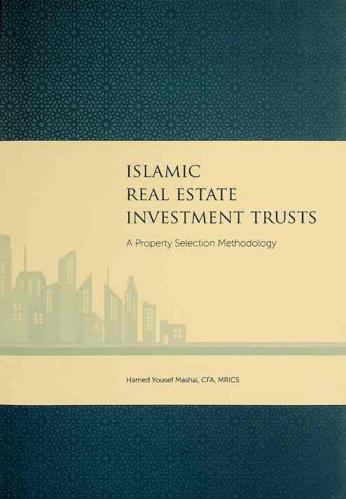
Islamic real estate investment trusts : a property selection methodology
\"This book represents the culmination of over 18 months of research and analysis conducted on the Islamic finance industry in general and Islamic Real Estate Investment Trusts specifically. The fact that Islamic REITs are increasing in popularity within the GCC region is very promising; however, it also magnifies the importance of setting up these structures and managing them in the correct way both financially and ethically in order to ensure that investor confidence in these products increases over time. As REIT structures provide investors with the ability to obtain real estate exposure at very low investment amounts, such structures effectively allow a much larger segment of our society to participate in what may be considered one of the largest asset classes in the GCC region. Initial research conducted indicates that investment products generally tend to fail due to a variety of reasons and one of these reasons is usually where the management activities of these investment products are not well- documented and thought through prior to the marketing of these products. As a result, this book expands on a subset of the investment methodology pertaining to real estate funds by devising a logical and efficient property selection methodology that may be used by Islamic REIT managers in managing such products.\" -- page [4] of cover.
Book

Tail risk diversification strategy with flight-from-loss approach: Evidence from U.S. REITs
This study introduces a novel portfolio allocation strategy, the flight-from-loss approach, designed to diversify tail risk in the REIT market. The strategy reallocates capital toward assets that have historically outperformed during periods of extreme REIT losses, aiming to reduce downside risk and improve portfolio efficiency. Using U.S. REIT data from 1993 to 2023, we demonstrate that our portfolio approach reduces tail risk significantly, while also enhancing Sharpe ratios compared to a REIT-only benchmark portfolio. These diversification benefits are particularly significant during market crises, such as the subprime mortgage crisis, when risk reduction exceeds 30%. Our analysis further reveals that the minimum-variance and tangency portfolio approaches consistently outperform the equal-weight method in both risk control and performance efficiency. To test the strategy’s generalizability, we applied it to the Fama-French 30 industry portfolios, where the results of some industries indicate even stronger risk reduction and Sharpe ratio gains than in the REIT market. These findings suggest that the flight-from-loss strategy offers a practical, cross-sector solution for managing concentrated portfolio risks.
Journal Article

Optimal Housing, Consumption, and Investment Decisions over the Life Cycle
We derive explicit solutions to life-cycle utility maximization problems involving stock and bond investment, perishable consumption, and the rental and ownership of residential real estate. Prices of houses, stocks and bonds, and labor income are correlated. Because of a positive correlation between house prices and labor income, young individuals want little exposure to house price risk and tend to rent their home. Later in life the desired housing investment increases and will eventually reach and exceed the desired consumption, suggesting that the individual should buy his home-and either additional housing units (for renting out) or house price-linked financial assets. In the final years, preferences shift back to home rental. The derived strategies are still useful if housing positions are only reset infrequently. Our results suggest that markets for real estate investment trusts or other house price-linked contracts lead to nonnegligible welfare gains.
This paper was accepted by Wei Xiong, finance.
Journal Article

Corporate Social Responsibility and Growth Opportunity: The Case of Real Estate Investment Trusts
Corporate social responsibility (CSR) involvement and disclosure has been becoming increasingly popular among US public firms, including those that qualify as real estate investment trusts (REITs). This paper aims to discover the relationship between CSR involvement and potential determinants such as growth opportunities, profitability, visibility, and agency costs. Types of CSR involvement are assessed in terms of environmental, community, and governance disclosures and are quantified using word count from the company's voluntary disclosure. Our results support the hypothesis that CSR has a strategic element and that REITs have greater CSR involvement when they have greater growth and investment opportunities. When the type of disclosure is broken into subcategories, the results show that not all dimensions of CSR are alike: environmental, community, and governance CSR disclosures appear to be motivated by different sets of incentives and reasons.
Journal Article
REIT Operational Efficiency: External Advisement and Management
This paper examines the operational efficiency of equity Real Estate Investment Trusts (REITs) with respect to external advisement and management. We employ data envelopment analysis (DEA), a non-parametric statistical procedure that tests whether decision-making units are operating on their efficient frontier, to measure the relative performance of REITs before, during, and after the 2008–2010 financial crisis. Annual observations of both advising and management status of each REIT allow us to parse efficiency by these groups in various combinations. Our evidence suggests the inefficiency of externally-advised REITs has diminished in recent years, and the structure is no longer strictly inferior. External management of property operations, however, remains less efficient than self-management. General and administrative expenses, external advisory fees and property management fees are the main sources of inefficiency over the study period. In a difference-in-difference specification we find industry-wide operational efficiency was higher in the post-crisis than the pre-crisis period, indicating efficiency gains following the crisis.
Journal Article

Quantile connectedness among real estate investment trusts during COVID-19: evidence from the extreme tails of distributions
Purpose
Given the evolving market integration, this study aims to explore the connectedness of 12 real estate investment trusts (REITs) during the COVID-19 period.
Design/methodology/approach
The connectedness of 12 REITs was examined by considering three sample periods: full period, COVID peak period and COVID recovery period by using the quantile vector autoregressive (VAR) approach.
Findings
The findings ascertain that REIT markets are sensitive to COVID, revealing significant connectedness during each sample period. The USA and The Netherlands are the major shock transmitters; thus, these countries are relatively better options for the predictive behavior of the rest of the REIT markets. In contrast, Hong Kong and Japan are the least favorable REIT markets with higher shock-receiving potential.
Research limitations/implications
The study recommends implications for real estate industry agents and investors to evaluate and anticipate the direction of return connectedness at each phase of the pandemic, such that they can incorporate those global REITs less vulnerable to unplanned crises. Apart from these implications, the study is limited to the global REIT markets and only focused on the period of COVID-19, excluding the concept of other financial and health crises.
Originality/value
This study uses a novel approach of the quantile-based VAR to determine the connectedness among REITs. Furthermore, the present work is a pioneer study because it is targeting different time periods of the pandemic. Additionally, the outcomes of the study are valuable for investors, policymakers and portfolio managers to formulate future development strategies and consolidate REITs during the period of crisis.
Journal Article