
Catalogue Search | MBRL


Are you sure you want to remove the book from the shelf?

{{itemTitle}}
8
result(s) for
"Investments, Foreign Law and legislation Southeast Asia."
Sort by:

The ASEAN comprehensive investment agreement : the regionalisation of laws and policy on foreign investment
The International Investment regime is one of the fastest growing areas of international economic law which increasingly rely on large membership investment treaties such as the ASEAN comprehensive Investment Agreement. This book comprehensively examines the role of this specific agreement and situates it in the wider trend towards the regionalisation of laws and policy on foreign investment.
Book
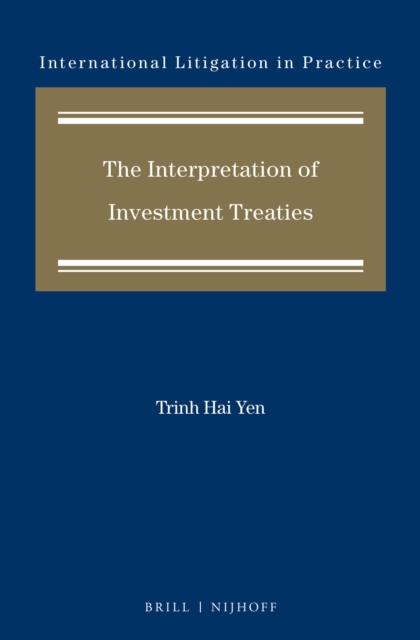
The Interpretation of Investment Treaties
In The Interpretation of Investment Treaties, Trinh Hai Yen analyzes arbitral neglect or misapplication of international rules on treaty interpretation in investor-state arbitrations and proposes both adjudicative and legislative solutions.
eBook

WILL ASEAN ECONOMIC INTEGRATION PROGRESS BEYOND A FREE TRADE AREA?
The raison d'être of ASEAN was a political one,1 to secure the region's peace, stability, and development. Against all odds, the founding members, namely, Indonesia, Malaysia, the Philippines, Singapore, and Thailand signed the ASEAN Declaration on 8 August 1967. Brunei was admitted in January 1984, Vietnam in 1995, which was followed closely by Laos and Myanmar in 1997. Thirty-two years later, on 30 April 1999, ASEAN formally encompassed all ten countries of South-East Asia by admitting Cambodia.2
Journal Article

Domestic regulation and service trade liberalization
This book addresses two central questions: What impact can international trade rules on services have on the exercise of domestic regulatory sovereignty? And how can services negotiations be harnessed to promote and consolidate domestic policy reform across highly diverse sectors?.
eBook

LAOS: Mired in Economic Stagnation?
The article examines developments in Laos in 2002, covering domestic and social issues, the economy, and foreign policy and the politics of foreign aid. It identifies Laos main problems as too much dependence on foreign aid, lack of openness and transparency, little or no investment outside the power sector, and reluctance to reform and liberalize the economy.
Journal Article
NEGARA BRUNEI DARUSSALAM: Socio-Economic Concerns Amid Stability and Plenty
The main concerns in 2002 continued to be economic growth and diversification, including the related challenge of graduate unemployment. Bruneians generally remained satisfied with their depoliticized welfare state, notwithstanding some social concerns like drug-taking. The year 2002 was an active year for foreign diplomatic and military relations.
Journal Article

From Communism to Capitalism in Laos: The Legal Dimension
Laos has been the least observed former communist country to gradually adopt free market capitalism. The discernible elements of Laos' creation of a legal foundation for its newly emerging society are discussed.
Journal Article